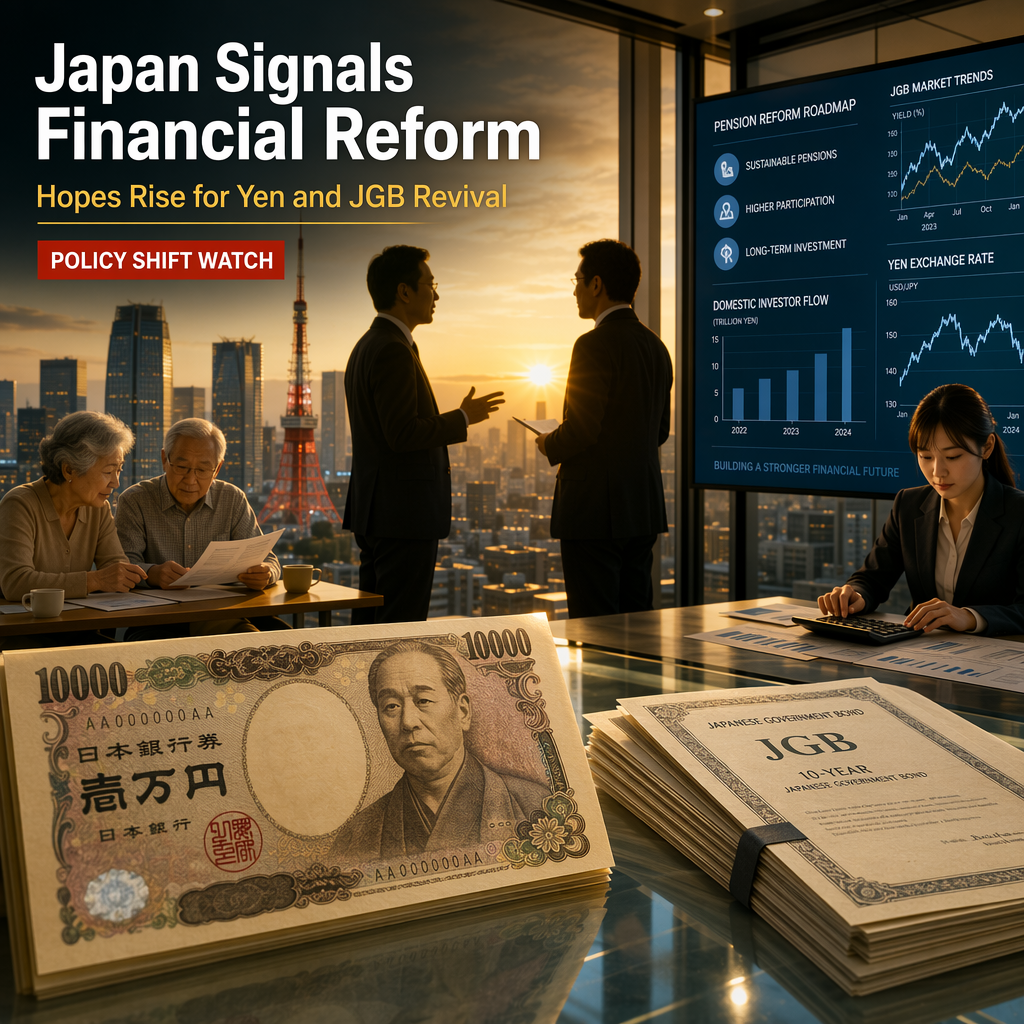
The Japanese Yen (JPY) remains under pressure, with the USD/JPY pair trading near a 40-year high around 162.00. Despite this, Japanese Government Bonds (JGBs) have shown unexpected resilience, outperforming their global counterparts even as global yields rise. This outperformance is attributed to verbal interventions from Japanese policymakers, including Finance Minister Satsuki Katayama and Health, Labour and Welfare Minister Kenichiro Ueno, who have signaled intentions to redirect Japan's substantial domestic savings and pension assets into local markets. These officials have discussed potential tax-advantaged treatments for individual investors and a strategic review of public pension holdings, aiming to make yen-denominated assets more attractive [1].
Analysts at MUFG note that these policy signals are fueling speculation that Japan's vast savings could be mobilized to support both JGBs and the yen. Brown Brothers Harriman (BBH) points to robust demand at a recent 20-year JGB auction, where yields dropped by 18 basis points to 3.56% and the average bid-to-cover ratio reached an impressive 4.52. This surge in demand aligns with proposals to include government bonds in Japan's tax-free retail investment program and to potentially rebalance the ¥294 trillion ($1.8 trillion) Government Pension Investment Fund (GPIF). The GPIF currently maintains a strict allocation of 25% each in domestic and foreign stocks and bonds [1].
Japan's net foreign asset position stands at approximately $3.6 trillion, or 83% of GDP as of Q1. Analysts suggest that even a modest shift in the GPIF's allocation could trigger significant capital repatriation, boosting demand for both the yen and JGBs. The banks referenced in the article project a medium-term upward bias for the Japanese Yen, should these domestic investment policy changes materialize. The government's campaign to encourage local households to invest domestically is expected to further reinforce this trend [1].
CONCLUSION
Japan's policymakers are signaling major reforms to unlock domestic savings and pension assets, which could drive substantial capital back into yen-denominated assets. Analysts anticipate that even minor portfolio shifts could have a meaningful impact on the yen and JGBs, potentially reversing the currency's long-standing weakness. Market participants are closely watching for concrete policy actions that could catalyze a structural shift in Japan's financial landscape.