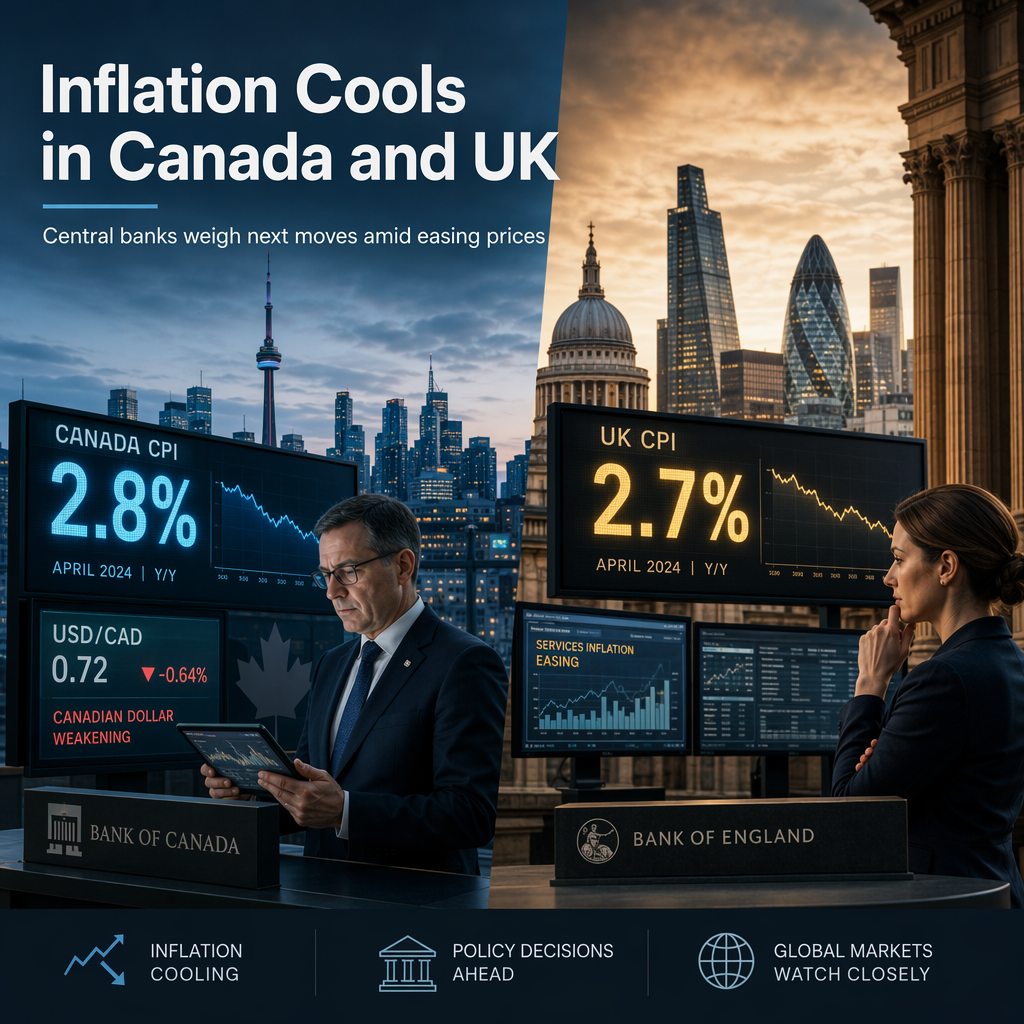
Canada's Consumer Price Index (CPI) rose by 2.8% year-on-year in June, marking a slowdown from the 3.2% increase recorded in May and coming in below market expectations [1]. On a monthly basis, Canadian prices declined by 0.4%, the largest monthly drop since December 2024, while the seasonally adjusted monthly CPI fell by 0.1%, the first decline since April 2025 [1]. The Bank of Canada's (BoC) preferred core measure, which excludes volatile components such as food and energy, rose 2.1% year-on-year and increased by 0.1% month-on-month [1]. Other key BoC inflation gauges also showed a downward trend: Common CPI at 2.6% (from 2.7%), Trimmed CPI at 1.8% (from 2.0%), and Median CPI at 1.9% (from 2.1%) [1]. The deceleration in headline CPI was primarily driven by slower increases in gasoline prices, while excluding gasoline, the CPI was unchanged at 2.2% year-on-year [1].
The market reaction to the Canadian inflation data was negative for the Canadian Dollar (CAD), which traded on the back foot, causing USD/CAD to revisit the 1.4050 zone and reversing part of the recent pullback [1].
In the United Kingdom, TD Securities expects headline CPI to slow to 2.7% year-on-year in June, matching consensus but coming in below the Bank of England's (BoE) projection of 3.1% [2]. Core CPI is forecast at 2.6% and services inflation at 3.6% [2]. The anticipated easing is attributed to lower fuel prices, though services inflation is expected to remain sticky due to pressures from airfares [2]. Energy inflation, including electricity and gas, is projected to rise to 5.9% year-on-year, with further pass-through expected in the coming months [2]. TD Securities notes that the index date for price collection could introduce downside risk to services and core inflation figures, potentially lowering them to 3.5% and 2.5% year-on-year, respectively [2].
TD Securities highlights that, barring significant wage responses to higher inflation, the BoE is likely to maintain its current restrictive Bank Rate for a prolonged period rather than opt for an imminent hike [2].
CONCLUSION
Canada's inflation data for June showed a sharper-than-expected cooling, prompting a negative reaction in the Canadian Dollar, while UK inflation is also expected to ease, supporting a prolonged hold in Bank of England policy. Both central banks are closely monitoring underlying inflation trends and wage dynamics as they consider their next policy moves.