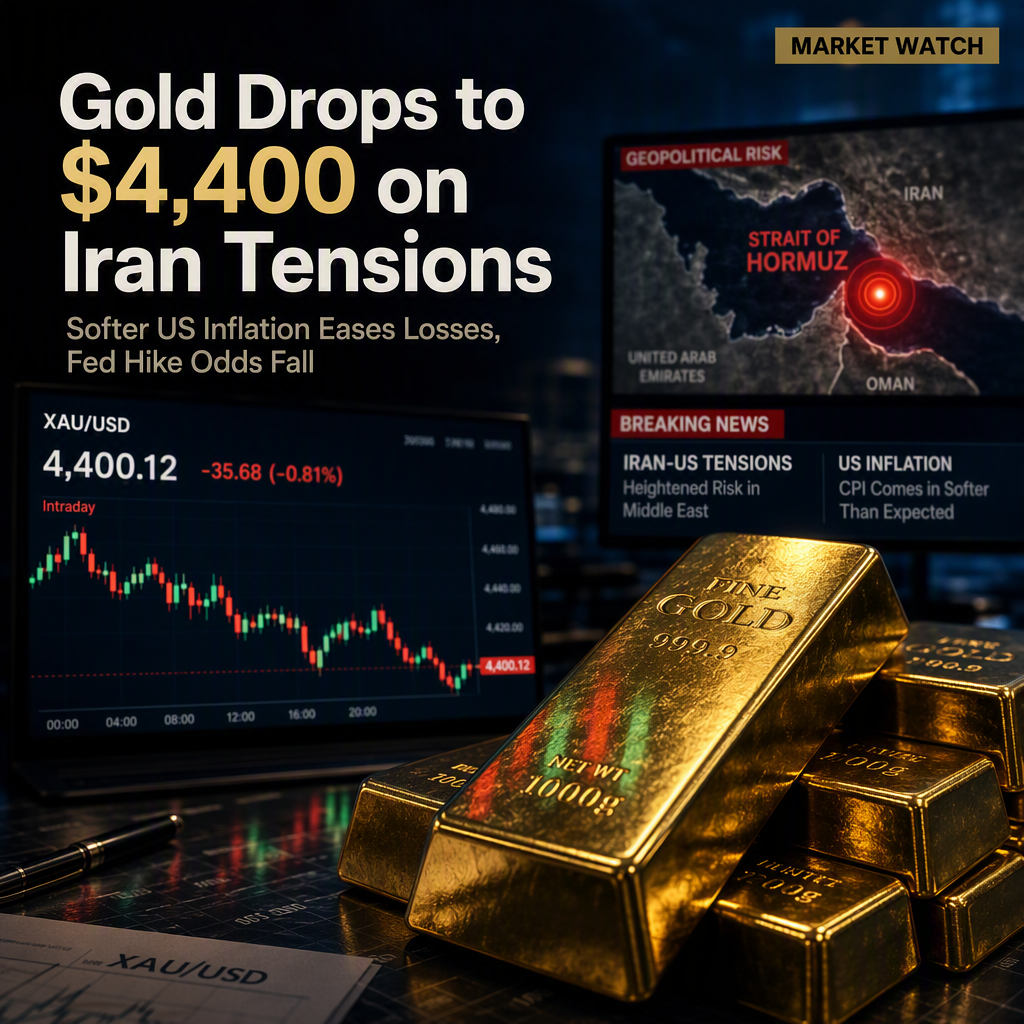
Gold prices (XAU/USD) declined to around $4,400 during the early Asian session on Thursday, pressured by escalating geopolitical tensions between the United States and Iran [1]. A senior Iranian official stated that Washington and Tehran remain at loggerheads over efforts to agree a permanent end to the war in the Gulf, with no progress in talks to revive the interim deal agreed in June or define a time frame for its implementation [1]. The continued closure of the Strait of Hormuz has raised oil-driven inflation fears, weighing on gold as investors monitor upside inflation risks [1]. Seema Shah, chief global strategist at Principal Asset Management, commented, 'With the Strait of Hormuz still shut, upside inflation risks will remain top of mind for the foreseeable future' [1].
Despite these pressures, the downside for gold may be limited due to a tame reading of US inflation, which eased expectations for a US Federal Reserve rate hike in September [1]. The US July Consumer Price Index (CPI) increased 3.4% year-over-year, versus 3.5% prior, while the core CPI rose 2.5% year-over-year compared to 2.6% in June, both in line with expectations [1]. Interest-rate swaps are now pricing in nearly a 40.1% odds of a Fed hike in September, with the odds for an October move falling to about 60% from 75% a day earlier, and the next increase fully priced for December, according to the CME FedWatch tool [1].
TD Securities noted that 'precious metals maintain upside' as the latest US CPI release 'did little to reignite the Fed hike pricing,' highlighting that recent price action shows the gold market is increasingly not expecting hikes, which provides a supportive backdrop for bullion [1]. Technical analysis indicates that XAU/USD holds a bullish near-term bias, extending above the 100-day simple moving average and remaining comfortably over the Bollinger Bands’ 20-day middle line, suggesting a well-supported uptrend structure [1]. The Relative Strength Index (14) at 67.51 flirts with overbought territory, hinting that the latest advance is strong but increasingly stretched [1]. Immediate resistance is defined by the Bollinger upper band at $4,410, where a sustained break would open the way to further gains [1].
CONCLUSION
Gold's decline to $4,400 is driven by heightened Iran-US tensions and concerns over oil-driven inflation, but softer US inflation data has limited losses and reduced expectations for imminent Fed rate hikes. Technical indicators suggest a bullish near-term bias, with resistance at $4,410 and continued upside potential if geopolitical risks persist. The market remains cautious, balancing geopolitical uncertainty against a supportive monetary backdrop.