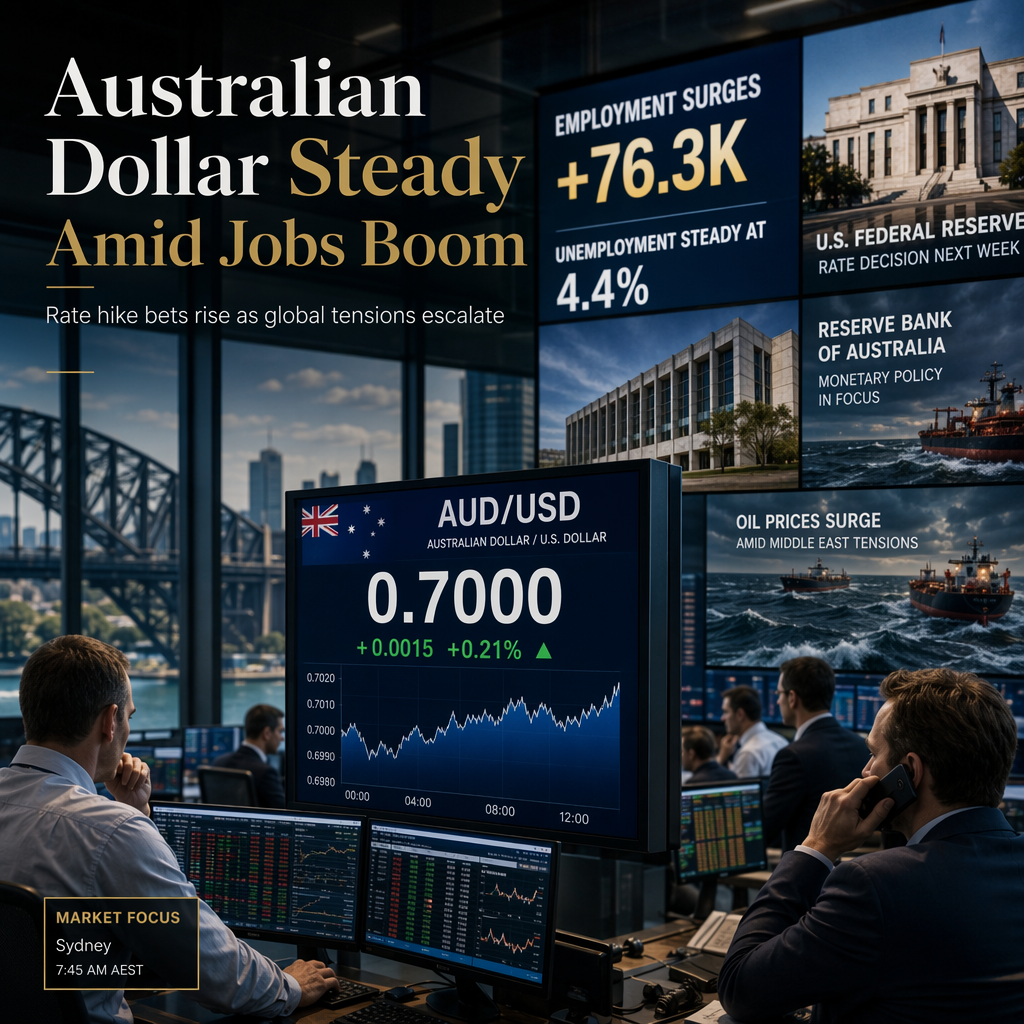
The Australian Dollar (AUD) remained steady against the US Dollar (USD), with the AUD/USD pair trading around 0.7000 during European hours on Thursday after posting minor gains the previous day [1]. This stability followed the release of improved Australian employment data, which showed that the country's unemployment rate held steady at 4.4% in June, matching market expectations [1]. Notably, employment surged by 76.3K, significantly surpassing the forecast of 15K and building on May’s revised gain of 44K [1].
The robust labor data has increased market expectations for another rate hike by the Reserve Bank of Australia (RBA), which has already raised rates three times this year to 4.35% [1]. However, traders are exercising caution ahead of Friday’s flash PMI readings, which could provide further insight into the economic outlook [1].
On the global front, the AUD/USD pair's resilience is also attributed to a weakening US Dollar, as the US economy shows signs of slowing and the Federal Reserve (Fed) is broadly expected to keep interest rates unchanged at its upcoming meeting [1]. Uncertainty around future Fed policy has been heightened by unclear guidance from new Fed Chair Kevin Warsh [1].
Additionally, escalating regional tensions have contributed to market uncertainty. US President Donald Trump threatened strikes on Iranian infrastructure following attacks on ships in the Strait of Hormuz, prompting retaliatory threats from Tehran against US-linked energy assets [1]. Iran-backed Houthi militants also targeted two Saudi oil tankers in the Red Sea, marking the first direct strikes on tankers in this critical waterway and raising concerns over global energy supply routes [1].
CONCLUSION
The Australian Dollar's stability reflects strong domestic employment data and rising expectations for further RBA rate hikes, despite global uncertainties and geopolitical tensions. Market participants remain cautious ahead of upcoming economic indicators, while the US Dollar faces its own headwinds from a weakening economy and unclear Fed policy direction.