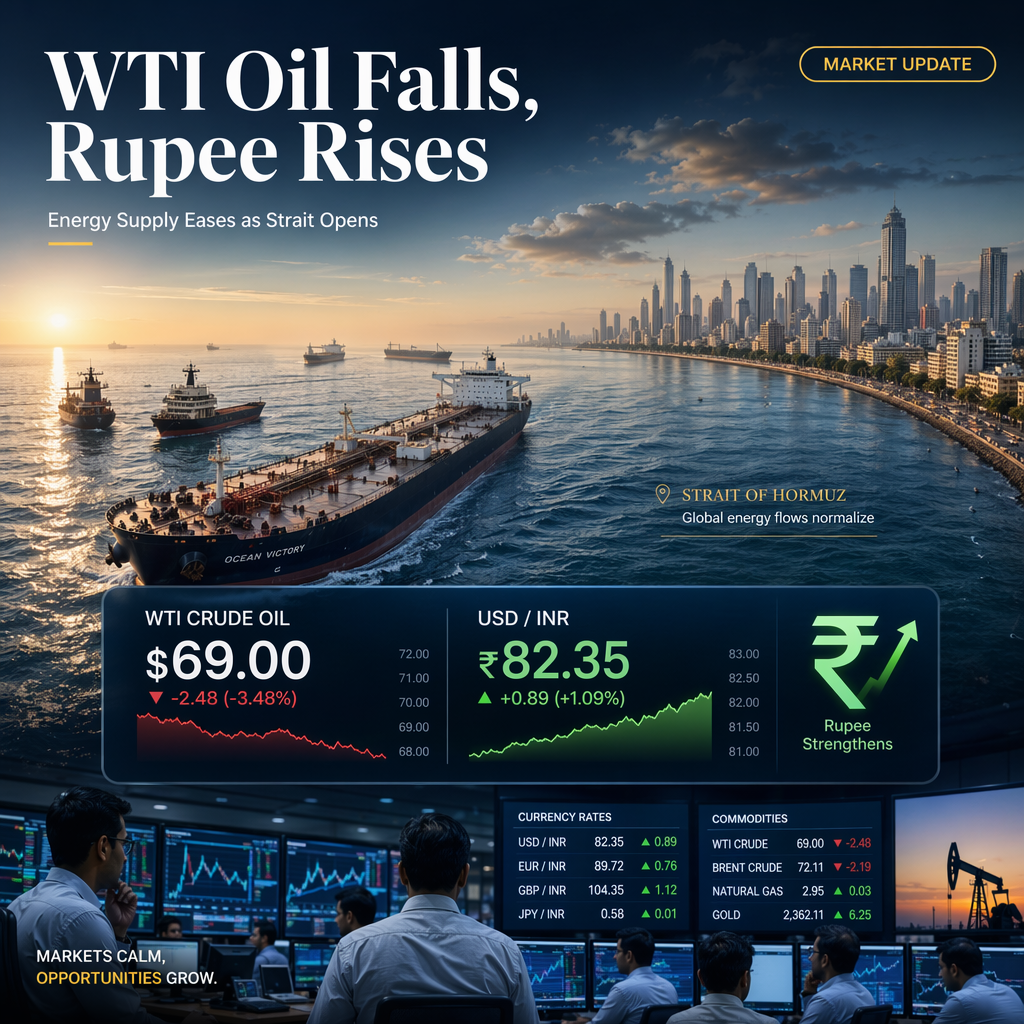
West Texas Intermediate (WTI) oil futures on NYMEX have declined by 0.7% to near $69.00 during the late Asian trading session on Thursday, returning to levels seen before the Middle East war. This drop is attributed to increased oil flows through the Strait of Hormuz, a critical chokepoint for nearly one-fifth of global energy supply, as more ships signal their intention to traverse the strait and the International Maritime Organization reports guarantees for hundreds of ships to exit the Persian Gulf. The International Energy Agency (IEA) notes that the United Arab Emirates (UAE) is exporting oil at nearly 85% of pre-war levels [1][2].
The decline in oil prices has had a notable impact on currency markets, particularly the Indian Rupee (INR), which opened strongly against the US Dollar (USD) on Thursday. The USD/INR pair fell to near 94.30, supported by the lower WTI oil price, which trades 0.75% lower at $69.25. The MCX Crude Oil contract expiring July 20 is also down 1.6% to near 6,563. Economies like India, which rely heavily on oil imports, tend to see their currencies appreciate when oil prices fall significantly [2].
Market sentiment is also influenced by expectations regarding US monetary policy. The CME FedWatch tool indicates that the odds of the Federal Reserve hiking interest rates this year are almost 82%, with a 42.2% chance of at least two hikes. The US Dollar Index (DXY) trades marginally lower at 101.52, close to its over-a-year high of 101.80 posted on Wednesday. Investors are awaiting the US Personal Consumption Expenditure Price Index (PCE) data for May, with core PCE inflation expected to arrive higher at 3.4% YoY from 3.3% in April, which could further boost hawkish Fed prospects [1][2].
Despite the positive impact of lower oil prices and the Reserve Bank of India's stance against imminent rate hikes, Foreign Institutional Investors (FIIs) continue to maintain distance from the Indian stock market. On Wednesday, FIIs offloaded their stake worth Rs. 1,843.40 crore. RBI Governor Sanjay Malhotra stated it is "premature" to consider interest rate hikes, noting the central bank does not see signs of energy crisis-led inflation generalizing. He added, "If we wanted to prepare the market for rate hikes, we would have changed stance from neutral to restrictive" [2].
Looking ahead, an earthquake in Venezuela has caused serious infrastructure damage, which could slightly impact global oil prices. Venezuelan oil has recently become a significant factor in global supply, as the United States is now controlling its energy resources and marketing them globally after abducting Venezuelan President Nicolás Maduro [1].
CONCLUSION
WTI oil's return to pre-war levels has eased energy supply concerns and strengthened oil-importing currencies like the Indian Rupee. However, despite improved oil flows and central bank assurances, overseas investors remain cautious about the Indian stock market. Market attention now turns to US inflation data and Federal Reserve policy, which could further influence global asset prices.