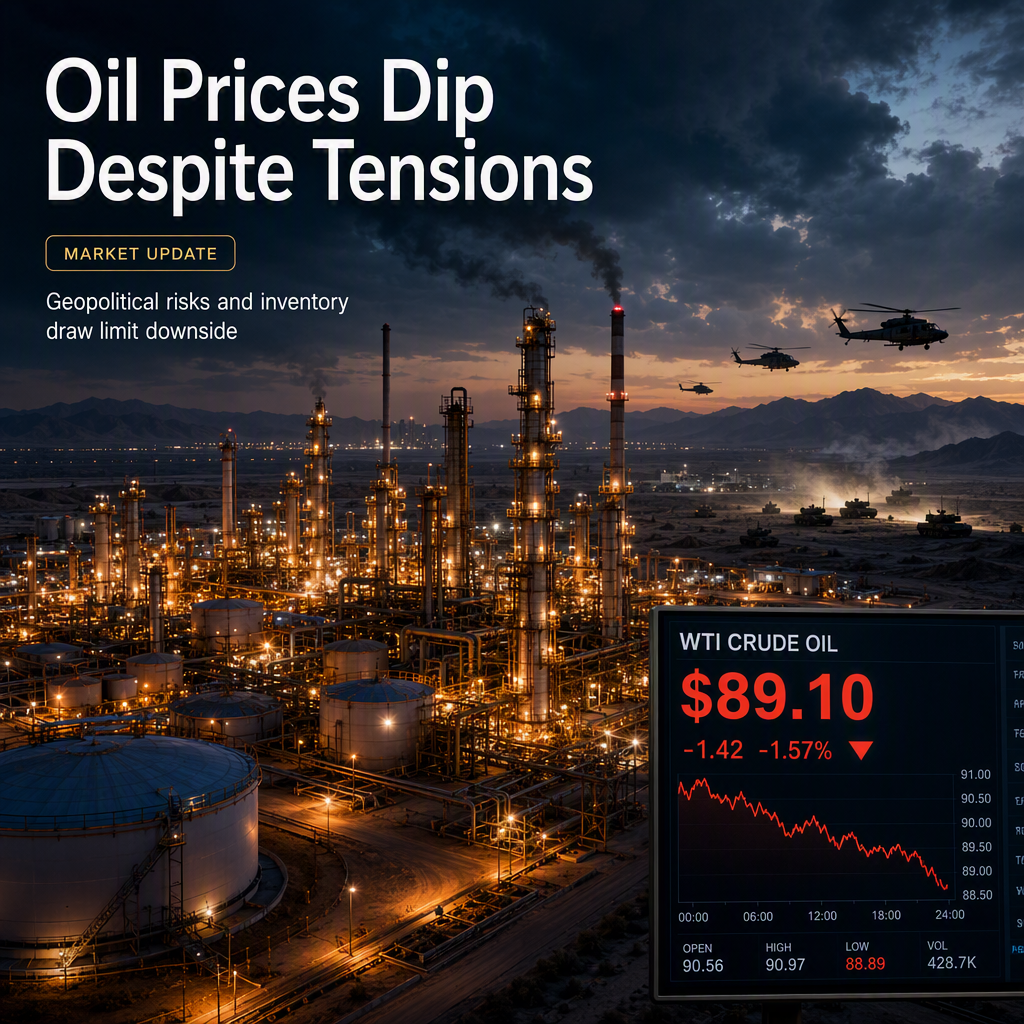
West Texas Intermediate (WTI), the US crude oil benchmark, declined to around $89.10 during early European trading hours on Wednesday, despite ongoing geopolitical tensions between the US and Iran in the Middle East [1]. The decline is attributed to traders taking profits, though the downside may be limited due to heightened concerns over potential oil supply disruptions stemming from the conflict [1].
Iran’s Islamic Revolutionary Guard Corps (IRGC) claimed responsibility for a 'heavy' ballistic missile attack on Prince Hassan airbase and a US Marine base in Jordan, citing retaliation for earlier US strikes that resulted in civilian casualties [1]. In response, the US military reported completing a wave of strikes against Iranian targets following what it described as attempted attacks by Iran on commercial shipping and American service members [1]. US President Donald Trump warned of further attacks if Tehran retaliated, intensifying fears of further escalation and possible supply disruptions [1].
On the supply side, US crude oil inventories dropped more than expected last week. The American Petroleum Institute (API) reported a drawdown of 2.6 million barrels for the week ending August 28, compared to a market consensus of an 800,000-barrel decline and a previous week's increase of 4.2 million barrels [1]. Traders are awaiting the US Energy Information Administration (EIA) report, due later on Wednesday, which could further influence WTI prices depending on whether it confirms a larger-than-expected draw or signals weaker demand [1].
TD Securities analysts highlighted that the latest US-Iran escalation underscores the fragile security situation in the Gulf, with headline-driven truces offering little lasting assurance for oil flows through critical chokepoints like the Strait of Hormuz [1]. Technical analysis indicates WTI maintains a constructive bullish bias in the near term, trading above the 100-day moving average and the Bollinger middle band, with resistance near $89.55 and support at $85.10 and $83.15 [1].
CONCLUSION
Despite profit-taking pressure, WTI remains supported by geopolitical risks and a larger-than-expected US crude inventory draw. Market participants are closely watching for further developments in US-Iran tensions and the upcoming EIA report, both of which could significantly impact oil prices in the near term.