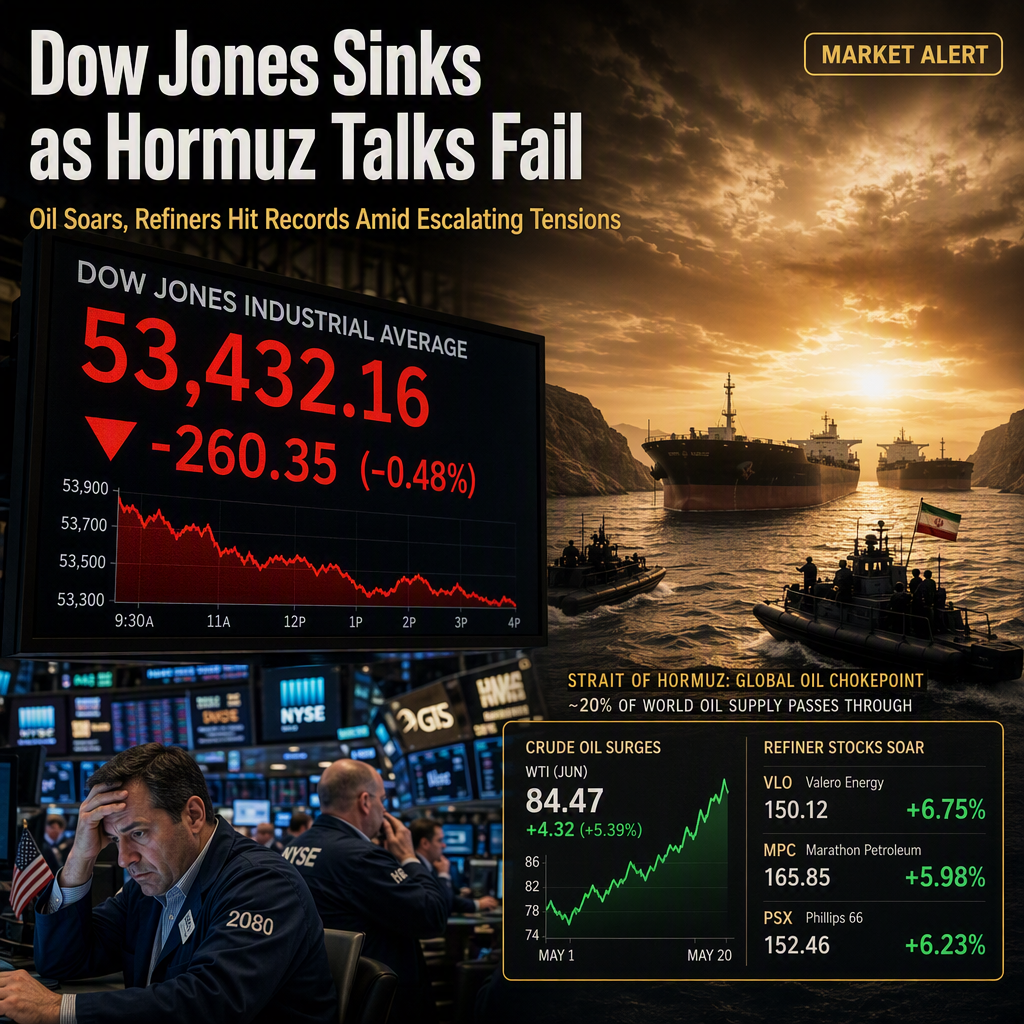
The Dow Jones Industrial Average declined by nearly 260 points, closing below 53,500, representing a drop of approximately half a percent, as the 60-day negotiating window intended to resolve the conflict over the Strait of Hormuz expired without any agreement to replace it [1]. This marks the second consecutive session where the day's highest level was at the open, with the index hitting its lowest point in the 53,400 area during the final hours, coinciding with the 30-year Treasury yield reaching a 19-year high [1].
Tensions escalated as a senior Iranian official indicated that Iran may shift from a defensive to an offensive stance if diplomacy fails, potentially intensifying conflict in the Strait and the broader region [1]. The Iranian Revolutionary Guard reiterated that no vessel would pass without Iranian permission and that the waterway would only reopen once Tehran's conditions are met. Vessel transit has plummeted, with only three ships crossing on Sunday compared to a five-day average of 12 and about 130 per day before the conflict began [1].
Crude oil prices responded sharply, with West Texas Intermediate (WTI) rising roughly 3% to above $83.00 per barrel and Brent crude surpassing $88.00 per barrel [1]. American refiners such as Valero (VLO), Marathon Petroleum (MPC), and Phillips 66 (PSX) are trading at or near record highs, with Valero at an all-time high, Marathon Petroleum at its best since its 2011 separation, and Phillips 66 at a record since listing. Valero and Marathon Petroleum have more than doubled in value this year, while Phillips 66 is up about 85%, driven by diesel margins near $100 a barrel as Ukrainian strikes disrupt Russian refining and Gulf capacity remains constrained [1].
Despite these gains, the Dow Jones Industrial Average does not include these refiners, with Chevron (CVX) being the only energy name among its thirty components. The 30-year Treasury yield climbed above 5.31%, its highest since June 2007, while the 10-year yield rose above 4.72% and the two-year yield also increased, reflecting inflation concerns rather than growth fears. The Empire State manufacturing survey printed at 20.6, well above the consensus of 11, but this data was largely overlooked during the session [1].
CONCLUSION
The expiration of the Strait of Hormuz negotiating window without resolution heightened geopolitical risks, leading to a drop in the Dow Jones and surging oil prices. Refiners outside the Dow benefited significantly, while Treasury yields spiked on inflation concerns. The market remains focused on energy supply disruptions and inflationary pressures.