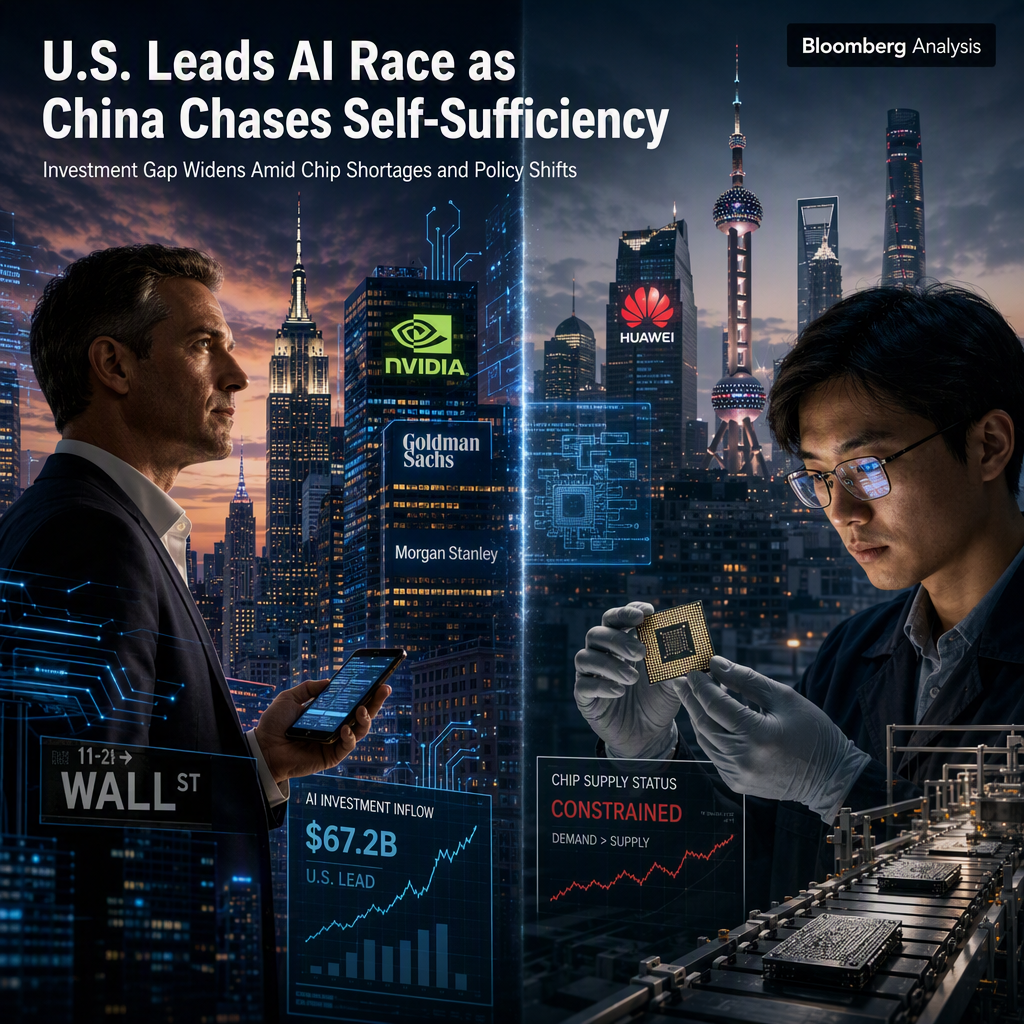
The core event centers on the ongoing competition between the U.S. and China in artificial intelligence (AI), with China increasingly prioritizing AI investment over other sectors such as real estate. Bruce Liu, CEO of Esoterica Capital, emphasized that if China had only one dollar left, it would be spent on AI rather than real estate, highlighting Beijing's resolve to achieve self-sufficiency in AI without relying on the U.S. or necessarily aiming to have the world's best AI technology [1].
Despite China's ambitions, the U.S. maintains a significant lead in private sector AI investment, with U.S. investment approximately 23 times greater than that of mainland China, according to Fitch's BMI and analyst Alexander Kheder. This financing gap is reinforced by Wall Street's backing of $500 billion in AI development for Nvidia, underscoring the U.S. advantage in capital and market support [1]. Unless Beijing facilitates easier access to external, non-state capital for Chinese AI firms, this financing asymmetry is expected to persist as a structural reason for U.S. leadership in the sector [1].
China has made progress in developing advanced chips for AI, but still lags behind Nvidia's capabilities. Huawei's most advanced Ascend 950 chips offer only about 13% of the computing power of Nvidia's GB300 chip, and Huawei is expected to produce just 1.35 million advanced AI chips this year, compared to even the most conservative estimate of 6 million Nvidia chips. Nvidia is also set to release an even more powerful Vera Rubin chip later this year, further widening the gap [1].
While Chinese companies have released AI models with similar capabilities at lower prices, global businesses are interested in these offerings. However, the lack of advanced chips remains a critical bottleneck. Clifford Kurz of S&P Global Ratings noted that even increased financial support from Beijing would be limited in impact without sufficient chip production, stating, "But if they don't have the chips, what's the point of support? There's nothing to finance" [1]. Despite these challenges, Huawei and other Chinese firms have rapidly narrowed the gap with global rivals in recent years, and China continues to court AI talent [1].
CONCLUSION
The U.S. retains a dominant position in AI investment and chip technology, with Nvidia leading the market and Wall Street providing substantial financial backing. China's strategic focus on AI and rapid progress in talent and chip development signal determination, but significant structural and technological gaps remain. Market sentiment is cautiously optimistic about China's potential, but the current impact favors U.S. leadership.