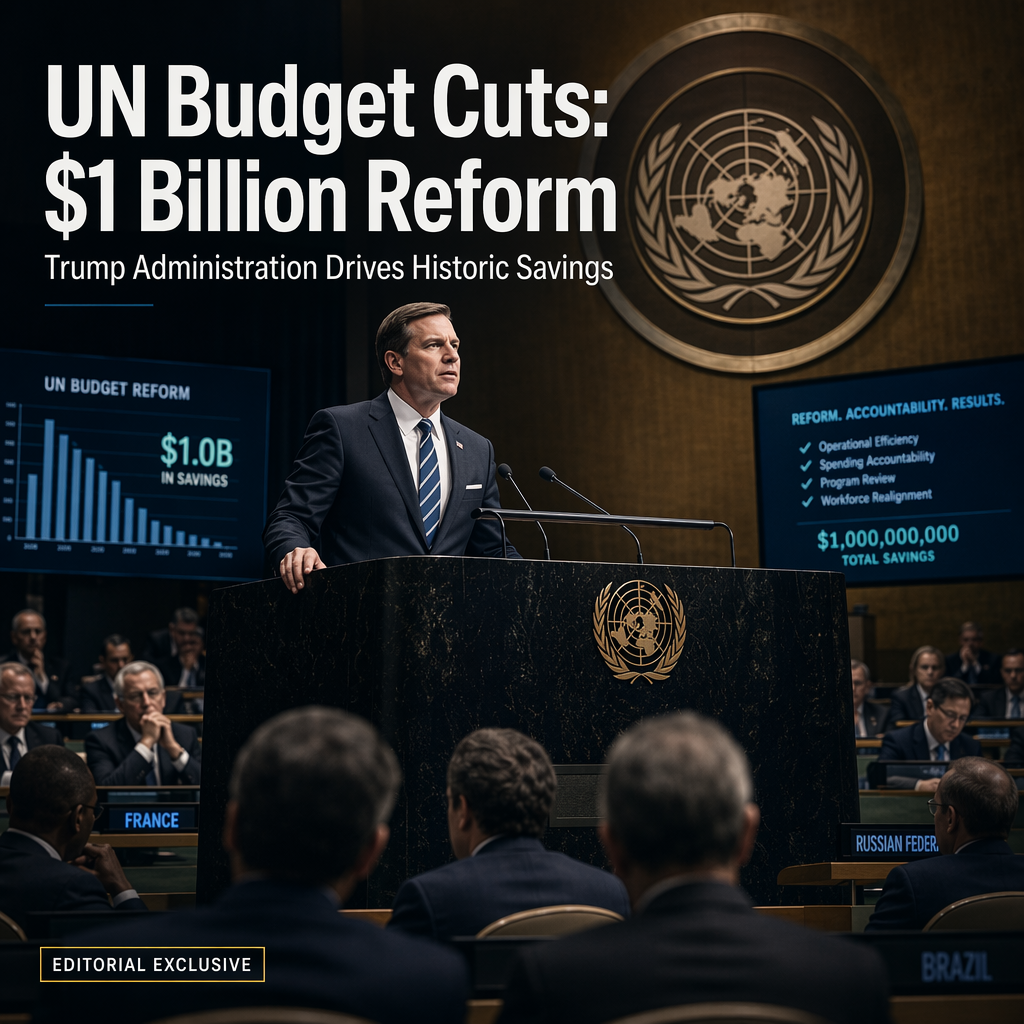
The Trump administration has announced that it has achieved more than $1 billion in cuts to United Nations budgets within a six-month period, marking what U.S. officials describe as an unprecedented level of savings and reform for the organization [1]. The most recent milestone occurred on June 30, when all 193 U.N. member states approved a peacekeeping budget of approximately $5.1 billion for the upcoming fiscal year, representing a reduction of about $550 million, or 9.7%, compared to the previous year [1]. This follows a 15% reduction to the U.N.'s regular budget approved in December, with U.S. officials stating that the combined agreements amount to over $1 billion in cuts to assessed U.N. budgets [1].
Assessed budgets are funded through mandatory contributions from member states, calculated primarily based on the size of their economies [1]. U.S. Ambassador for U.N. Management and Reform Jeff Bartos emphasized the significance of these reforms, stating, "We've achieved over a billion dollars of savings in six months, which is unprecedented. Any one cut would be unprecedented. The totality of the reforms is monumental" [1]. U.N. spokesman Stéphane Dujarric confirmed the reductions, describing both the peacekeeping and regular budget cuts as "unprecedented" [1].
The Trump administration has made reform a central pillar of its U.N. strategy, arguing that the organization has become overly bureaucratic and inefficient [1]. Bartos highlighted that the new budget and enhanced efficiency measures are changing the culture of U.N. peacekeeping, with a focus on ensuring that "every dollar has to achieve impact on the ground" [1]. The U.N. Mission in South Sudan was cited as an example where the United States worked to streamline the mission's mandate before reducing its budget [1].
Additionally, a significant reform was introduced regarding the handling of unused budget credits. Previously, U.N. financial rules required the return of unspent funds to member states even if those contributions had not been paid, exacerbating the organization's liquidity crisis. The General Assembly voted on June 30 to implement, on a four-year trial basis, a new methodology where unspent funds will only be returned when backed by cash actually received, a change expected to improve the U.N.'s financial stability [1].
These reforms come as the United Nations faces mounting financial pressure and prepares for a leadership transition in 2027, with Secretary-General António Guterres set to leave office at the end of his second term [1].
CONCLUSION
The Trump administration's push for U.N. budget reform has resulted in over $1 billion in unprecedented cuts, signaling a shift toward greater efficiency and financial discipline within the organization. While the reforms are expected to improve the U.N.'s operational impact and liquidity, the long-term effects will be observed as the organization undergoes leadership changes and adapts to new financial methodologies. Market sentiment is cautiously positive, reflecting the potential for improved fiscal management at the U.N.