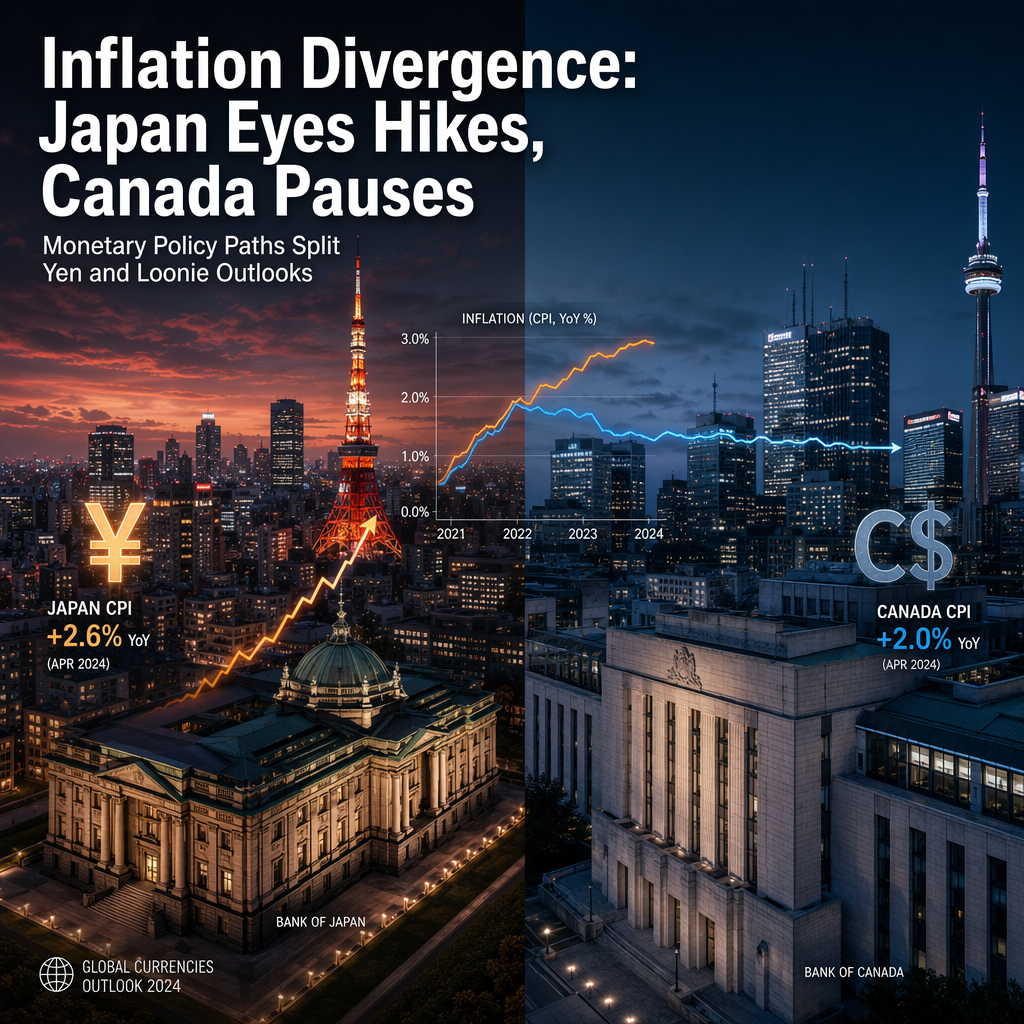
Recent analysis by Brown Brothers Harriman’s (BBH) Elias Haddad highlights contrasting inflation trends and central bank expectations for Japan and Canada. In Japan, June Consumer Price Index (CPI) is anticipated to rise, with headline CPI expected at 1.7% year-on-year versus 1.5% in May, core CPI excluding fresh food at 1.6% versus 1.4% in May, and core CPI excluding fresh food and energy projected to remain steady at 1.8% for the second consecutive month [1]. The swaps market is currently pricing in a 25 basis point Bank of Japan (BoJ) rate hike by year-end and a total of 50 basis points over the next twelve months, which would bring rates to 1.50%, still near the lower end of the BoJ’s estimated neutral range of 1.10%-2.50% [1]. BBH notes that Japan’s loose monetary policy, amid economic growth above potential, increases the likelihood of upward adjustments to BoJ rate expectations, which could support the Japanese Yen [1].
In contrast, Canada’s June headline CPI is expected to slow to 2.9% year-on-year from 3.2% in May, primarily due to lower gasoline prices. Core CPI (excluding food and energy) is forecast at 1.7% versus 1.6% in May, while the average of trim and median core measures is projected to remain at 2.05% for the third consecutive month [2]. With core inflation anchored near the Bank of Canada’s (BoC) 2% target, the swaps market assigns less than a 50% probability of a 25 basis point rate hike by year-end and anticipates only 50 basis points of tightening over the next twelve months, bringing policy rates to 2.75%, the midpoint of the BoC’s estimated neutral range of 2.25%-3.25% [2]. BBH suggests that this extended pause in rate hikes is a headwind for the Canadian Dollar [2].
The market implications are clear: while rising inflation and the potential for tighter monetary policy in Japan may bolster the Yen, Canada’s subdued inflation outlook and the likelihood of a prolonged pause in rate hikes could weigh on the Canadian Dollar [1][2]. Both central banks remain cautious, with market pricing reflecting moderate expectations for policy adjustments over the coming year [1][2].
CONCLUSION
Japan’s rising inflation and potential for higher BoJ rates may support the Yen, while Canada’s anchored inflation and extended BoC pause present a headwind for the Canadian Dollar. Market pricing reflects moderate expectations for policy changes in both countries, with Japan skewed to the upside and Canada likely to remain on hold.