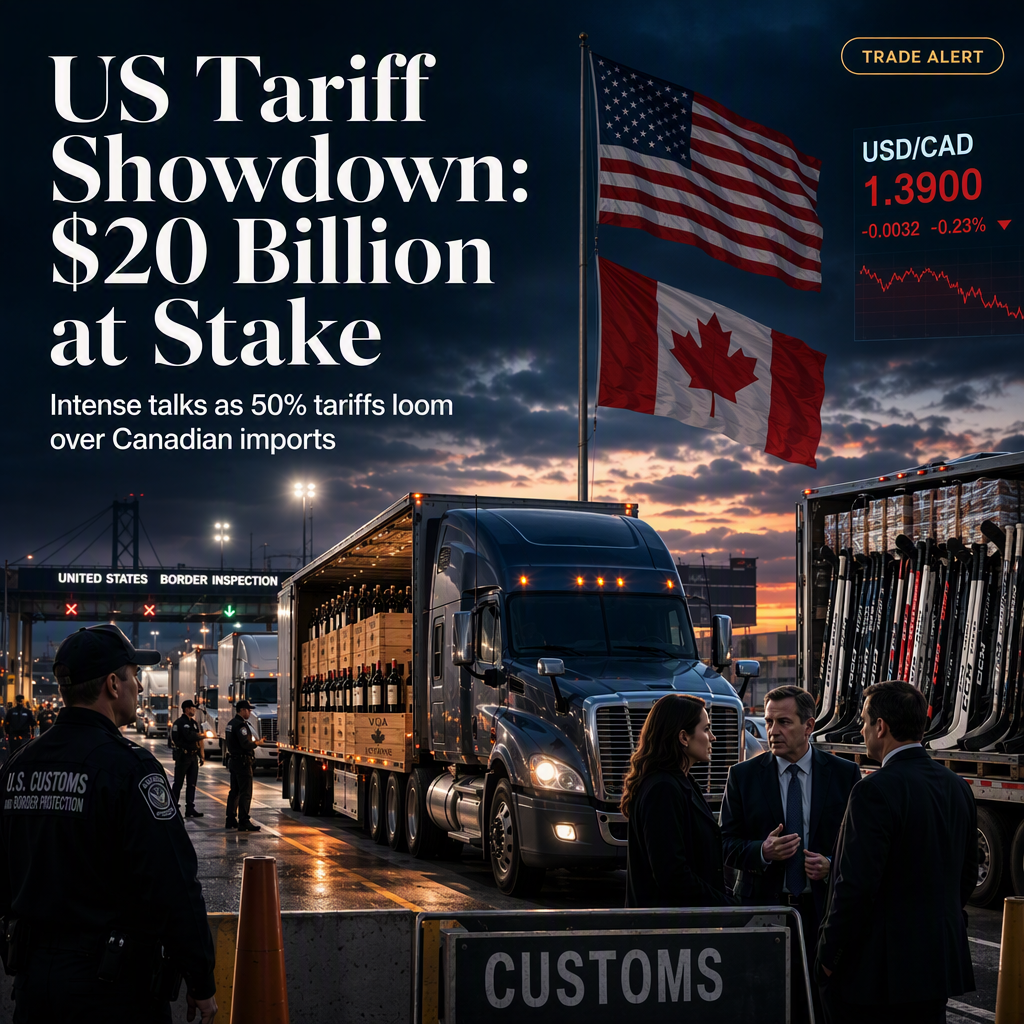
US President Donald Trump and Canadian Prime Minister Mark Carney are engaged in intense, last-minute negotiations to avert the imposition of new 50% tariffs on a range of Canadian goods, including hockey sticks and wine, according to CNBC as reported on Tuesday [1]. The tariffs, which are scheduled to take effect on Wednesday unless a deal is reached, would impact approximately $20 billion worth of Canadian imports, as stated by the Office of the US Trade Representative [1].
Prime Minister Carney described the negotiations as 'very intense and delicate,' emphasizing that this is not the time to discuss details publicly [1]. The tariffs represent the latest in a series of trade measures enacted by President Trump against Canada, reflecting his broader strategy to support the US economy and domestic producers through protectionist policies [1].
Market reaction has been immediate, with the USD/CAD currency pair rising 0.20% on the day to 1.3900, indicating investor concern over potential disruptions to US-Canada trade flows [1]. The article also notes that tariffs are designed to give local producers a price advantage over imports, but economists remain divided on their long-term impact, with some warning of higher prices and the risk of a damaging trade war [1].
Trump's tariff plan is part of his 2024 presidential campaign platform, which aims to use tariffs on major trading partners—Mexico, China, and Canada—to generate revenue that could be used to lower personal income taxes [1]. In 2024, these three countries accounted for 42% of total US imports, with Mexico being the largest exporter to the US at $466.6 billion [1].
CONCLUSION
The impending 50% tariffs on Canadian imports mark a significant escalation in US-Canada trade tensions, with substantial market and economic implications if implemented. The outcome of the ongoing negotiations will be closely watched by markets, as a failure to reach a deal could lead to higher prices and increased volatility in US-Canada trade relations.