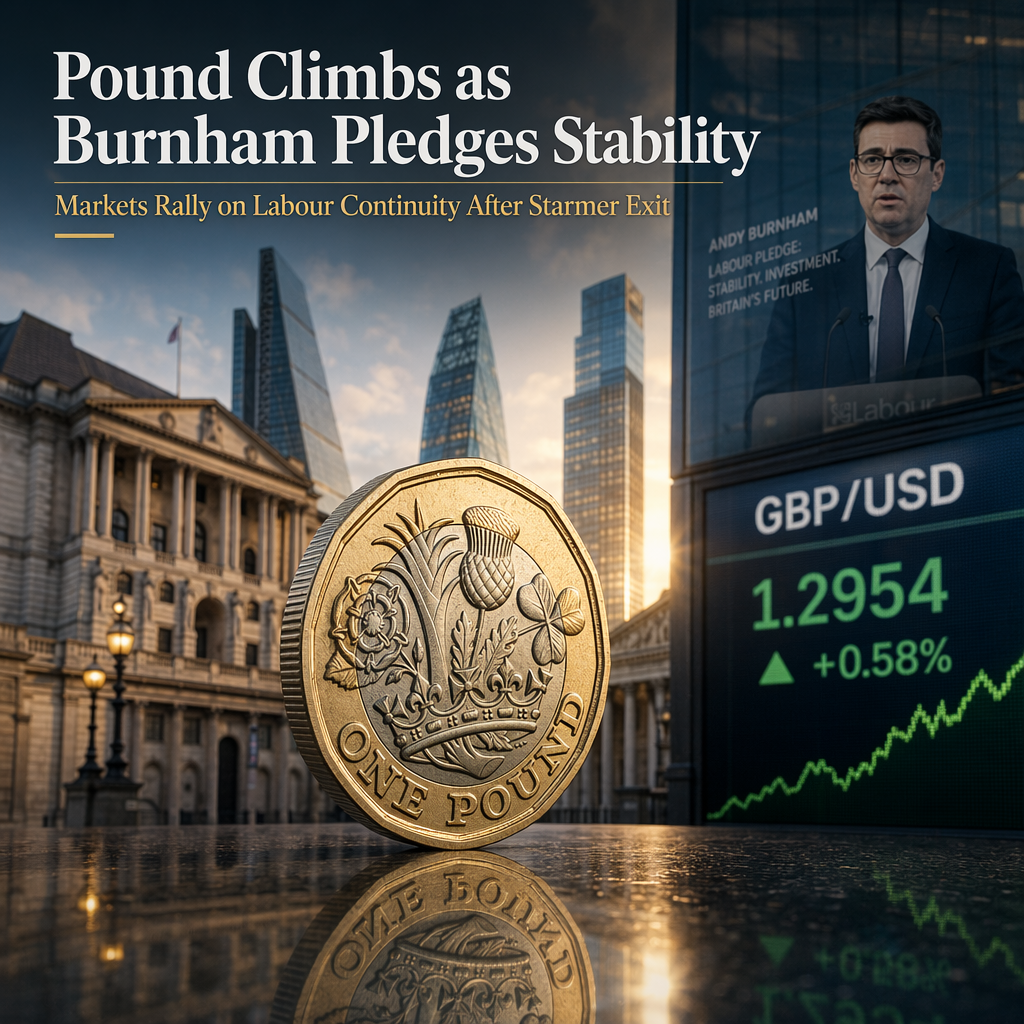
The British Pound (GBP) strengthened against its major currency peers, trading 0.25% higher near 1.3230 against the US Dollar (USD) during the European trading session on Monday [1]. This appreciation followed comments from Greater Manchester Mayor Andy Burnham, who is considered the frontrunner for the Labour Party leadership after Prime Minister Keir Starmer's resignation. Burnham pledged to continue the principles of the Labour Party’s 2024 manifesto, signaling a continuation of current fiscal policy [1].
According to a currency heat map, the British Pound was the strongest against the Canadian Dollar, gaining 0.34%, and also posted gains against the Japanese Yen (0.32%), Euro (0.07%), and Swiss Franc (0.07%) [1]. The GBP's outperformance is attributed to market expectations that there will be no significant changes in UK fiscal policy, which means no additional boost to government interest obligations on new debt—a scenario typically seen when there is a political shift between parties [1].
In the bond market, 10-year UK Gilt yields gave back earlier gains and were marginally lower, trading near 4.73% during European hours [1]. On the monetary policy front, investors are seeking further guidance on how long the Bank of England (BoE) will maintain interest rates at 3.75%. The BoE recently left rates unchanged with a 7-2 majority, with MPC member Megan Greene voting for a rate hike as a precaution against potential second-round inflation effects [1].
Meanwhile, the US Dollar traded slightly lower as investors awaited the upcoming US Nonfarm Payrolls data for June, scheduled for release on Thursday, which could provide further cues for Federal Reserve policy [1].
CONCLUSION
The British Pound's gains reflect market confidence in policy continuity following Burnham's pledge to uphold the Labour manifesto after Starmer's resignation. With UK Gilt yields steady and the BoE maintaining rates, investors are focused on upcoming economic data for further direction. The market impact is moderate, driven by political stability and steady monetary policy signals.