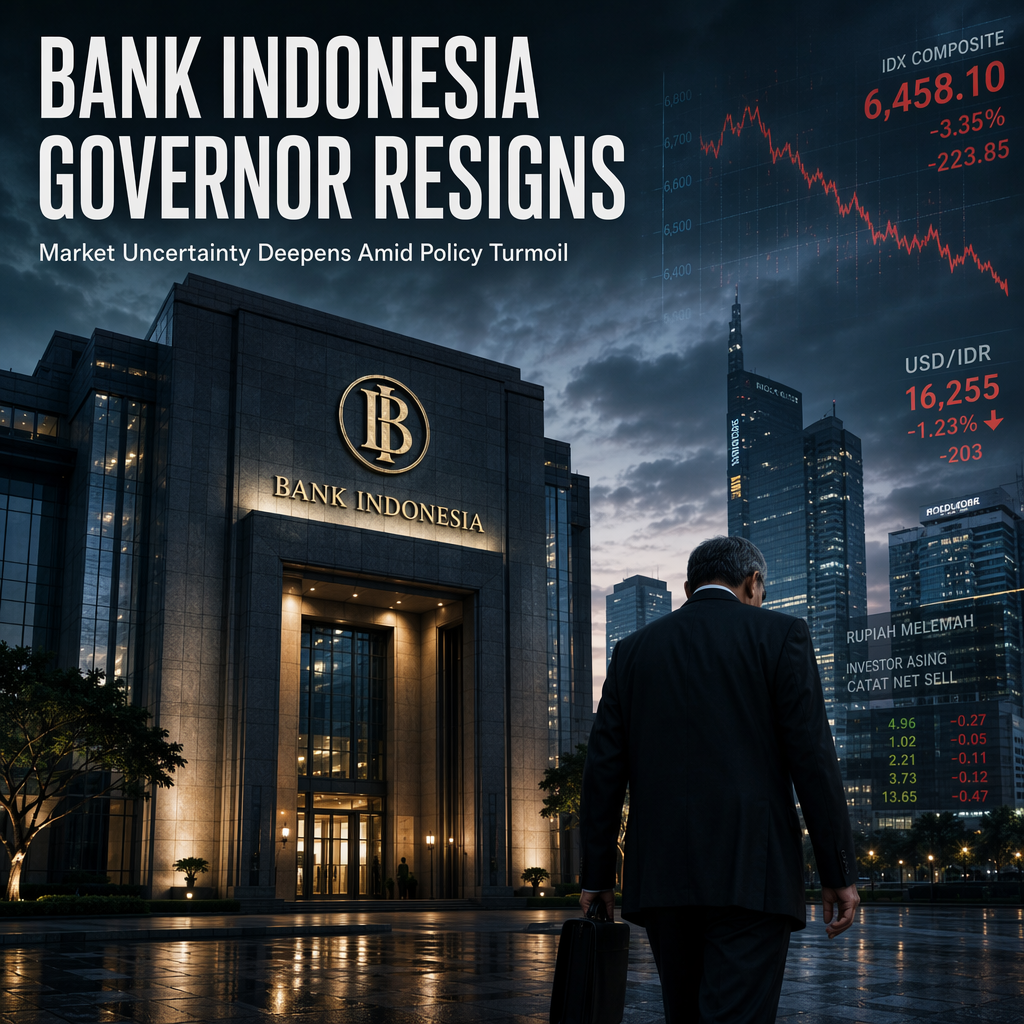
Bank Indonesia Governor Perry Warjiyo resigned on Monday, citing personal reasons that were not publicly disclosed, with President Prabowo approving the resignation following a period of prolonged market turmoil [1]. The announcement was made by the Indonesian government on July 27, 2026, as Warjiyo stepped down amid mounting pressure on the country's financial markets [1].
Warjiyo's resignation follows a period of significant volatility, during which Bank Indonesia raised its policy rate by a total of 1% within a month, including a recent 0.5 point hike that exceeded market expectations [1]. These aggressive rate increases were implemented in response to persistent inflation and currency pressures, with the rupiah underperforming in regional markets [1].
Market participants have expressed concern about Indonesia's economic outlook. MSCI has extended its review of Indonesia to November and flagged a possible downgrade due to ongoing instability [1]. Additionally, Indonesia recently recorded its first trade deficit in six years as imports surged, further raising questions about the country's external balance [1].
Indonesia's stock market has faced credibility challenges, with subdued trading volumes despite government interventions [1]. Analysts note that Warjiyo's resignation adds to uncertainty, as investors await clarity on future monetary policy direction and central bank leadership [1]. A Jakarta-based analyst stated, "The resignation introduces a new layer of unpredictability for financial markets. Investors will be closely watching the government's next steps and any signals regarding policy continuity" [1].
The government has not yet named a successor to Warjiyo. Market sentiment remains cautious, with traders monitoring key technical levels for the rupiah and local equities. Technical analysis indicates resistance for the USD/IDR pair at 16,000 and support at 15,700, reflecting heightened sensitivity to central bank leadership changes and policy signals [1].
CONCLUSION
The resignation of Bank Indonesia Governor Perry Warjiyo has intensified uncertainty in Indonesian financial markets, already under pressure from inflation, currency weakness, and a recent trade deficit. Market participants are adopting a cautious stance as they await clarity on future monetary policy and central bank leadership.