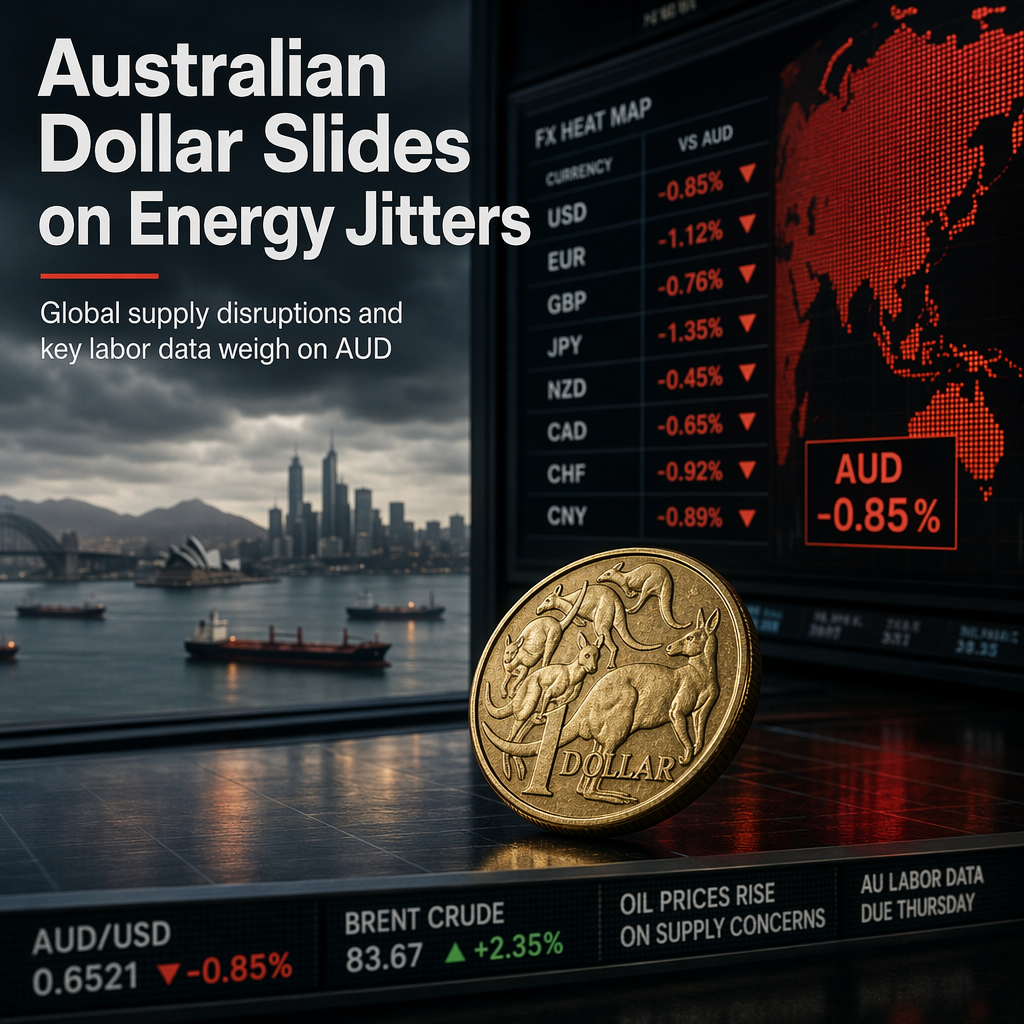
The Australian Dollar (AUD) weakened against its major currency peers, trading marginally down at around 0.7000 against the US Dollar (USD) during the European trading session on Wednesday [1]. The AUD faced selling pressure as oil prices rallied further, driven by intensifying global energy supply risks [1]. The disruption in global energy supply was attributed to Yemen's Iran-aligned Houthis announcing a 'maritime embargo' on Saudi Arabia in retaliation for a Saudi blockade of ports and airports in Houthi-controlled north-western Yemen, resulting in the closure of the Bab el-Mandeb strait [1]. According to a Reuters report cited in the article, approximately 7% of global energy is transited through the Bab el-Mandeb strait, the southern gateway of the Red Sea [1].
The AUD was the weakest against the Japanese Yen, declining by 0.14% on the day, and also posted losses against the US Dollar (-0.03%), Euro (-0.11%), Canadian Dollar (-0.14%), and Swiss Franc (-0.14%) [1]. The heat map provided in the article illustrates the percentage changes of major currencies against each other, highlighting the broad-based weakness of the AUD [1].
On the domestic front, investors are awaiting the release of Australian labor market data for June, scheduled for Thursday [1]. The employment report is expected to show the creation of 15,000 new jobs, a significant decrease from the 40,300 jobs added in May, while the Unemployment Rate is projected to remain steady at 4.4% [1]. Market participants are closely monitoring this data for fresh cues regarding the Reserve Bank of Australia’s (RBA) monetary policy outlook [1].
Meanwhile, the US Dollar traded marginally lower as investors shifted their focus to the upcoming flash United States S&P Global PMI data for July, set to be released on Friday [1].
CONCLUSION
The Australian Dollar came under pressure due to escalating global energy supply disruptions and cautious sentiment ahead of key domestic labor market data. Market participants are expected to closely watch the upcoming employment figures for further direction on the RBA’s policy stance. The overall market impact is medium, with the AUD showing broad-based weakness against major peers.