
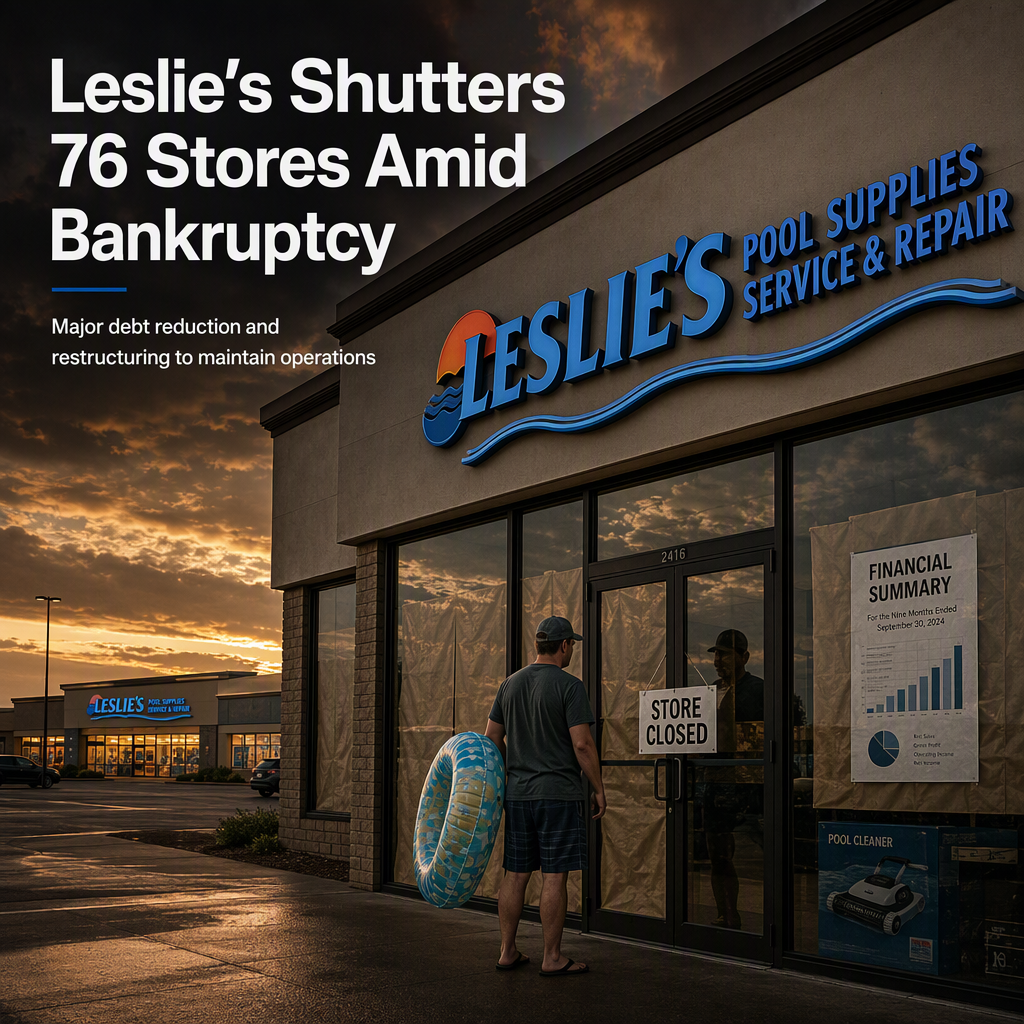
Leslie's Inc., a leading pool and spa service provider, has filed voluntary petitions for prearranged Chapter 11 bankruptcy in federal court, marking a significant restructuring milestone for the company [1]. As part of the bankruptcy process, Leslie's will close 76 stores after evaluating its store network to better align with customer demand [1]. Despite these closures, the company emphasized that its remaining stores will stay open and fully operational, and it remains committed to serving customers without interruption through both physical locations and digital platforms [1].
The restructuring agreement includes commitments for $90 million in new-money debtor-in-possession (DIP) financing and a $60 million equity financing [1]. Leslie's has also filed motions seeking approval for a fully committed $225 million DIP asset-based financing facility from its existing ABL lenders [1]. A key component of the restructuring is a reduction of approximately $685 million, or 90%, of the company's outstanding funded debt [1].
Leslie's CEO Jason McDonell stated that the announcement is an important milestone in the company's commitment to customers and business, expressing confidence that a stronger balance sheet and greater financial flexibility will allow Leslie's to reinvest across the business and deliver improved customer experiences both in-store and online [1]. The company expects to emerge from Chapter 11 in early 2027 under the majority ownership of its existing lenders [1].
Leslie's also filed customary first day motions to ensure continued payment of wages and benefits, maintenance of customer programs, honoring obligations to vendors, and obtaining other relief measures common in bankruptcy proceedings [1]. All gift cards and loyalty program benefits will continue to be honored during the restructuring process [1].
CONCLUSION
Leslie's Inc.'s Chapter 11 bankruptcy filing and store closures represent a major restructuring effort, with significant debt reduction and new financing commitments. The company aims to maintain uninterrupted operations and emerge stronger by early 2027. Market impact is high due to the scale of the restructuring and store closures.