
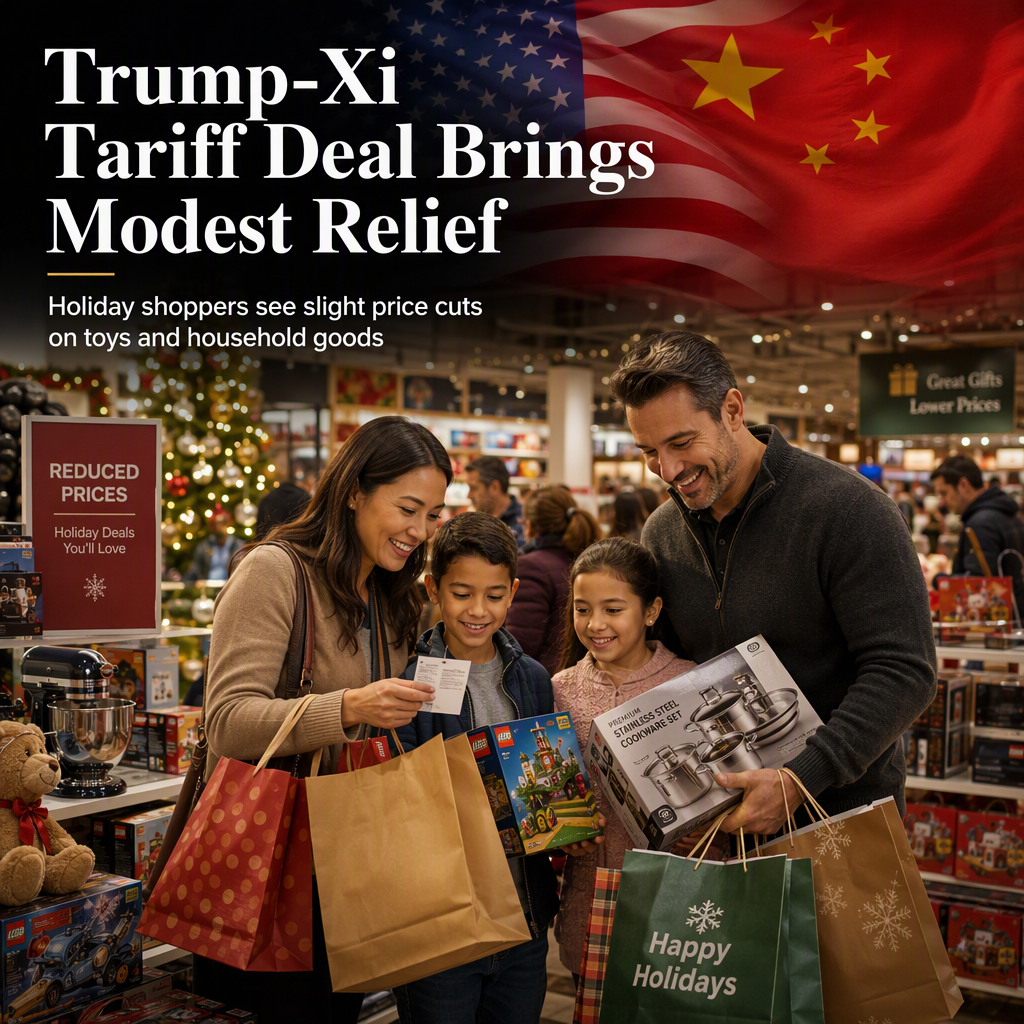
President Donald Trump and Chinese President Xi Jinping have reached an agreement to reduce tariffs on $30 billion worth of non-sensitive goods, including household items and toys, ahead of the holiday season [1]. According to Clark Packard, a research fellow for international trade policy at the Cato Institute, this deal could result in modest price relief for American consumers, particularly on items commonly purchased as holiday gifts such as toys, dolls, puzzles, and kitchen wares [1].
Packard noted that the overall impact on consumers may be limited, as the $30 billion in goods affected represents only a small fraction of the more than $400 billion in U.S. imports from China last year [1]. The agreement is estimated to lower the average U.S. tariff rate on Chinese imports from about 22% to 20.5% [1]. While some sectors, especially retail, may benefit, the extent of consumer savings is uncertain due to potential retailer strategies involving holiday discounts and profit-margin adjustments [1].
High-tech items, including internet-connected auto parts and advanced semiconductors, were excluded from the deal due to ongoing geopolitical and security concerns. Packard highlighted that the U.S. remains wary of Chinese control over rare earth mineral supply chains, while China is concerned about U.S. dominance in the semiconductor sector [1].
The agreement is characterized as a short-term, incremental step that postpones more significant decisions and does not address the deeper causes of U.S.-China trade tensions. Packard emphasized that there is currently no political willingness on either side to resolve these underlying issues, suggesting that further progress will be incremental and that a comprehensive trade agreement remains distant [1].
CONCLUSION
The Trump-Xi $30 billion tariff reduction deal is expected to provide modest price relief for U.S. consumers on select goods during the holiday season, with the retail sector seeing some benefit. However, the agreement is limited in scope and does not resolve broader trade tensions, leaving major issues for future negotiations.