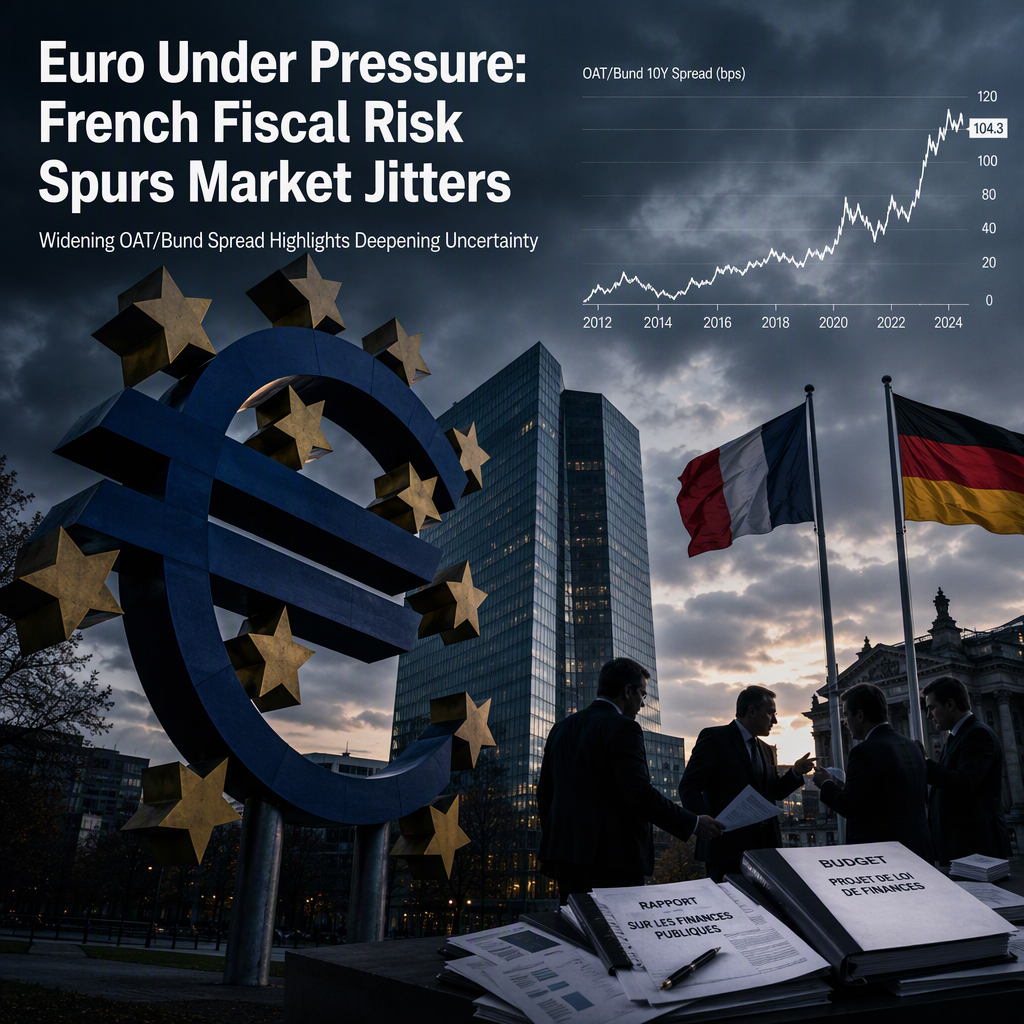
MUFG analyst Derek Halpenny highlights that the Euro is under significant pressure due to widening French OAT/Bund spreads and increased global fixed income risk aversion, which are contributing to negative momentum for the currency [1]. The spread between French and German government bonds (OAT/Bund) has widened to 110 basis points, marking its highest level since 2012 during the euro-zone debt crisis [1]. This development is attributed to ongoing political and fiscal uncertainties in France, including challenges in passing the 2027 budget and a large planned fiscal consolidation of EUR 54 billion aimed at reducing the budget deficit from 5.4% of GDP this year (revised up from 5.0% due to weaker GDP growth) to 5.0% [1].
A recent ratings downgrade by Scope, a smaller ratings agency, brought France's rating in line with S&P and Fitch at A+, though both major agencies confirmed a stable outlook earlier this year (S&P in May and Fitch in August) [1]. Despite stronger-than-expected advance PMIs, EUR/USD continued to decline, underscoring the dominance of fiscal and political risks over positive economic data [1].
MUFG identifies 1.1340 as a key support level for EUR/USD, representing the 38.2% retracement from the February 2025 low to the January 2026 high. A breach of this level could extend losses toward the 1.10–1.12 range [1]. The reopening of the French parliament this week may have brought fiscal risks back into focus, with clear risks of difficulties in passing the 2027 budget [1].
Overall, the global fixed income backdrop is amplifying market risks around France's budget, and MUFG expects downside risks for the euro to persist in the coming weeks [1].
CONCLUSION
French fiscal and political uncertainties, combined with a widening OAT/Bund spread and global risk aversion, are exerting strong downward pressure on the euro. MUFG warns that unless key support levels hold, EUR/USD could see further declines, with market sentiment remaining cautious amid ongoing budget risks.