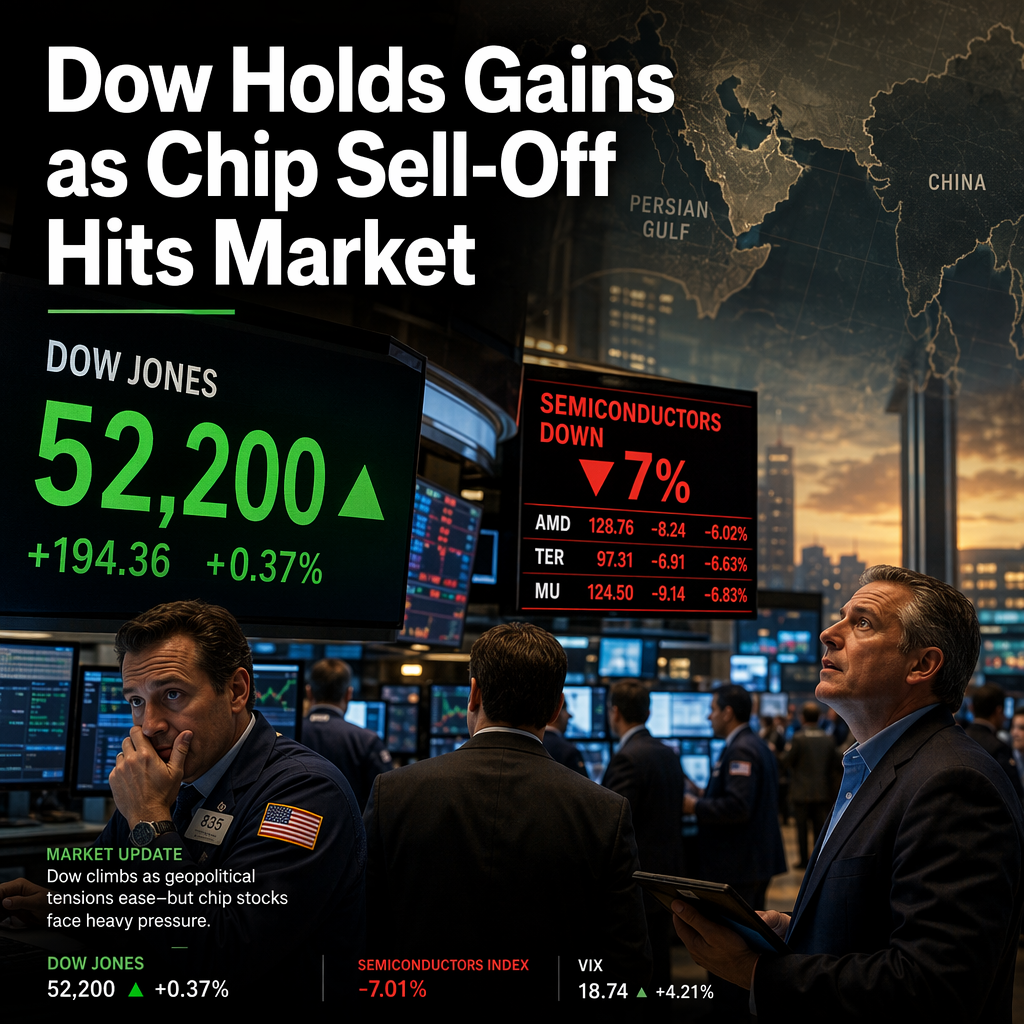
The Dow Jones Industrial Average traded near 52,200, up approximately 250 points, after a session that initially provided a strong bullish catalyst but later saw most of those gains erased due to a semiconductor sector sell-off linked to developments in China [1]. The index briefly approached 52,600 before a sharp decline in chip stocks, attributed to reports that Chinese toolmakers have begun mass producing domestic deep ultraviolet lithography machines, pulled the Dow back to the 52,000 level. The late session saw the Dow reclaim about half of the lost ground [1].
Geopolitical tensions between the United States and Iran eased over the weekend, leading to a significant repricing in crude oil markets. Brent crude fell around 7% to the $90.00 handle, and West Texas Intermediate dropped to near $84.00, after both had traded above $100.00 the previous week. While former President Trump stated that talks are making progress, Tehran has only confirmed a willingness to hold fire as long as Washington does, with no formal agreement in place [1]. The pause in hostilities is partly attributed to concerns over the depletion of munitions and a shortage of viable targets, according to wire reports. Despite the de-escalation, shipping transit through Hormuz and Bab al-Mandeb slowed, and Yemen's Houthis continued to claim attacks on Saudi vessels [1].
The semiconductor sell-off was not related to the Iran situation. Instead, it was triggered by the Chinese supply chain story, which led to a more than 7% drop in the dominant Western supplier and a roughly 3% decline in the benchmark semiconductor complex. Specific stocks impacted included Advanced Micro Devices (AMD), down 7%, Teradyne (TER), down 5.9%, and Micron (MU), down 4%. These losses erased an earlier rally that had been fueled by a Chinese memory maker's strong Shanghai debut [1].
While the Dow managed to hold a gain of about half a percent, the S&P 500 and Nasdaq Composite both closed lower. The Dow's relative insulation from the chip sector is due to its price-weighted structure, which gives Nvidia (NVDA) a smaller influence compared to capitalization-weighted indices. Additionally, SpaceX (SPCX) continued to trade near half its post-listing high and below its offer price for the eighth consecutive session, reflecting risk sentiment at the speculative end of the market [1].
CONCLUSION
The Dow Jones managed to post a modest gain despite a sharp sell-off in semiconductor stocks and ongoing geopolitical uncertainty. However, the broader market, including the S&P 500 and Nasdaq, faced pressure from the chip sector's decline. The session highlights the market's sensitivity to both geopolitical developments and supply chain news out of China.