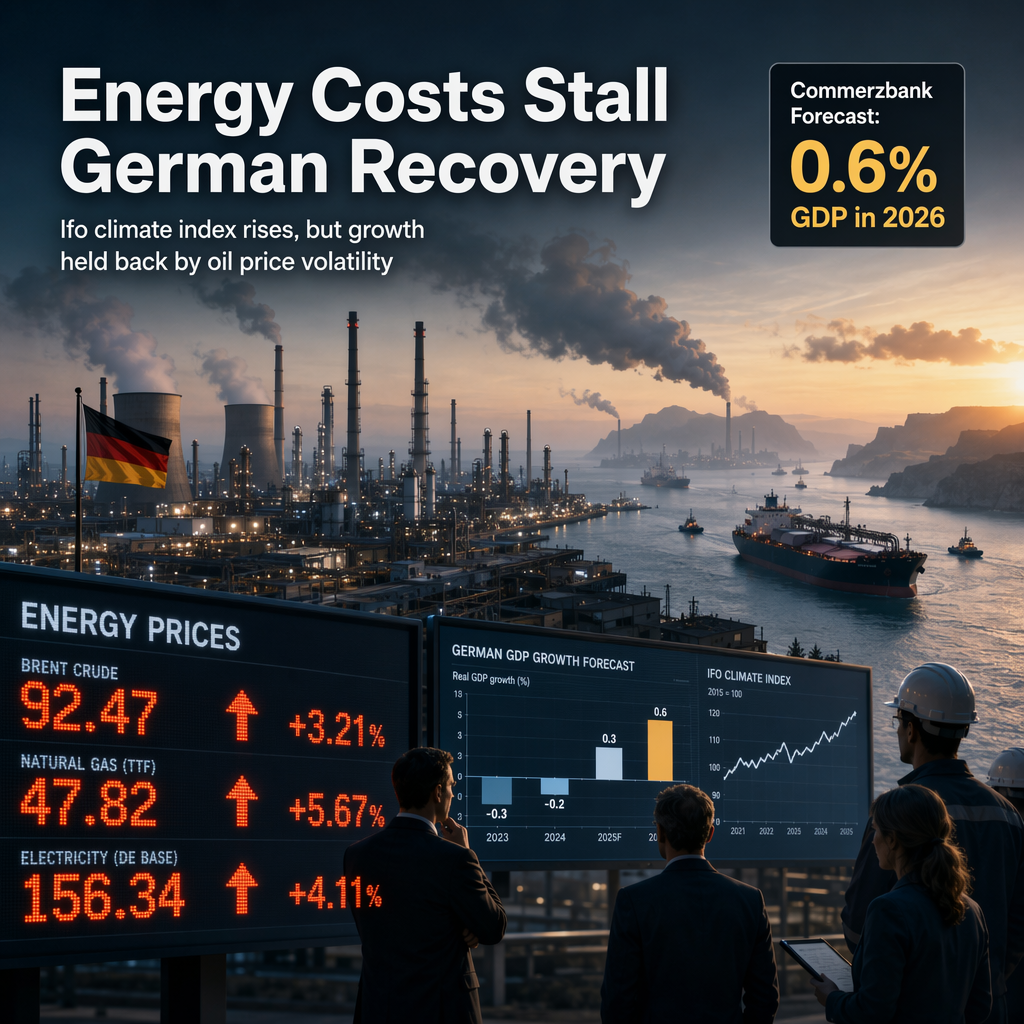
Commerzbank’s Dr. Jörg Krämer highlights that elevated energy prices are expected to continue weighing on the German economy throughout the second half of 2026, restricting full-year growth to just 0.6% [1]. The recent sharp increase in the Ifo business climate index, rising to 86.6 from 85.7, is noted as only partially indicative of actual business sentiment, since most survey responses were collected before the significant oil price surge over the past two weeks [1]. Krämer cautions that the July Ifo reading may exaggerate the current economic outlook, as companies had not yet reacted to the oil price spike, despite Brent crude falling by around $10 to approximately $90 this morning compared to Friday [1].
The report underscores that the German economy's recovery potential is contingent on geopolitical developments, specifically the possibility of an agreement between the US and Iran and the permanent reopening of the Strait of Hormuz [1]. However, Krämer warns that achieving such an agreement is likely to be a protracted and challenging process, meaning high energy costs will persist as a drag on growth in the near term [1].
Looking ahead, Commerzbank maintains a cautious optimism, forecasting a modest increase in German GDP of 1.0% for the coming year if geopolitical tensions ease and energy prices stabilize [1]. The analysis suggests that while the current Ifo business climate improvement signals recovery potential, actual economic performance will remain subdued unless there is a breakthrough in US-Iran relations and energy supply routes [1].
CONCLUSION
Commerzbank projects limited German economic growth of 0.6% for 2026, citing ongoing high energy prices as a major constraint. The positive Ifo business climate reading points to recovery potential, but actual improvement depends on geopolitical developments, particularly US-Iran negotiations and the reopening of the Strait of Hormuz. Market sentiment remains cautious, with only modest growth expected unless energy costs decline.