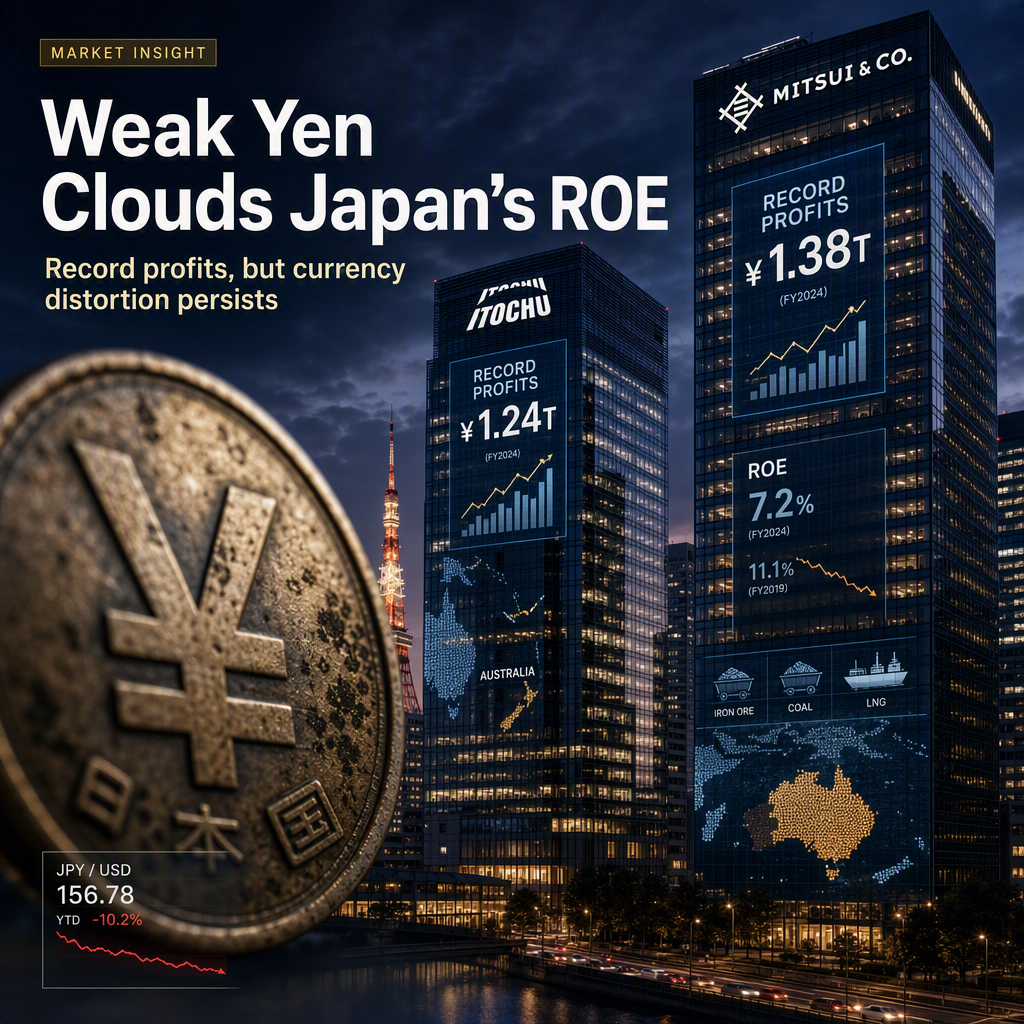
Return on equity (ROE) at Japan's listed companies declined in the fiscal year ended March, even as operating profits reached record highs, due to the impact of a weak yen on shareholders' equity values [1]. The depreciation of the yen led to significant translation adjustments, particularly for general trading companies such as Itochu and Mitsui & Co., whose overseas investments—including assets like mines in Australia—experienced a boost in equity value when converted to yen [1]. This increase in shareholders' equity outpaced profit growth, thereby pushing down ROE, a key financial metric used by investors to assess corporate performance [1].
The effect was most pronounced among trading houses and companies with substantial overseas operations, as currency fluctuations amplified the value of their foreign subsidiaries on the balance sheet [1]. Market analysts highlighted that this trend is likely to persist as long as the yen remains weak and Japanese companies continue to hold significant overseas assets [1]. Investors are closely monitoring for potential stabilization of the yen or strategic corporate actions to mitigate currency exposure [1].
While the article does not provide specific trading advice or chart descriptions, it notes a cautious market sentiment regarding the use of ROE as a sole performance indicator, given the distorting effects of currency translation adjustments on equity values [1].
CONCLUSION
The weak yen has distorted ROE figures for Japanese corporates, despite strong underlying business performance and record profits. Investors are advised to exercise caution when relying on ROE, as currency translation effects may continue to impact financial ratios until the yen stabilizes or companies adjust their currency exposure strategies.