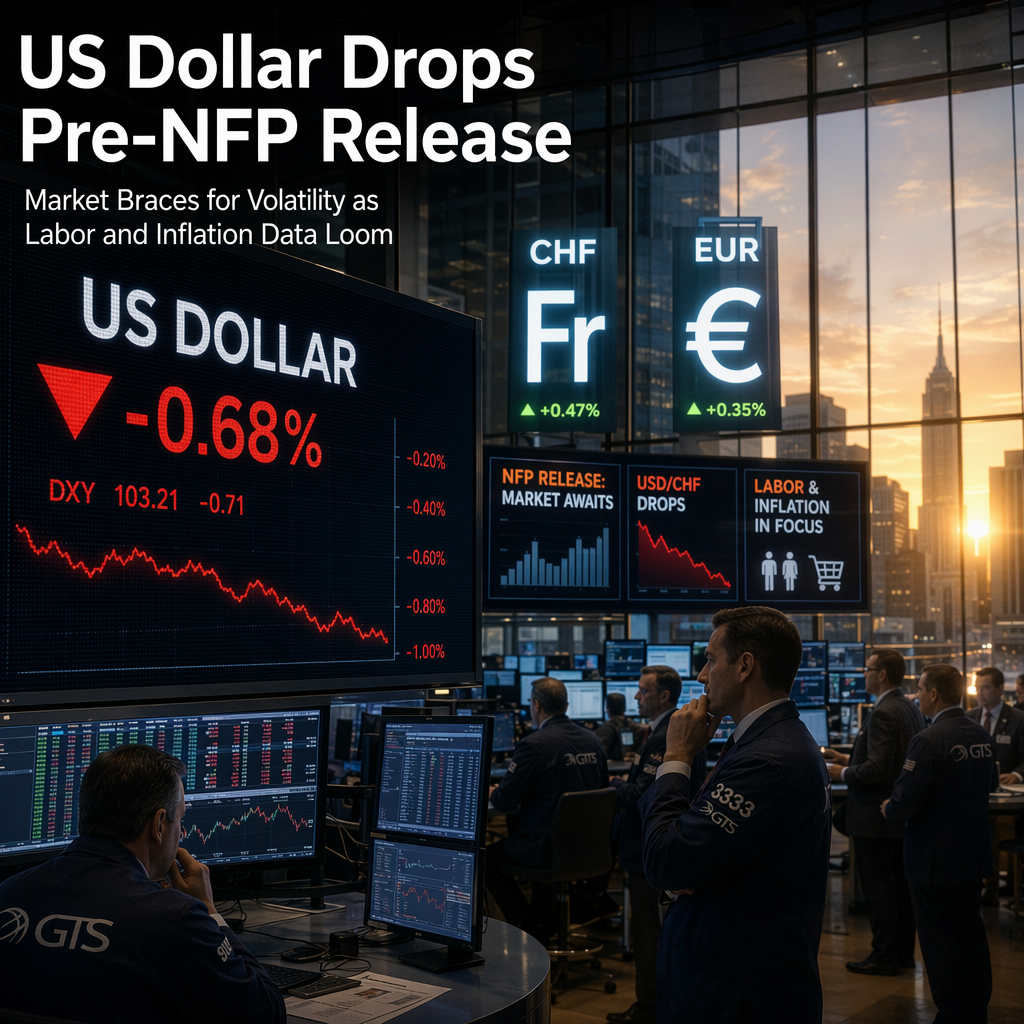
The US Dollar (USD) traded lower against several major currencies, including the Swiss Franc (CHF) and Indonesian Rupiah (IDR), as investors awaited the release of the US Nonfarm Payrolls (NFP) report and Swiss Consumer Price Index (CPI) data on Thursday. The USD/CHF pair declined to around 0.8085 during early European trading, with the Swiss Franc strengthening near 0.8100. This move was attributed to a weaker-than-expected ADP June employment report, which showed US private sector employment rising by just 98K, below the market expectation of 113K and down from May's 122K increase [1][2][3].
Market participants expect the US economy to add 110,000 jobs in June, with the Unemployment Rate projected to remain steady at 4.3%. However, some analysts, such as those at TD Securities, forecast a softer NFP increase of 80K, while the National Bank of Canada expects a 90K rise, citing softer employment indicators and a slight uptick in layoffs based on initial jobless claims [1][2]. Average Hourly Earnings (AHE) are projected to edge higher to 3.5% year-over-year, up from 3.4% in May, though TD Securities expects a moderation to 0.2% month-over-month [2].
Federal Reserve (Fed) Chairman Kevin Warsh commented that inflation expectations and price risks have eased in recent weeks, reinforcing the view that policymakers are in no rush to raise interest rates. Warsh's tone at the ECB Forum was perceived as less hawkish than anticipated, and he refrained from providing explicit guidance on the upcoming July policy decision [1][3]. Mitsubishi UFJ Bank analyst Akihiko Yokoo noted that a stronger-than-expected payrolls report could trigger a rebound in the US Dollar, while a weak print would likely weigh further on the currency [1].
The EUR/USD pair edged higher to around 1.1385 but remained close to weekly lows, with technical indicators suggesting a bearish near-term outlook. Traders are closely watching the NFP release for fresh direction, as a disappointing result could reinforce the current negative bias for the US Dollar [4].
On the Swiss side, the headline CPI is expected to show a 0.5% year-over-year increase in June, down from 0.6% in May. Analysts believe that a downside surprise in Swiss inflation, similar to trends in the Eurozone, could weigh on the CHF and solidify expectations for prolonged low interest rates. The Swiss National Bank's Financial Stability Report highlighted ongoing challenges in the economic and financial environment but affirmed the resilience of the Swiss banking sector [1].
In summary, the market is highly focused on the upcoming US NFP and Swiss CPI data, with the potential for significant volatility in the USD and related currency pairs depending on the results. The overall sentiment is cautious, with recent soft US data and a less hawkish Fed tone weighing on the Greenback, while technical and fundamental factors suggest further downside risk if labor market data disappoints.
CONCLUSION
The US Dollar remains under pressure ahead of the crucial Nonfarm Payrolls report, with recent soft employment data and a less hawkish Fed tone dampening sentiment. Market participants are bracing for potential volatility, as both US labor and Swiss inflation data could significantly influence currency movements and central bank policy expectations.