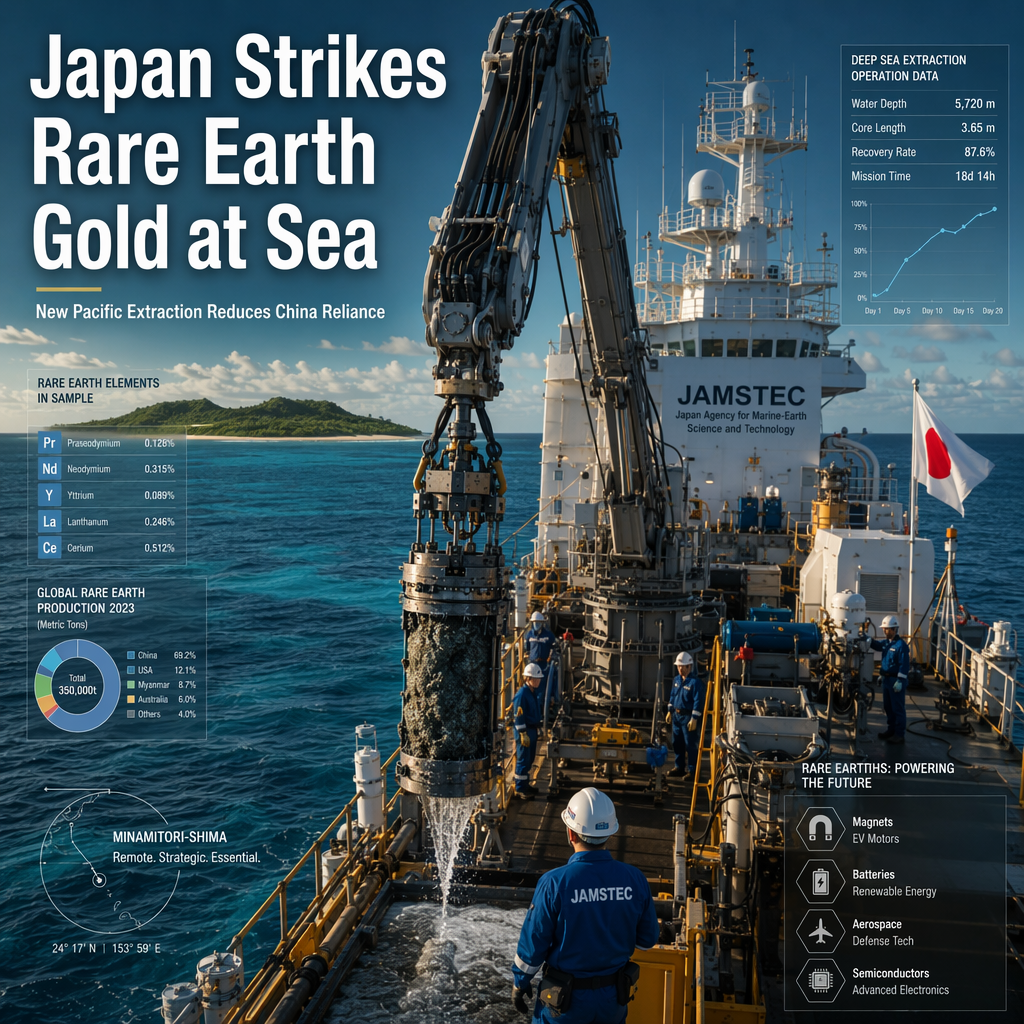
Japan has successfully recovered rare-earth elements from the seabed near Minamitori-shima, a remote Pacific island, through a deep-sea drilling test [1]. These rare earths are critical for the production of semiconductors, electric vehicles, and defense applications [1]. This development is seen as a significant step toward reducing Japan's reliance on supply chains dominated by China, which currently controls much of the global rare earth market [1].
The extraction demonstrates Japan's ongoing efforts to diversify its sources of rare earths and address vulnerabilities in its supply chains, especially amid rising costs and geopolitical tensions with China [1]. According to recent industry surveys, rare earth prices have experienced significant volatility, with costs for Japanese firms surging over 20% [1]. This price instability has heightened the urgency for Japan to secure stable supplies of these critical materials [1].
In response, Japan is not only exploring mining ventures within its own territorial waters but is also considering international locations such as Greenland to further diversify its rare earth sources [1]. The strategy to obtain rare earths from non-China sources is part of a broader initiative to strengthen Japan's economic security and ensure the resilience of critical supply chains [1].
CONCLUSION
Japan's successful extraction of rare earths from the Pacific seabed marks a pivotal move to reduce dependence on China and stabilize supply chains for high-tech industries. With rare earth prices surging over 20% for Japanese firms, this initiative is expected to have a significant impact on market dynamics and economic security.