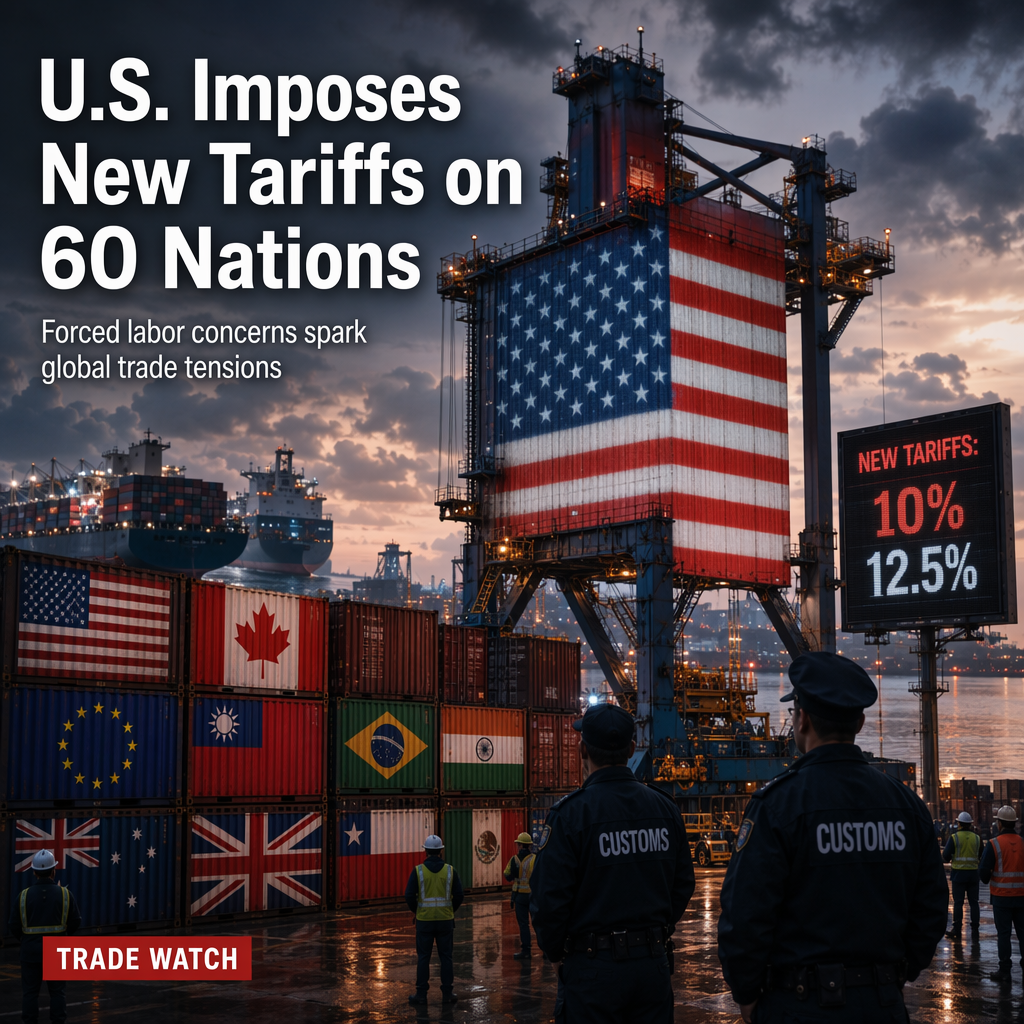
The Trump administration has announced the imposition of new tariffs on imports from 60 trading partners, with rates set at 10% and 12.5%, effective immediately after the expiration of a temporary global tariff at 12:01 a.m. ET Friday [1][2]. These tariffs are being implemented under Section 301 of the Trade Act of 1974, following the Supreme Court's February decision to strike down President Donald Trump's previous 'reciprocal' tariffs of 10% to 50% [1][2]. The temporary 10% global tariff, imposed under Section 122 of the Trade Act, is expiring and being replaced by the new measure [1][2].
According to the Office of the U.S. Trade Representative, the new tariffs target countries for what Washington describes as their failure to impose and enforce bans on goods made with forced labor [1][2]. Canada, Mexico, India, and the United Kingdom will face a 10% tariff, while Taiwan and the European Union are subject to a 12.5% tariff [1]. The duties cover the top 60 U.S. trade partners and 99.4% of American imports [2]. Many products are exempt, including oil and gas, fertilizer, certain food products, and goods already subject to Section 232 national security tariffs such as automobiles, steel, aluminum, and copper [1].
The new tariffs have drawn criticism from several U.S. trading partners. Australia, Brazil, and Chile have publicly rejected the forced-labor justification, with Australian Trade Minister Don Farrell calling the tariffs 'unjustified' and inconsistent with free trade agreements [2]. Brazil's President Luiz Inácio Lula da Silva labeled the tariffs 'arbitrary' and indicated Brazil would seek other markets if necessary, noting the new duty adds to a separate 25% Section 301 tariff imposed on Brazilian goods this month, creating a combined barrier of 37.5% [2]. Chile argued the measure was inconsistent with its labor standards and the evidence it provided, and stated it would seek exclusions for key exports [2]. Canada, which is in the 10% tier with exemptions for USMCA-compliant goods, responded more mildly, with Minister Dominic LeBlanc stating the move was 'not unexpected' and that Canada would continue constructive engagement [2].
A senior U.S. administration official stated that the new tariffs are not intended to replace the expiring global duties, despite their timing, and emphasized that the U.S. enforces bans on goods made with forced labor more aggressively than any other country, which they argue puts American businesses at a competitive disadvantage [1]. Analysts cited in the sources suggest the investigation is less about labor standards and more about pressuring other countries to adopt Washington's ban on Chinese forced-labor goods and rebuilding the tariff regime struck down by the Supreme Court [2].
The announcement follows other recent trade actions by the Trump administration, including a 50% tariff on certain Canadian imports set to take effect August 19 under the Tariff Act of 1930, and a decision to keep imported generic drugs tariff-free for two years before imposing new duties [1].
CONCLUSION
The Trump administration's new tariffs on 60 trading partners have prompted strong reactions from several countries, who dispute the forced-labor rationale and warn of potential trade tensions. With exemptions for key goods and ongoing negotiations, the market impact is significant, and the situation remains fluid as affected nations consider their responses.