
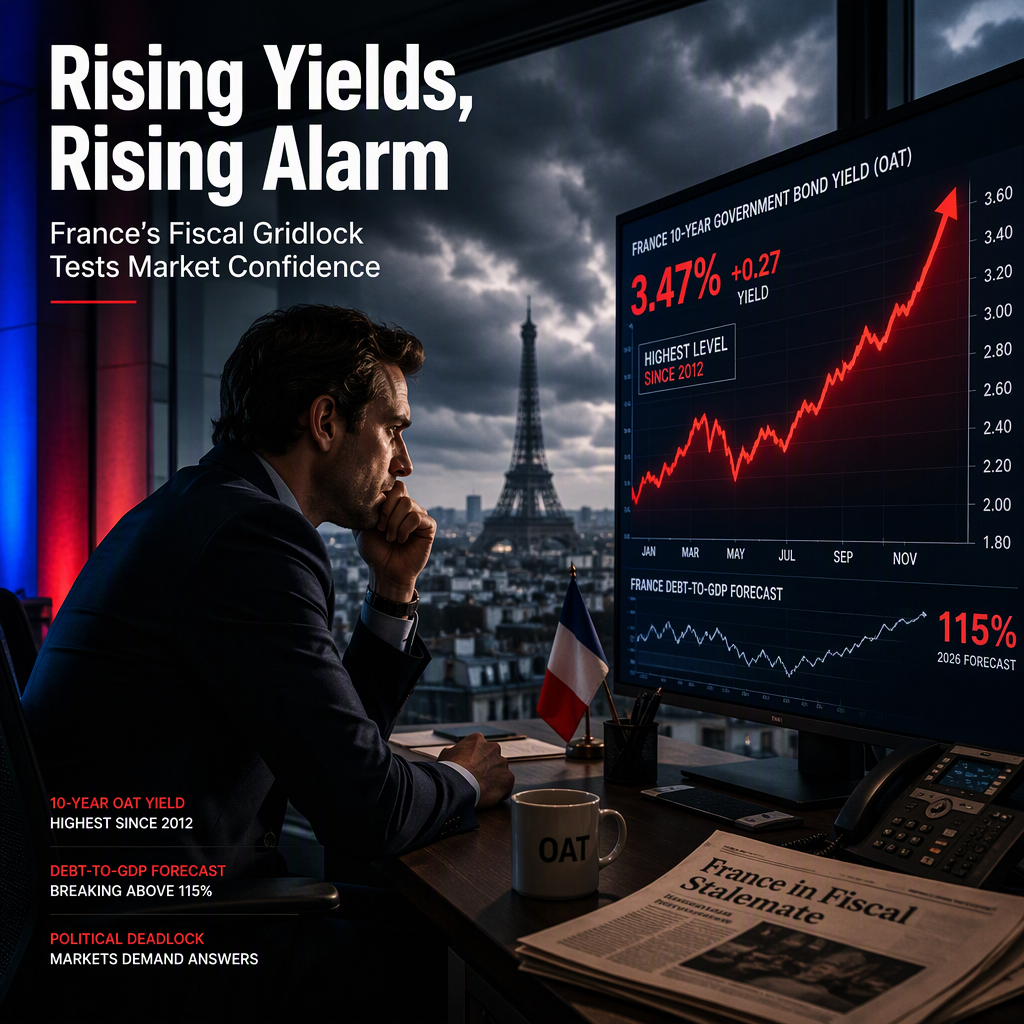
France is facing mounting concerns over its public finances, as evidenced by a surge in yields on French government bonds to their highest levels in years, at times surpassing those of other major eurozone economies [1]. This increase in borrowing costs reflects investor skepticism about the sustainability of France's budget deficit and public debt, with the country's debt-to-GDP ratio hovering around 110% and the budget deficit forecasted to remain well above the eurozone's 3% limit for the foreseeable future [1]. The market is demanding a higher risk premium for French debt, underscoring the seriousness of the fiscal situation [1].
The root of the problem lies in France's political landscape, where successive governments have struggled to enact meaningful spending cuts or tax reforms due to resistance from vested interests and frequent street protests [1]. This political inertia has left France increasingly dependent on favorable financing conditions and support from the European Central Bank to manage its debt load [1]. According to a Paris-based bond strategist, "Markets are sending a clear message. Unless there is a credible plan to bring down deficits, France risks being lumped together with other highly indebted eurozone countries" [1].
Despite clear signals from the market, the political consensus needed for deep fiscal reform remains elusive, especially with presidential and parliamentary elections approaching. Politicians are hesitant to propose unpopular measures that could alienate voters, perpetuating a cycle where worsening fiscal problems increase the political cost of action, making reform even less likely [1].
The stakes are significant: failure to restore market confidence could lead to even higher borrowing costs, further straining public finances and threatening the stability of the eurozone as a whole. Investors and policymakers are closely monitoring whether France can overcome its political gridlock and implement a sustainable fiscal strategy [1].
CONCLUSION
Investor concerns over France’s fiscal trajectory have driven government bond yields to multi-year highs, signaling a demand for greater risk premiums. Without credible fiscal reforms, France faces the prospect of higher borrowing costs and increased pressure on eurozone stability. The political stalemate remains a critical barrier to restoring market confidence.