
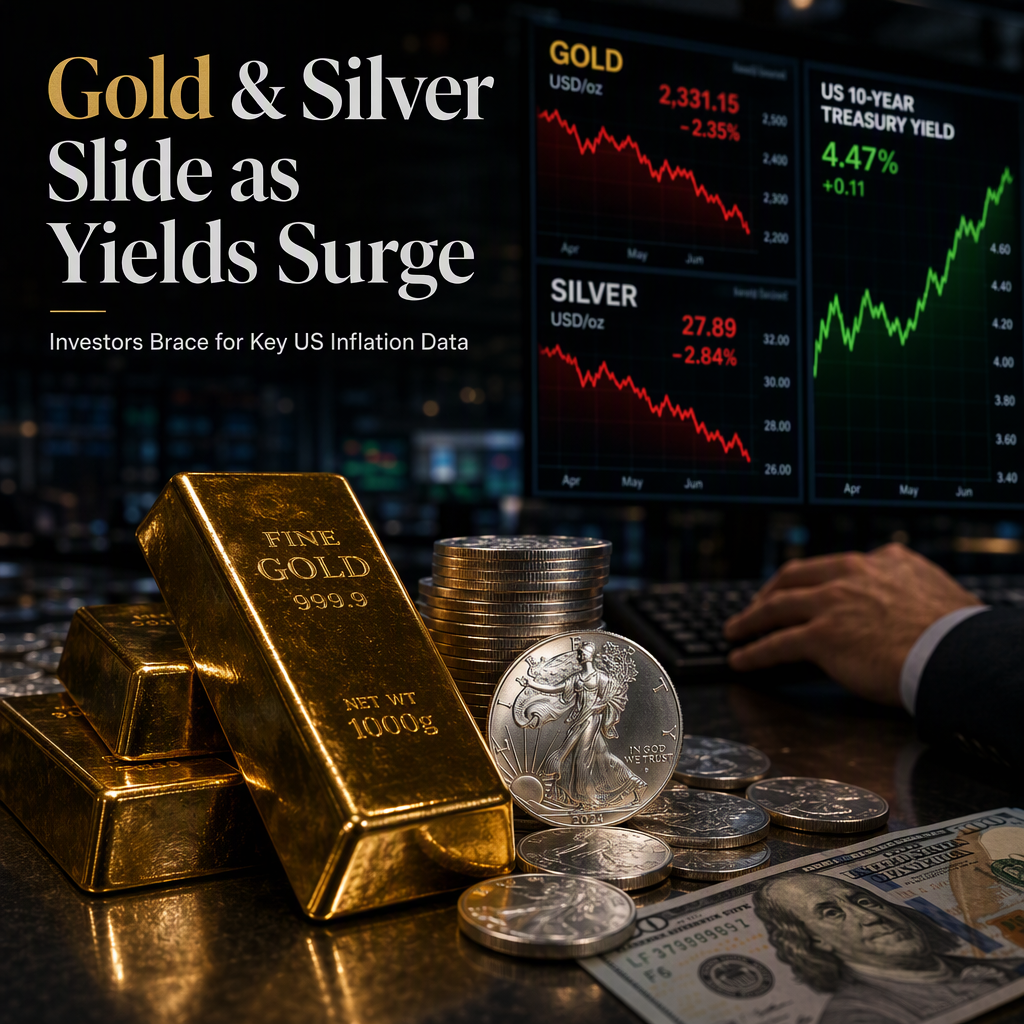
On Tuesday, both gold and silver prices experienced notable declines as US Treasury yields rose and investors braced for the upcoming US Consumer Price Index (CPI) release scheduled for Wednesday, October 14 [1][2][3]. Gold (XAU/USD) extended its losses, trading at $4,157, down 0.37%, and approaching the $4,150 support level, which marked a fresh weekly low [2]. Silver (XAG/USD) dropped more than 1.5% to around $59.25, hovering near two-month lows [3].
The US Dollar Index (DXY) retreated from recent highs, slipping to the 102.20-102.25 region, as the Greenback faced downside pressure amid declining crude oil prices and mixed US Treasury yields [1][2][3]. Despite the weaker dollar, rising Treasury yields—specifically, the US 10-year yield climbing 6 basis points to 5.223%—overpowered the usual support for precious metals, contributing to their bearish momentum [2][3]. Technical indicators for both gold and silver reinforced this negative bias, with gold unable to decisively clear the $4,200 resistance and silver trading below key moving averages, suggesting further downside risk [2][3].
Market participants are closely watching the US CPI data, as a hotter-than-expected reading could lift the US Dollar and Treasury yields, reviving expectations of a rate hike at the Federal Reserve's October 27-28 meeting [2][3]. Money markets currently price in a 23% chance of a 25 basis point rate hike, while the CME FedWatch Tool indicates an 80% probability that rates will remain unchanged [2][3]. Federal Reserve officials, including Chicago Fed President Austan Goolsbee and Governor Christopher Waller, commented on the stability of the labor market and the importance of inflation persistence in guiding policy decisions [2].
In the broader market, front-month West Texas Intermediate (WTI) crude futures continued their recovery, rising for the fourth consecutive day and nearing $95.00 per barrel, supported by ongoing Middle East tensions [1][2]. Despite these geopolitical risks, recent reports indicated that traffic through the Strait of Hormuz is near 80% of pre-war levels, suggesting some stabilization in crude and energy markets [2].
Looking ahead, investors are not only focused on Wednesday's CPI release but also on Thursday's Producer Price Index figures and remarks from Fed Chair Kevin Warsh, which could further influence market direction [2].
CONCLUSION
Gold and silver prices are under pressure as rising US Treasury yields and anticipation of key inflation data weigh on the precious metals market. With the US Dollar weakening but yields climbing, traders are bracing for potential volatility around the CPI release, which could shape expectations for future Federal Reserve policy moves. The market remains cautious, with technical and fundamental signals pointing to continued downside risk for both gold and silver.