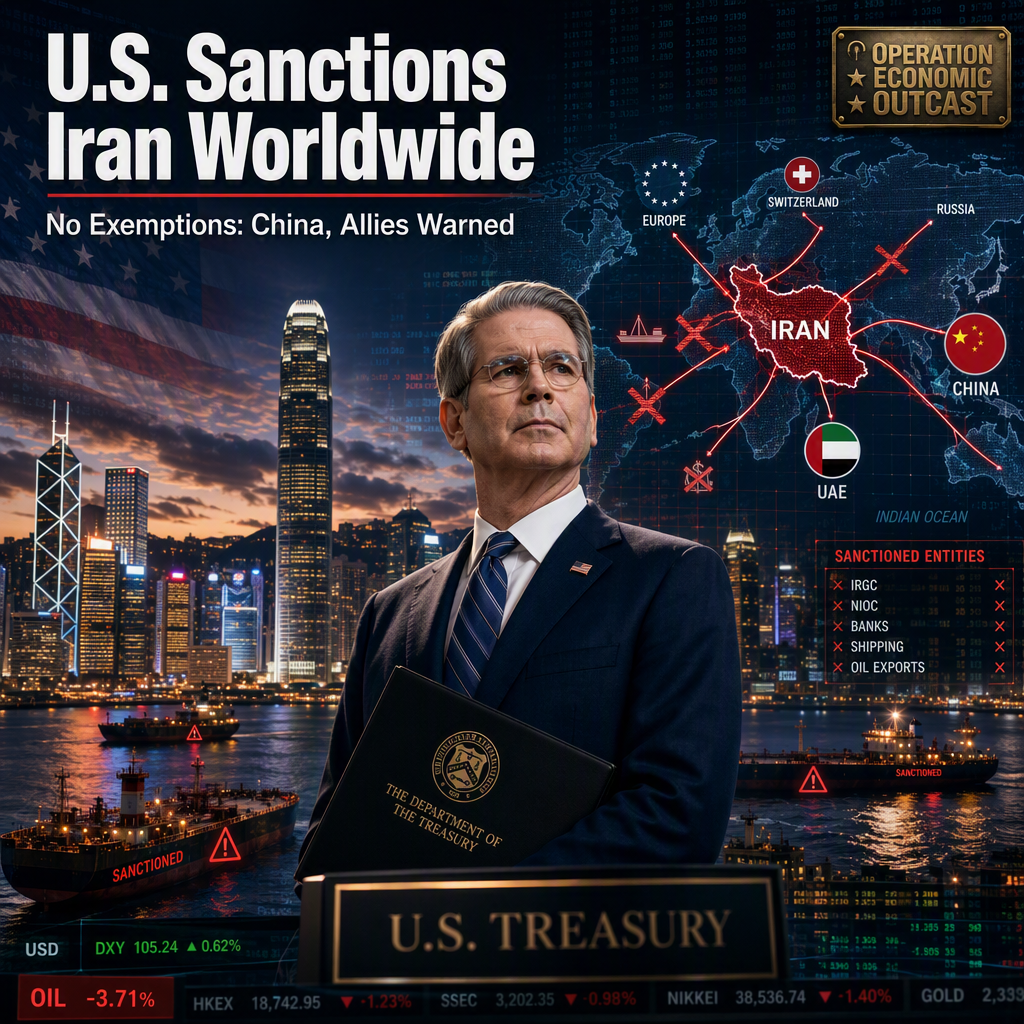
The United States, under Treasury Secretary Scott Bessent, announced a major escalation in its sanctions campaign against Iran, unveiling what Bessent described as an 'economic onslaught' and 'Operation Economic Outcast' targeting Iran's financial connections worldwide [1][3][4]. The new measures, announced on August 24, 2026, include sanctions on nearly 60 Iran-linked entities, individuals, and vessels, with a particular focus on broker companies and shadow fleet vessels operating across the United Arab Emirates, Hong Kong, China, Singapore, Switzerland, and Europe [1][3]. The sanctions specifically target Iran's energy, financial, and shipping sectors, aiming to further restrict Tehran's ability to generate revenue from exports [2].
Bessent emphasized that there would be 'no exemptions' to these sanctions, explicitly stating that even major economies such as China are not above the reach of U.S. sanctions [1][2][3][4]. President Donald Trump is personally calling world leaders to press them to cut economic ties with Tehran, and the U.S. is engaging in 'quiet diplomacy' with Iranian trade partners to warn of the consequences for continued engagement [1][3]. Bessent warned that any entity facilitating money laundering for Iran would be removed from the U.S. dollar system and that there is a defined timeline, or 'cure period,' for nations to end targeted relations with Iran [1][3].
The announcement has significant implications for global markets, particularly for oil and commodity flows. Analysts are closely monitoring the potential disruption to Chinese imports of Iranian oil, which could force China to seek alternative sources or pay higher prices, increasing volatility in crude oil trading [2]. Technical analysis highlights key support at $83/barrel and resistance at $90/barrel for Brent crude, with the potential for a breakout above resistance if supply constraints worsen [2]. The financial community is also watching for ripple effects across Asian markets, especially if China retaliates or circumvents the sanctions, with the Shanghai Composite Index showing resistance near 3,100 and support at 2,950 [2].
Despite the sweeping rhetoric and the targeting of Chinese nationals among the sanctioned entities, Bessent did not announce immediate concrete actions against other countries, and markets showed little immediate reaction to his remarks [3]. However, the U.S. dollar strengthened against major currencies, with the largest gain against the Canadian dollar (+0.66%) [1]. The United Arab Emirates announced it was ending all trade relations with Iran ahead of the U.S. announcement [3].
Forward-looking statements from Bessent and President Trump indicate that the U.S. expects other countries to take similar steps to isolate Tehran, and that any country partnering with Iran risks financial isolation [1][3]. Experts note that the effectiveness of these measures will depend on the response from Iran's key trading partners, particularly China, India, and Russia [3].
CONCLUSION
The U.S. has launched a comprehensive sanctions campaign against Iran, targeting its global financial and trade networks and warning that even major economies like China are not exempt. While immediate market reaction was muted, analysts anticipate heightened volatility in oil and currency markets, with broader implications for global trade if key partners respond or retaliate. The ultimate impact will depend on the willingness of countries like China, India, and Russia to comply with or circumvent the new U.S. measures.