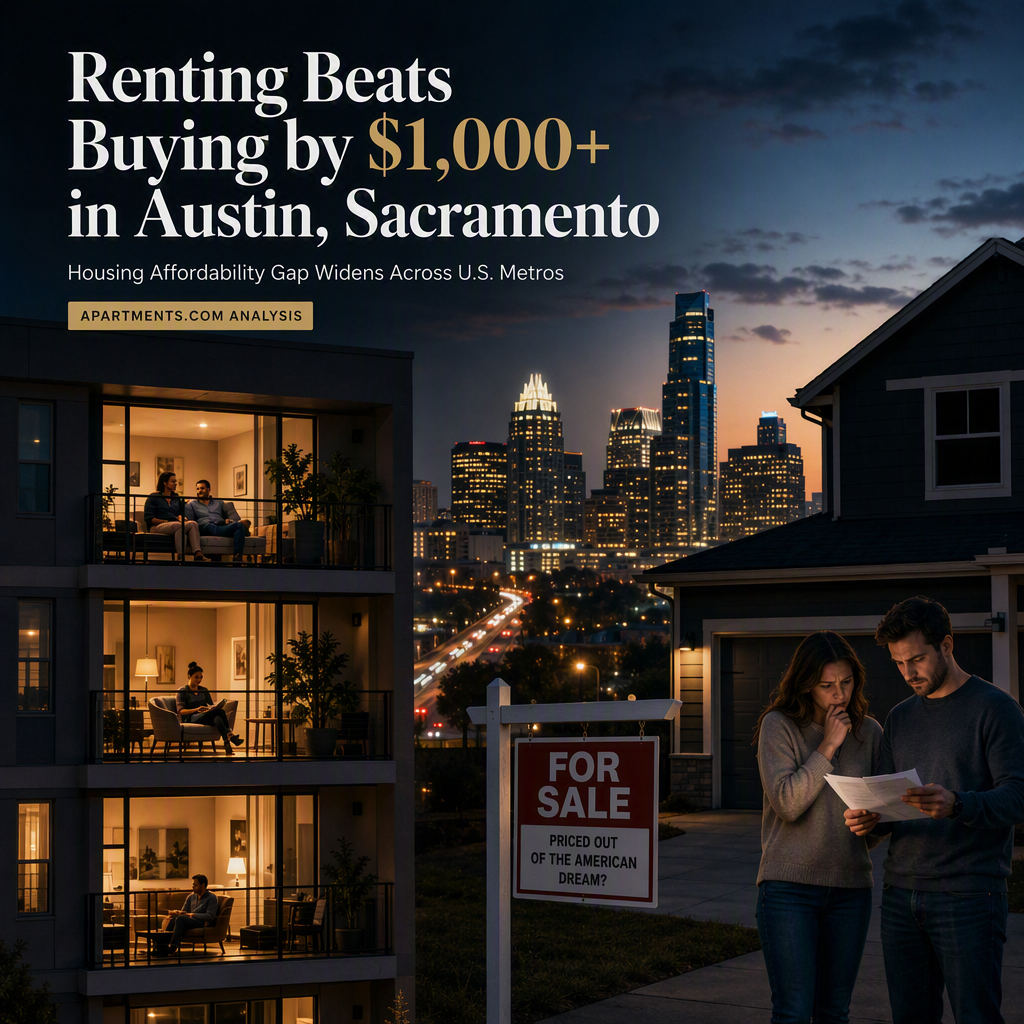
A recent analysis by Apartments.com has highlighted a widening housing affordability gap in seven major U.S. metro areas, where renting is significantly more affordable than buying a home [1]. The cities identified include Austin, Texas; Sacramento, California; Denver, Colorado; Portland, Oregon; Baltimore, Maryland; Salt Lake City, Utah; and Orlando, Florida [1]. Among these, Austin and Sacramento stand out, with average monthly rents more than $1,000 lower than median monthly mortgage payments. Specifically, Austin's median monthly mortgage payment is $2,475, while the average monthly rent is $1,421, resulting in a $1,054 difference. Sacramento's median mortgage payment is $2,621 compared to an average rent of $1,579, giving renters a $1,042 advantage [1].
Dillar Schwartz, an eXp real estate agent based in Austin, noted that the central Texas housing market remains active for both buyers and renters, with an uptick in rental leads and inquiries across various demographics, including those relocating for work [1]. Schwartz observed a recent increase in first-time homeowners and a diverse mix of sellers, with this blend emerging only in the past four to five months after a period of market stagnation [1].
Schwartz emphasized that high Texas insurance, property taxes, and elevated interest rates contribute to substantial upfront costs for homebuyers, which significantly impact monthly payments. Although home prices in Austin have fallen, these costs continue to surprise buyers during lender discussions. Rental rates are also lower, but renters may still face financial hurdles when securing an apartment [1].
The report underscores that, in these seven metro areas, renting offers a clear financial advantage over buying, especially in Austin and Sacramento, where the affordability gap exceeds $1,000 per month [1].
CONCLUSION
The analysis reveals that renting is currently a much more affordable option than buying in several major U.S. cities, particularly Austin and Sacramento. Elevated mortgage payments, driven by high insurance, property taxes, and interest rates, are deterring buyers and supporting increased rental activity. This affordability gap is likely to influence housing market dynamics in these metros in the near term.