
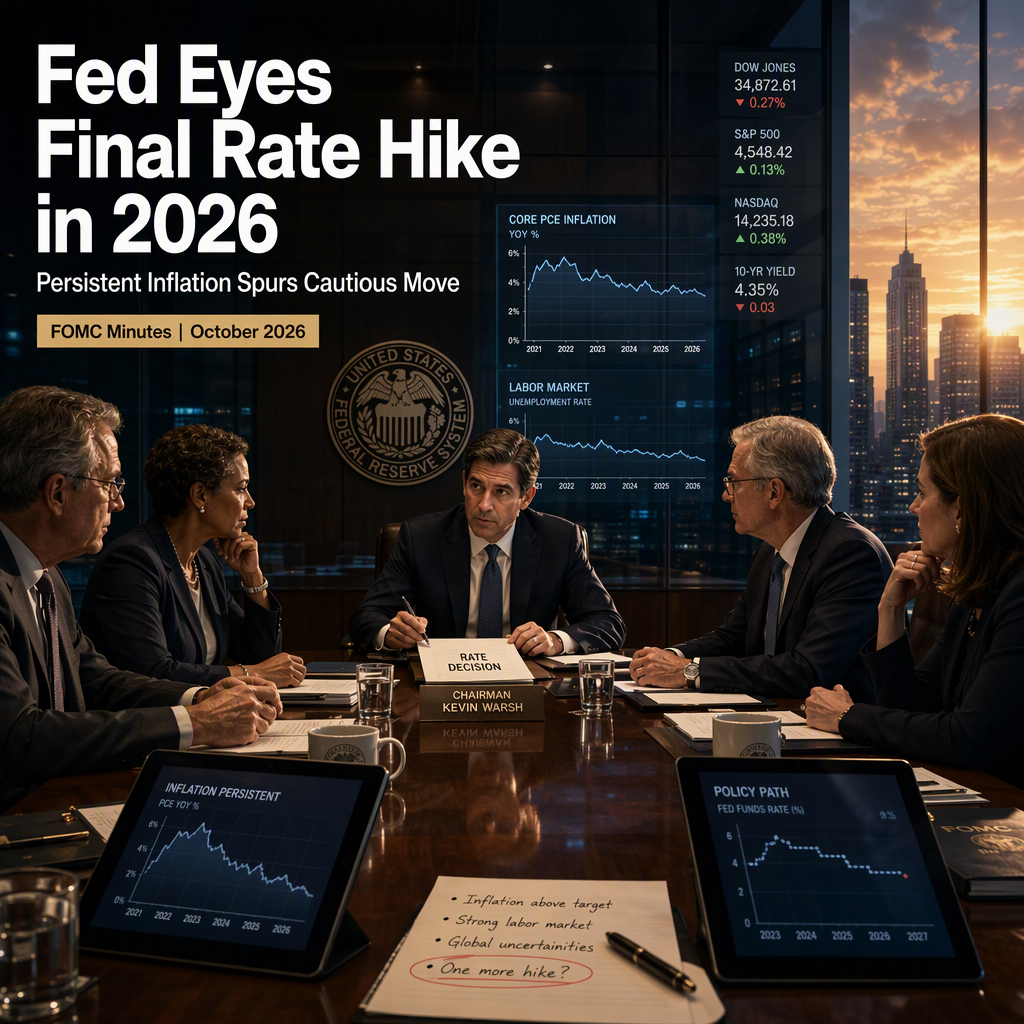
Federal Reserve officials anticipate raising interest rates once more before the end of 2026 to address inflation that has exceeded the central bank's target for over five years, according to minutes from their latest meeting released on October 7, 2026 [1]. The meeting summary did not specify the timing of the next rate hike, only noting that persistently high prices and a stable labor market would likely prompt a second increase this year. The Federal Open Market Committee (FOMC) is scheduled to decide on rates on October 28 and December 9 [1].
The minutes stated, 'most participants assessed that another increase in the target range for the federal funds rate would likely be appropriate by year end,' but emphasized that decisions at future meetings would depend on incoming data and the evolving economic outlook [1]. Chairman Kevin Warsh reinforced the Fed's tough stance on inflation during his post-meeting news conference, leading markets to anticipate a possible hike at the late October meeting. However, recent inflation data and comments from Fed officials suggest that an October increase is unlikely [1].
The Fed's preferred inflation measure, the personal consumption expenditures (PCE) price index, showed core inflation at 3% for August and headline inflation at 3.4%. Both figures remain above the Fed's 2% target but were lower than expected, partly due to changes in calculation methods [1]. The September meeting discussions highlighted concerns that inflation could remain sticky, while the labor market is considered 'close to maximum employment' and economic growth has strengthened [1].
The decision to raise the benchmark funds rate by a quarter percentage point was unanimous, despite earlier reluctance from some officials. The FOMC indicated that one more hike is expected this year, with none projected for 2027. Of the 18 FOMC officials who submitted forecasts, 16 anticipated another increase. Chairman Warsh, who has not submitted a forecast since May, described the recent hike as removing 'a dose of accommodation' from monetary policy, a comment that analysts interpreted as signaling potential further increases [1].
CONCLUSION
The Federal Reserve is signaling one more rate hike in 2026, driven by persistent inflation and a robust labor market, though the exact timing remains uncertain. Market expectations for an October hike have diminished following recent inflation data, with the FOMC emphasizing a data-dependent approach going forward. The unanimous decision and forward guidance suggest a cautious but resolute stance against inflation.