
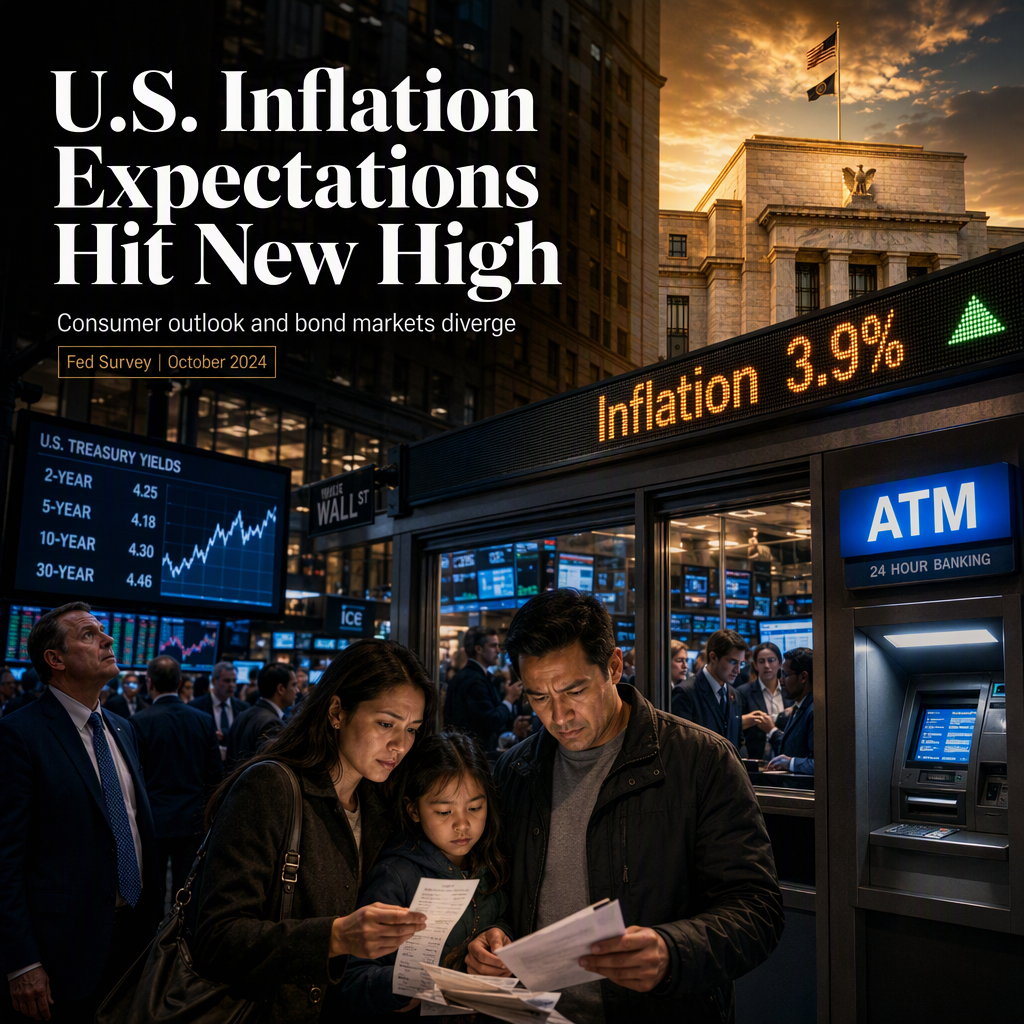
The New York Federal Reserve's Survey of Consumer Expectations revealed that the one-year inflation outlook surged to 3.9% in September, marking its highest level since May 2023, when the figure stood at 4.1% [1]. This represents a 0.3 percentage point increase from August. Alongside rising inflation expectations, household spending growth is also projected to reach 5.5%, up 0.3 percentage point month over month and the highest since May 2023 [1].
These developments come as Federal Reserve officials continue to debate the appropriate stance for monetary policy, with inflation remaining well above the central bank's 2% target [1]. Despite the uptick in near-term inflation expectations, the survey indicates that longer-term outlooks are more stable: the three-year expectation edged up slightly to 3.3%, while the five-year view remained unchanged at 3% [1].
Market-based indicators, however, paint a less optimistic picture. The five-year breakeven inflation rate, a closely watched bond market measure, is at 2.35%, its highest level of the year [1]. Treasury yields have also been climbing, reaching levels not seen since the early 2000s [1].
While markets largely anticipate that the Federal Open Market Committee will keep benchmark rates steady at its upcoming October meeting, Fed funds futures contracts suggest expectations for a much more aggressive central bank in the years ahead, with implied rates of 5.58% in five years compared to the current target range of 3.75%-4% [1]. Several key Fed officials, including New York Fed President John Williams, have recently stated that policymakers can afford to take their time in determining future interest rate moves [1].
CONCLUSION
Rising inflation and spending expectations are fueling market concerns, as reflected in both consumer surveys and bond market indicators. While the Fed is expected to hold rates steady in the near term, futures markets are pricing in a more aggressive stance in the coming years, highlighting persistent uncertainty about the inflation outlook.