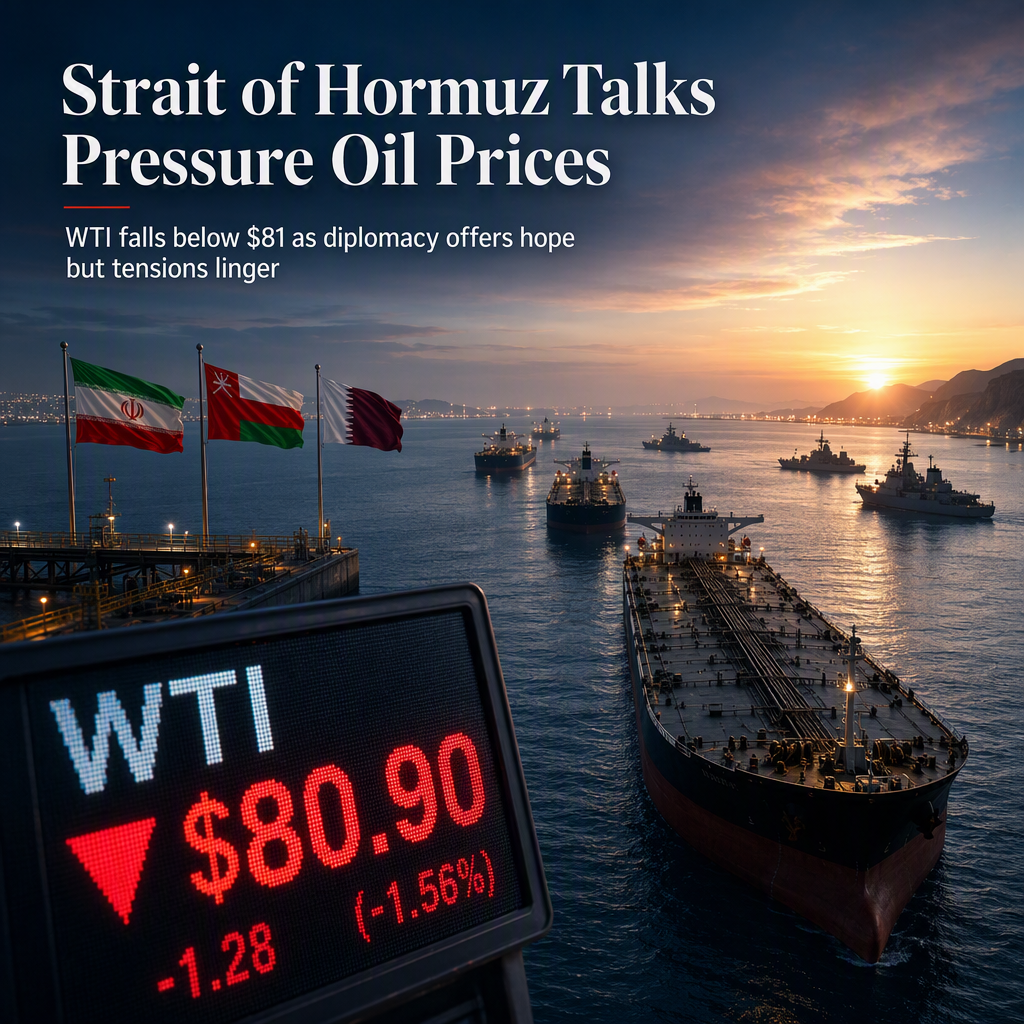
West Texas Intermediate (WTI), the US crude oil benchmark, fell to around $80.90 during early European trading hours on Thursday, driven by optimism surrounding diplomatic efforts between Iran and Oman to potentially reopen the Strait of Hormuz, a critical global oil shipping route [1]. Bloomberg reported that the Islamic Revolutionary Guard Corps (IRGC) announced a revenue-sharing agreement with Oman regarding the waterway, which goes beyond the earlier joint statement from the two countries’ foreign ministries that only referenced an 'interim framework' for resuming ship transits without mentioning any agreement on fees [1]. However, Iran cautioned that reopening the Strait would require more than just a deal with Oman, and diplomatic efforts are ongoing, with Qatar’s Prime Minister scheduled to visit Iran on Thursday to further negotiations aimed at ending the nearly six-month-long conflict [1].
Despite these diplomatic developments, tensions between the US and Iran persist. The US recently threatened new sanctions on countries maintaining economic ties with Iran, and US Treasury Secretary Scott Bessent warned that entities assisting Iran in money laundering could face expulsion from the US financial system [1]. Any escalation in US-Iran tensions could reignite fears of oil supply disruptions and potentially support WTI prices [1].
On the supply side, US crude oil inventories saw a modest weekly build, with the US Energy Information Administration (EIA) reporting an increase of 95,000 barrels for the week ending August 21, compared to a much larger rise of 4.405 million barrels the previous week. This figure was also below the market consensus of a 1.9 million barrel increase [1].
Strategists at UOB Group noted that oil prices declined due to continued optimism over a resolution in the Strait of Hormuz, while Wall Street closed modestly lower overnight. Easing geopolitical risks in this key shipping lane have weighed on crude benchmarks, even as US equities softened [1]. Technical analysis indicates that WTI remains capped below the 100-day simple moving average (SMA), with a broadly neutral 14-day Relative Strength Index of 48.30, suggesting a consolidation phase rather than a decisive recovery [1].
CONCLUSION
WTI prices have declined below $81 amid optimism for a diplomatic resolution to the Strait of Hormuz situation, reducing immediate supply concerns. However, ongoing US-Iran tensions and modest US inventory builds continue to influence market sentiment, keeping the outlook cautious and consolidative.