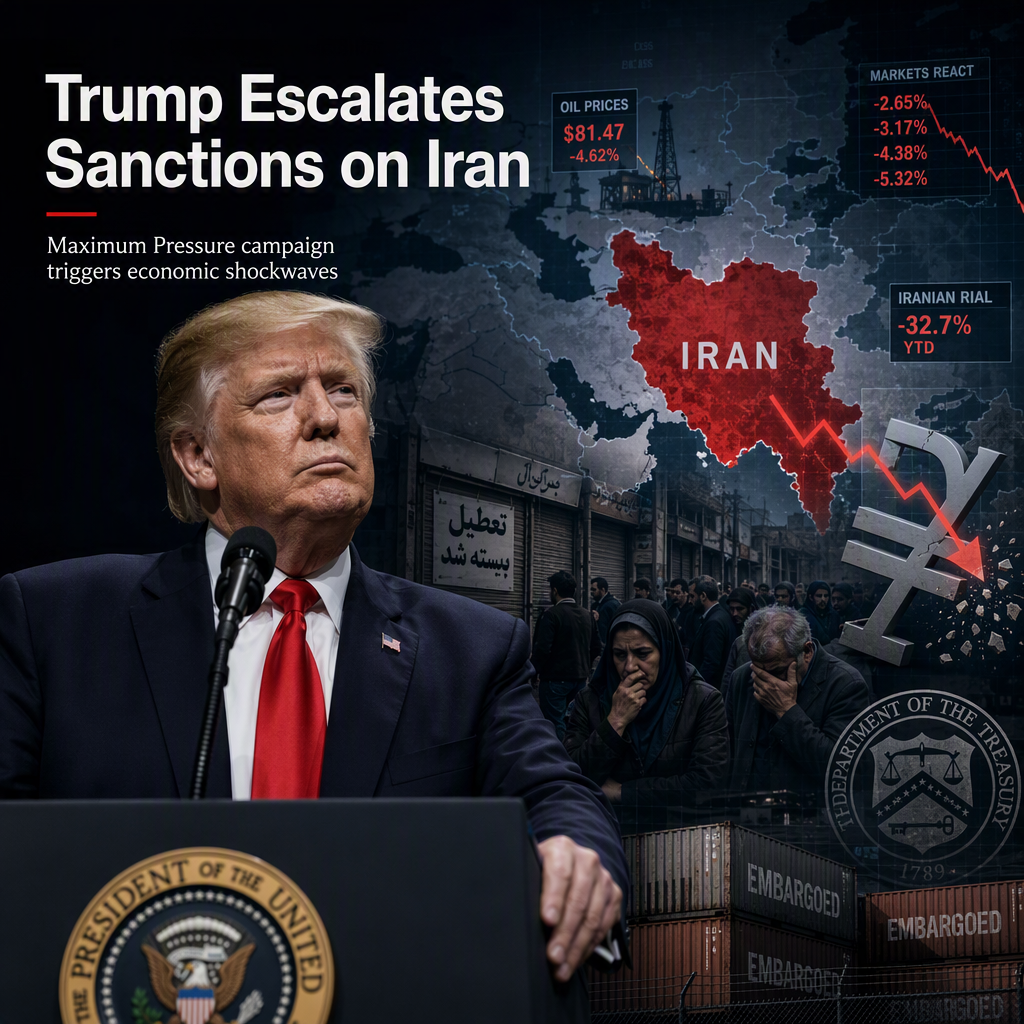
President Donald Trump has announced the reimposition of the Maximum Pressure campaign against Iran, intensifying economic sanctions in an effort to force Tehran into a new nuclear deal [1]. Treasury Secretary Scott Bessent unveiled the so-called "D-Day" sanctions as part of Operation Economic Outcast, which are expected to make economic conditions in Iran intolerable and give the U.S. significant leverage [1].
During Trump's first term, the Maximum Pressure campaign resulted in Iran's oil exports dropping from 2.5 million barrels per day to below 400,000 barrels per day, inflation soaring to 30%, and accessible foreign currency reserves plummeting from $122 billion to $12 billion [1]. In contrast, under the Biden administration, the easing of sanctions led to a rise in oil exports to 1.6 million barrels per day, foreign currency reserves increasing to $26 billion, and unemployment falling to a record low of 7.2% [1]. However, these economic gains were reportedly funneled into Iran's military budget, nuclear program, and regional proxies rather than domestic economic growth [1].
Following Trump's return to office in 2025, and after Iran's sponsorship of the Hamas attacks on Israel on October 7, 2023, the U.S. rapidly reinstated Maximum Pressure sanctions. This led to inflation in Iran rising to 50% in the lead-up to the Twelve-Day War, with the rial trading at around 1.87 million to the dollar, one major bank collapsing, and five others facing trouble [1]. The article suggests that the renewed sanctions are already having a severe impact on Iran's economy, exacerbating existing structural weaknesses [1].
The market implications are significant, as the U.S. is making it clear that countries must choose between doing business with America or Iran, with the expectation that most will opt for the U.S. due to economic incentives [1]. No specific analyst opinions or forward-looking statements are provided beyond the assertion that the pressure on Iran is expected to become intolerable, potentially forcing Tehran to negotiate [1].
CONCLUSION
The reimposition of Maximum Pressure sanctions by President Trump marks a decisive escalation in U.S. economic policy toward Iran, with immediate and severe impacts on Iran's economy. The move is expected to force international businesses to choose between the U.S. and Iran, likely isolating Tehran further. Market participants should anticipate heightened geopolitical and economic tensions as the situation develops.