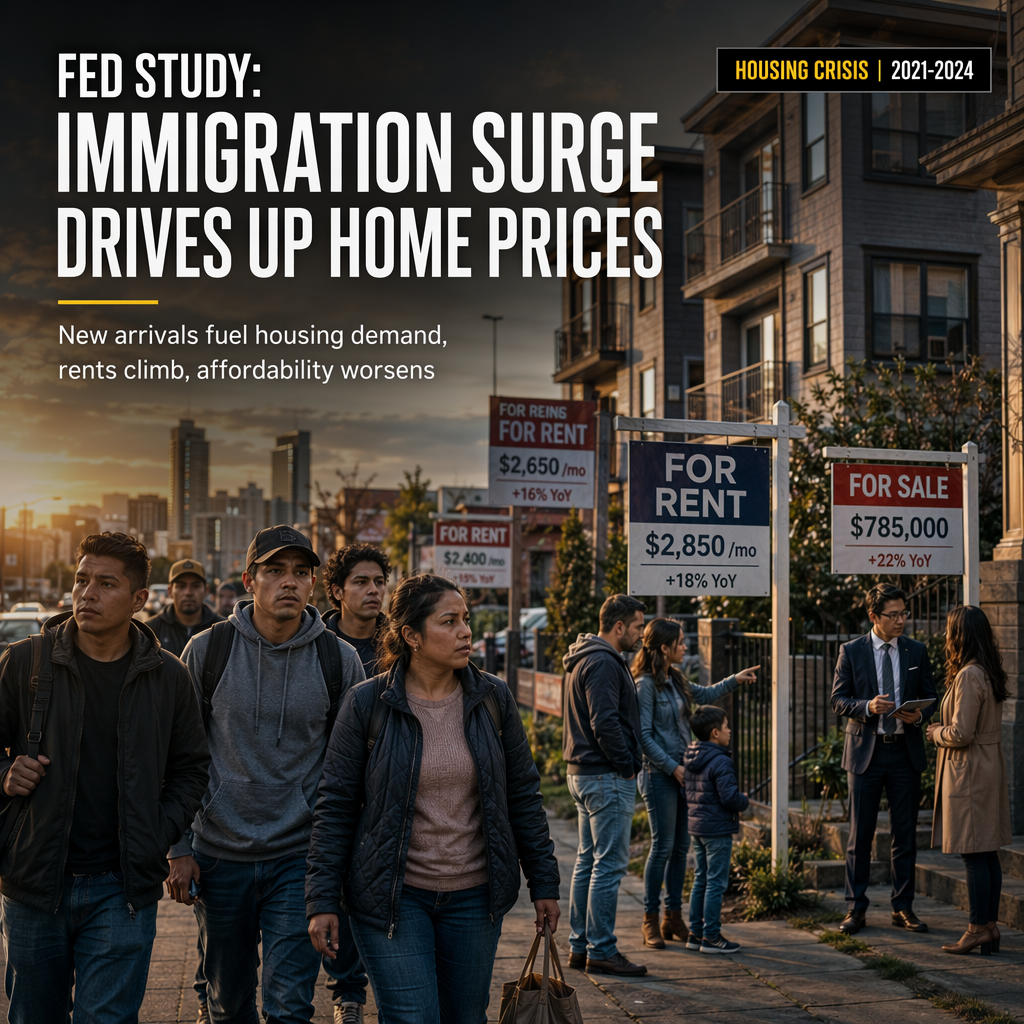
A new working paper from the Federal Reserve Bank of Dallas found that the record surge in illegal immigration during the Biden administration significantly contributed to higher home prices and rent rates in the United States between 2021 and 2024 [1]. The study, which compiled individual immigration court records and government administrative data, is among the first comprehensive efforts to measure the economic impact of the unprecedented wave of illegal migration on local labor markets and housing costs [1].
According to the report, a 1% increase in unauthorized immigrant worker flows led to a 2.2% rise in local home prices and a 1.4% increase in rents [1]. The researchers found that these inflows boosted local employment "approximately one-for-one," meaning a 1% increase in unauthorized workers relative to a local area's workforce corresponded with roughly a 1% increase in overall employment [1]. However, the study found no evidence that the immigration surge lowered average wages [1].
The paper noted that the increased demand for housing from illegal immigrant workers was not matched by a corresponding expansion in new housing construction, particularly in markets where supply was already constrained [1]. As a result, the influx acted as a housing demand shock, amplifying price pressures and leaving American workers struggling to keep up with rising costs [1]. The economists estimated that illegal immigrant worker flows accounted for roughly 30% of employment growth in the average local labor market between March 2021 and March 2024 [1].
The authors cautioned that the paper is a preliminary draft circulated for professional comment and that its findings do not necessarily reflect the views of the Federal Reserve Bank of Dallas or the Federal Reserve System [1]. The housing affordability crisis remains a key issue for voters, with the study's findings likely to fuel ongoing political debate over immigration and economic policy [1].
CONCLUSION
The Federal Reserve Bank of Dallas study directly links the Biden-era surge in illegal immigration to significant increases in U.S. home prices and rents, driven by heightened housing demand and limited supply. While local employment grew, wages remained stable, and housing affordability worsened. These findings are likely to intensify political and market discussions around immigration and housing policy.