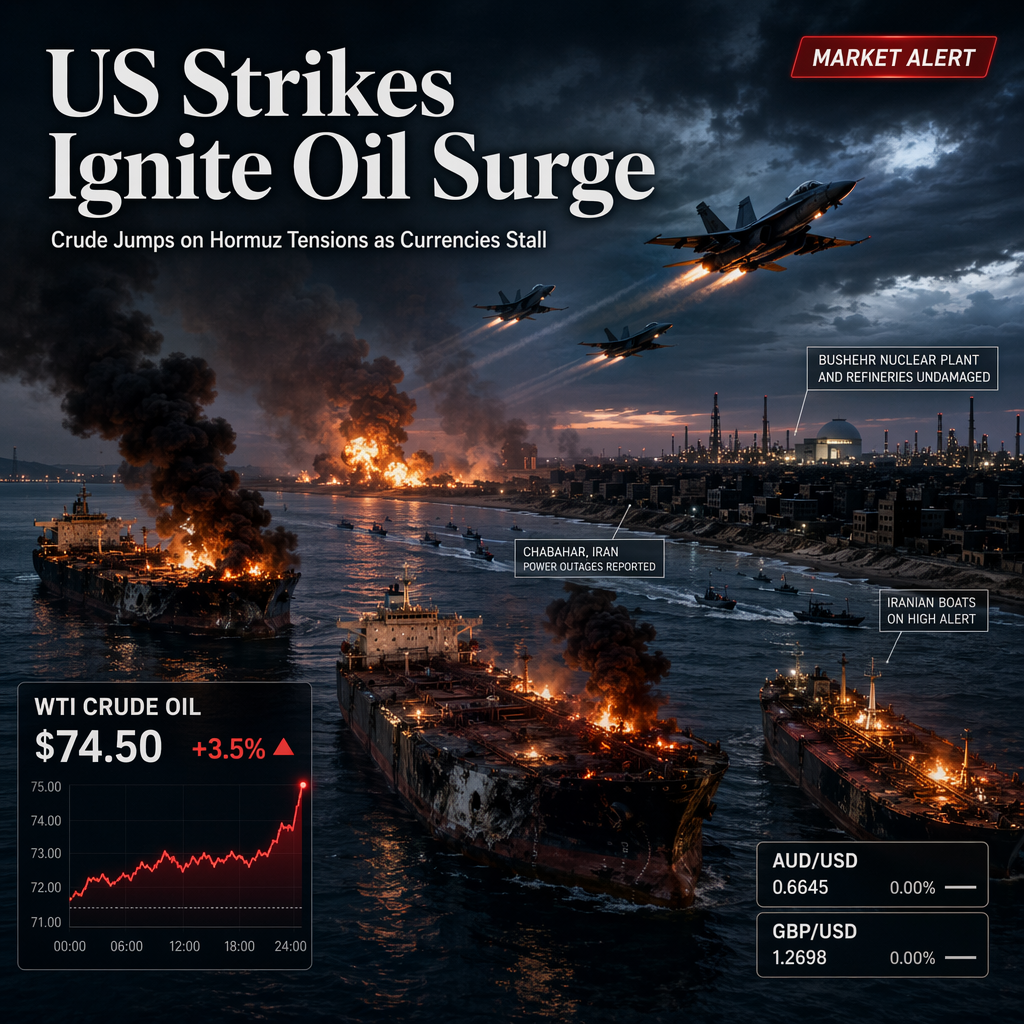
On Wednesday, the US initiated a new series of strikes on Iranian military targets in and around the Strait of Hormuz, with President Trump declaring the Versailles agreement over while allowing talks to continue. Tehran reportedly hit three tankers between Monday and Tuesday, prompting US Central Command (CENTCOM) to respond with strikes on more than 80 targets, including air defenses, coastal radar, anti-ship missile batteries, and over 60 Revolutionary Guard small boats. Explosions and power cuts were reported around Chabahar and Konarak, while Iranian media claimed the Bushehr nuclear plant was undamaged and threatened retaliation against US bases in the region [3]. The revocation of the US sanctions waiver on Iranian oil exports requires permitted transactions to wind down by July 17, effectively removing legal Iranian barrels from the market as the British Navy-linked maritime agency raised the strait's threat level to severe and insurers repriced hulls transiting the area [3]. West Texas Intermediate (WTI) Crude Oil traded near $74.50, up more than 3.5%, with a surge of over 6% noted in the broader market, although the rally stalled below $76.00 and remained under key moving averages [3][1][2]. OPEC+ recently lifted August output targets by 188,000 barrels per day, and hawkish Federal Reserve policy is seen as tempering demand, leading markets to price in a contained exchange rather than a full closure of the strait [3].
The currency markets reflected the geopolitical tension and central bank dynamics. AUD/USD remained flat between 0.6900 and 0.6950, showing indecision after a five-session rebound from the 200-day EMA. The Reserve Bank of Australia (RBA) held its cash rate at 4.35% in June after three hikes this year, supported by a cooling TD-MI Inflation Gauge at 3.9% YoY from 4.4%. The RBA Governor considers any inflation print with a three in front unacceptable, and rate markets previously flirted with a cash rate near 4.70% by year-end, though this has partially receded. Despite the energy shock, Australia's terms-of-trade benefit is blunted by Chinese iron ore demand, leaving the AUD in a state of paralysis [1].
GBP/USD traded just below 1.3400, up about 0.25%, leaning on the 200-day EMA after recovering from mid-June lows. The Pound's strength was driven by the imported inflation shock from the crude oil surge, which raised Bank of England (BoE) tightening expectations. Markets now fully price a 25-basis-point hike by year-end, with a November move seen as likely. The June hold at 3.75% had two dissenters favoring 4.00%. However, services inflation at 3.7%, a PMI below 50, shrinking payrolls, and cooling pay growth toward 3.4% highlight economic challenges. The BoE Governor has ruled out near-term cuts and conceded the 2% inflation target will arrive later than forecast. The FOMC minutes released Wednesday showed a committee split, with nine hikes, eight holds, and one cut in the June dot plot, keeping the US Dollar bid and limiting yield gaps for both AUD/USD and GBP/USD [2][1].
Gold traded almost 1% lower despite the missile strikes, reflecting the influence of hawkish Fed minutes and a firmer Dollar. The cross-asset reaction suggests markets are pricing a contained exchange rather than a full escalation, with crude oil's war premium returning but not reaching previous spike highs [3].
CONCLUSION
US strikes on Iran and the revocation of oil export waivers triggered a sharp rise in crude oil prices, with WTI up over 3.5% and broader market surges exceeding 6%. Currency markets, including AUD/USD and GBP/USD, showed limited directional movement, reflecting central bank stalemates and muted yield differentials. While the energy shock lifted tightening expectations for the BoE, the broader market reaction suggests anticipation of a contained conflict rather than a full-scale disruption.