
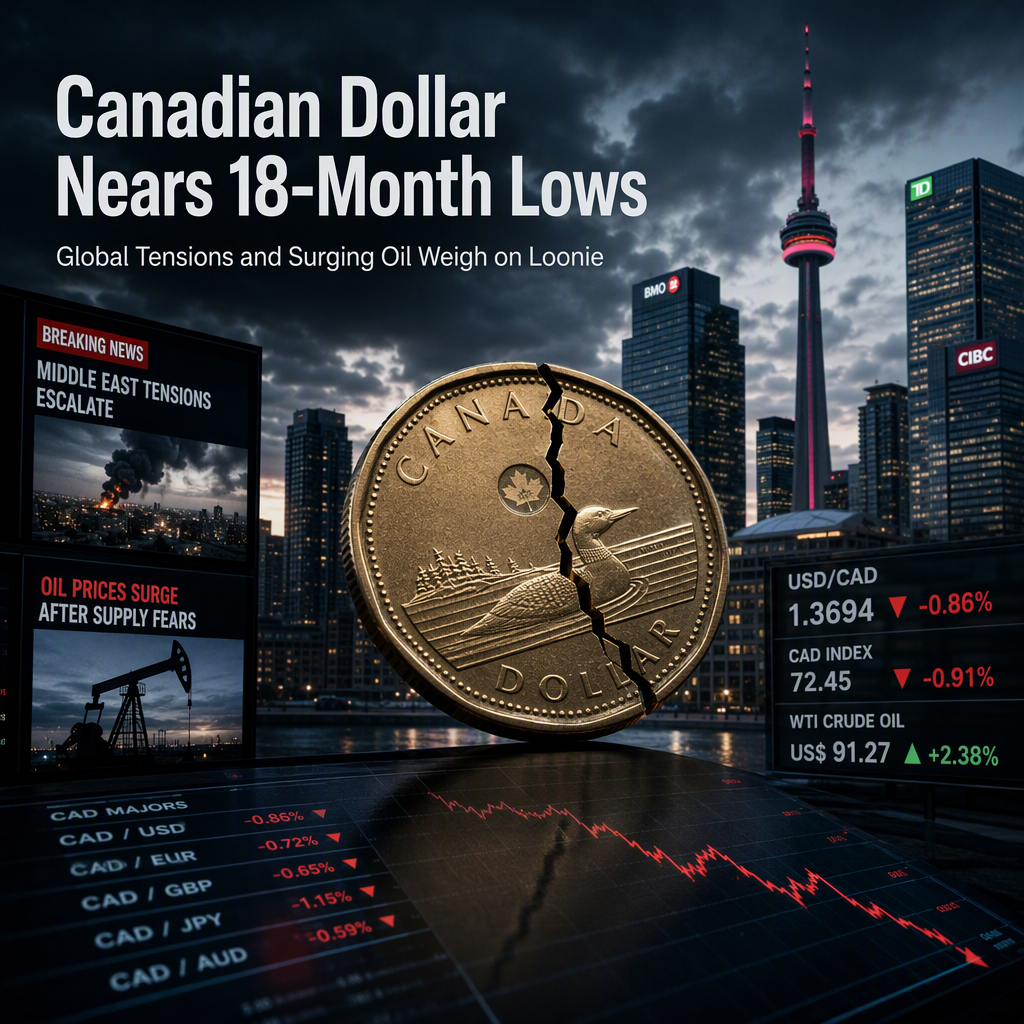
The Canadian Dollar (CAD) experienced marginal losses on Thursday, approaching 18-month lows as the US Dollar (USD) strengthened due to heightened risk aversion in global markets [1]. The USD/CAD pair traded at 1.4260 at the time of reporting, rebounding from lows near 1.4200 and nearing the 18-month high of 1.4293 [1]. This movement was driven by increased demand for the safe-haven US Dollar, as geopolitical tensions in the Middle East escalated, notably with fresh attacks from Houthi militias on Saudi Arabian airports, raising fears of further strikes on Saudi oil infrastructure [1].
Despite a rally in oil prices, which saw Brent Crude appreciate around 3.50% on the day to trade above $103.00—a three-week high—the commodity-sensitive Canadian Dollar failed to gain significant support [1]. The rise in crude prices has instead fueled expectations that central banks may need to maintain restrictive monetary policies to combat inflation, intensifying the ongoing global bond selloff [1].
In the US, the release of the Federal Reserve's September monetary policy meeting minutes reaffirmed that inflation remains a primary concern for committee members, but the impact on the US Dollar was minimal since the meeting occurred before recent softer US inflation and employment data [1]. This has led to the prevailing view that the Fed will likely keep rates unchanged at its October meeting [1].
Canadian economic data released earlier in the week was mixed. The Ivey Purchasing Managers Index (PMI) slowed to 58.2 in September from 64.3 in August, missing market expectations of 65.2, indicating a loss of momentum in the sector [1]. Conversely, Canada's international trade surplus widened significantly to CAD 4.2 billion in August from CAD 790 million in July, surpassing market expectations of a CAD 1.7 billion surplus and temporarily boosting the CAD before the gains reversed [1].
CONCLUSION
The Canadian Dollar's slide toward 18-month lows reflects a combination of global risk aversion, surging oil prices, and mixed domestic economic data. Despite a strong trade surplus, the CAD remains under pressure as investors favor the US Dollar amid geopolitical tensions and expectations of continued restrictive monetary policy. Market sentiment remains cautious, with the outlook for the CAD closely tied to evolving global and domestic developments.