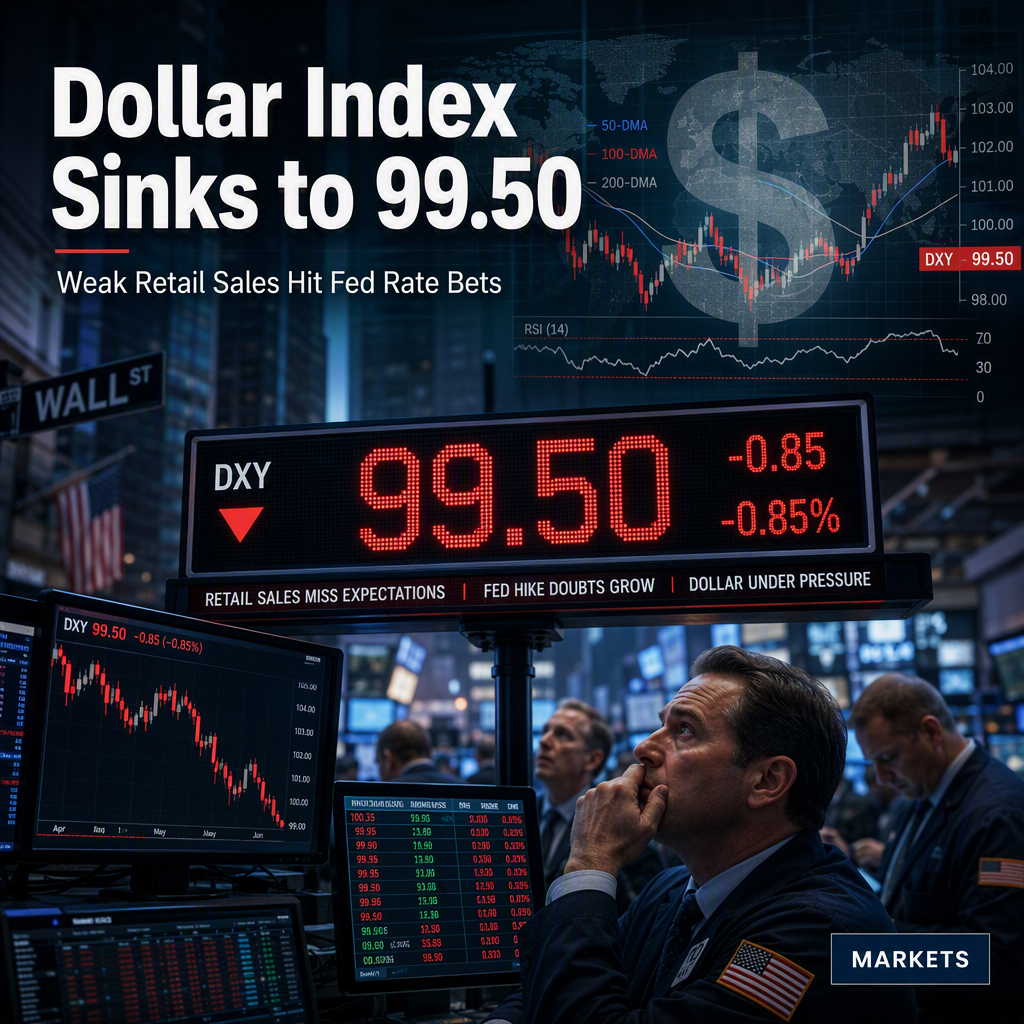
The US Dollar Index (DXY), which measures the value of the US Dollar against a basket of six major currencies, weakened to near 99.50 during Asian trading hours on Monday, reflecting a loss of momentum following disappointing US economic data [1]. Specifically, US Retail Sales declined by 0.6% in July, missing market expectations for a 0.1% increase and reversing the previous month's 0.2% gain, according to the US Census Bureau [1]. On an annual basis, Retail Sales rose 5.0% in July, down from a revised 6.8% in June [1].
This weaker-than-expected retail sales data, combined with softer Consumer Price Index (CPI) and Producer Price Index (PPI) inflation figures from the prior week, has led traders to scale back expectations for a Federal Reserve rate hike at the upcoming September 15-16 policy meeting [1]. The CME FedWatch tool now indicates only a 31% probability of a September rate increase, with a 69% chance of a hike by December [1]. BNY analysts noted that 'softer U.S. data over recent weeks has reduced rate hike expectations, with less than one full hike now priced for December,' while also highlighting that the back end of the Treasury curve remains elevated, possibly due to credibility concerns [1].
Strategists at Scotiabank observed that the Dollar's mid-week rebound after the CPI data release quickly lost steam following the PPI report, with markets resuming a broad short USD trade amid fading expectations of a September Fed rate hike [1]. This shift reflects growing investor conviction that the Fed is unlikely to tighten policy again in the near term [1].
From a technical perspective, the DXY remains capped below the 100-day simple moving average (SMA) at 99.75 and the Bollinger Bands' 20-period midline at 100.35, with the upper band at 101.80 serving as a more distant resistance level [1]. The 14-day Relative Strength Index (RSI) reading around 37 reinforces the weak tone, suggesting continued downside pressure as long as the index remains below these technical ceilings [1].
Additionally, traders are monitoring geopolitical developments, particularly the US conflict with Iran and the status of the Strait of Hormuz. Iran's Foreign Minister Abbas Araghchi stated that there are currently no negotiations between Tehran and Washington, and that the US must agree to Iran's conditions for shipping to resume through the waterway [1].
CONCLUSION
The US Dollar Index's decline to near 99.50 reflects market disappointment over weaker US retail sales and inflation data, which have significantly reduced expectations for a near-term Fed rate hike. Technical indicators and analyst commentary suggest continued downside pressure on the dollar, with traders now focused on both economic data and geopolitical risks.