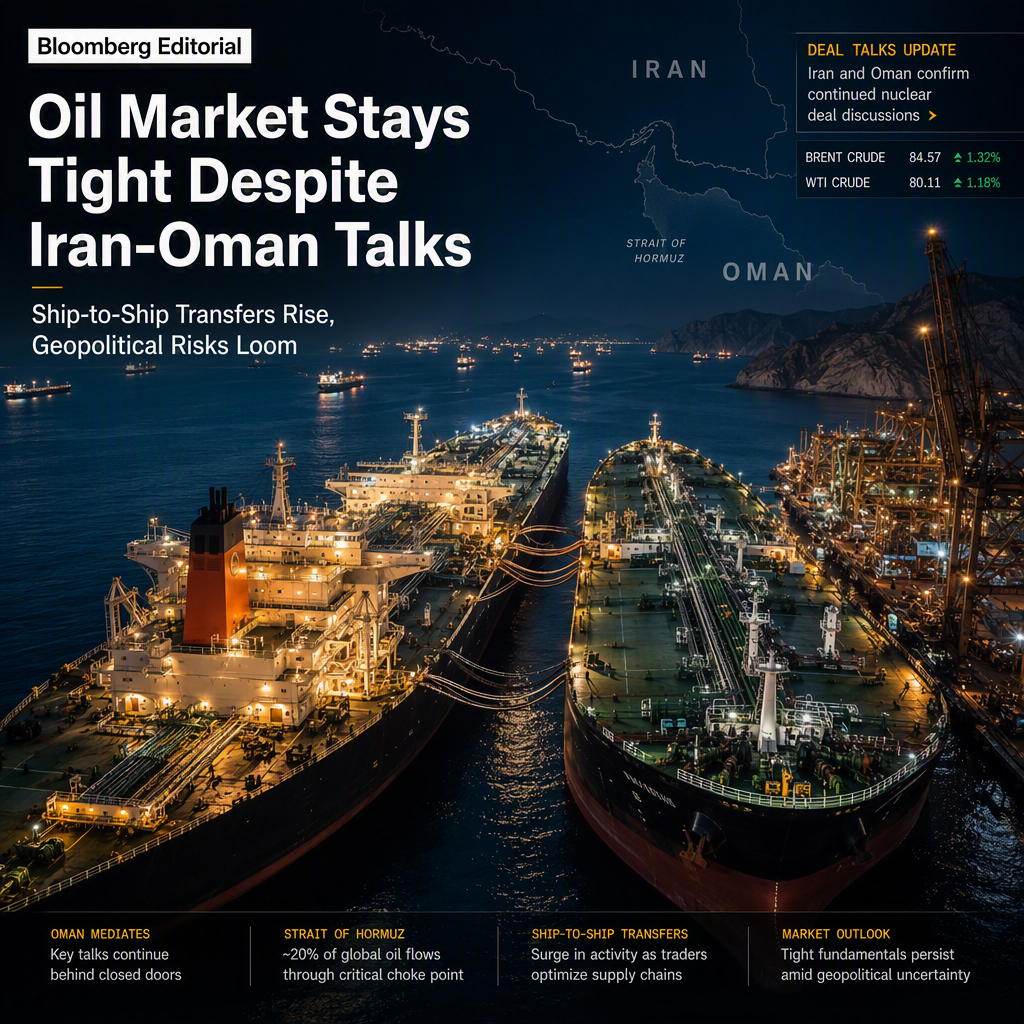
TD Securities’ commodity strategists Ryan McKay and Bart Melek report that recent headlines regarding potential deals involving Iran and Oman are influencing energy markets, but they emphasize that crude oil fundamentals remain tight [1]. The strategists note an increase in ship-to-ship transfers via the Omani route, with flows potentially rising to 7-8 million barrels per day (b/d) compared to the previous 5-6 million b/d range [1]. Despite this increase, when combined with Fujairah flows and declining Yanbu flows, total regional flow is still only at 50% of pre-war volumes, which has been the norm since the memorandum of understanding (MoU) [1].
The analysts highlight that talks between Iran and Oman on a Hormuz route indicate Iranian control and a shift away from the US-backed Southern corridor. They also mention that renewed discussions about returning to the MoU suggest Iran is seeking US concessions upfront, such as unfreezing funds, after previous failures to follow through [1].
TD Securities asserts that these developments are not fundamentally bearish for crude oil markets, as it is unlikely that any deal would significantly increase flows beyond what is already being leaked out [1]. The fundamental balance in the oil market remains extremely tight at current levels, and any increased flow is likely to be absorbed by Chinese demand, resulting in little change to the overall supply-demand balance [1].
The strategists also warn that increased leakage could both ease prices and provoke Iranian aggression, adding a layer of geopolitical risk to the market outlook [1].
CONCLUSION
Despite increased ship-to-ship transfers and ongoing Iran-Oman deal talks, crude oil fundamentals remain tight, with regional flows still at only 50% of pre-war levels. TD Securities suggests that any additional supply is likely to be offset by demand, particularly from China, resulting in minimal impact on the overall market balance.