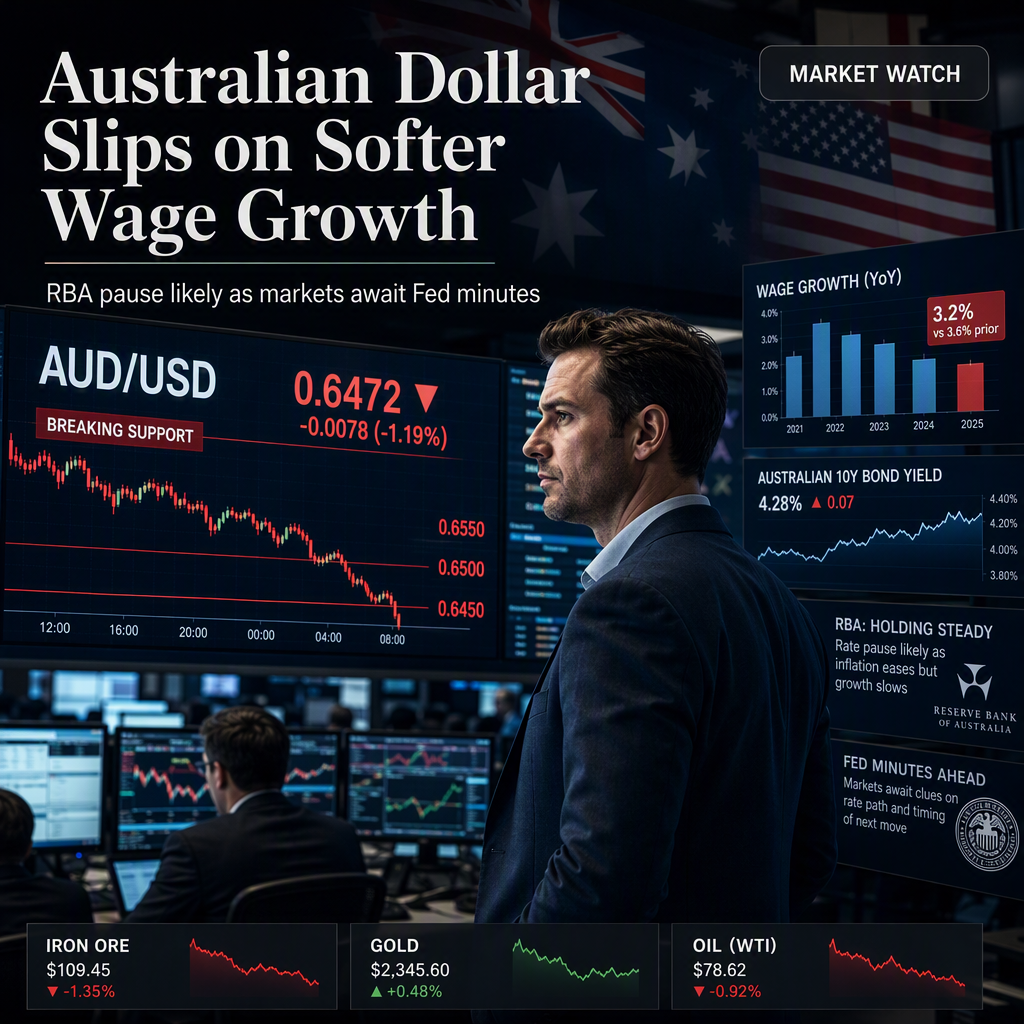
The Australian Dollar (AUD) has rebounded slightly from intra-week lows against the US Dollar (USD) on Friday, but remains weighed down by risk aversion and subdued wage growth, with the AUD/USD pair struggling to reclaim previous support above 0.7080 after finding support at 0.7065 earlier in the day [1]. Brown Brothers Harriman’s Elias Haddad notes that the AUD is underperforming across the board, with Australian bond yields falling after Q2 wage growth matched consensus expectations, rising 0.8% quarter-on-quarter for a third straight quarter to 3.2% year-on-year, compared to 3.2% in Q1 [3]. This annual wage growth was softer than the Reserve Bank of Australia’s (RBA) projection of 3.3%, and private sector wage gains eased to a four-year low at 3.1% year-on-year, while public sector wage growth held at 3.4% year-on-year for a second consecutive quarter [3].
RBA cash rate futures continue to imply 60% odds of one final 25 basis point hike by year end to 4.60%, but Haddad argues that the risk is skewed towards a more extended pause in the RBA tightening cycle because policy is already somewhat restrictive [1][3]. Despite these headwinds, dips in the AUD are likely to remain limited due to Australia’s attractive carry and strategic exposure to commodities linked to energy, AI, and defense, which remain key AUD tailwinds [1][3].
Meanwhile, the US Dollar is facing selling pressure as traders scale back Federal Reserve (Fed) interest rate hike bets due to weak US economic data for August [2]. The US Dollar Index (DXY) trades 0.26% lower to near 99.38, close to its two-month low of 99.29 posted on Monday [2]. Analysts at ING highlight that the focus is on the release of the minutes from July’s Federal Open Market Committee (FOMC) meeting, noting that the 12-member FOMC is suspected to be less hawkish than participants whose projections delivered forecasts of a 9:9 split for a hike in the June Dot Plots [1][2]. ING expects that while there may be a few hawkish references in the minutes that could nudge the Dollar and short-dated rates a little firmer, they do not see the minutes as a game changer [1][2]. Instead, ING suggests that upcoming CPI and jobs data, as well as the Jackson Hole symposium, will have a bigger influence on whether the Fed hikes in September, reiterating their base case that it does not, and the Dollar softens a little [1].
The AUD remains pressured by uncertainty surrounding the Middle East conflict and higher oil prices, while the steady growth of the Q2 Wage Price Index has eased pressure on the RBA to hike rates immediately, providing an additional bearish impulse to the currency [1].
CONCLUSION
Softer wage growth in Australia has reinforced expectations that the RBA will remain sidelined, with futures pricing only a 60% chance of one final rate hike by year end. The AUD is underperforming amid risk aversion and subdued wage data, while anticipation of the Fed minutes and weak US economic data are weighing on the US Dollar. Market participants are likely to focus on upcoming economic releases and central bank signals for further direction.