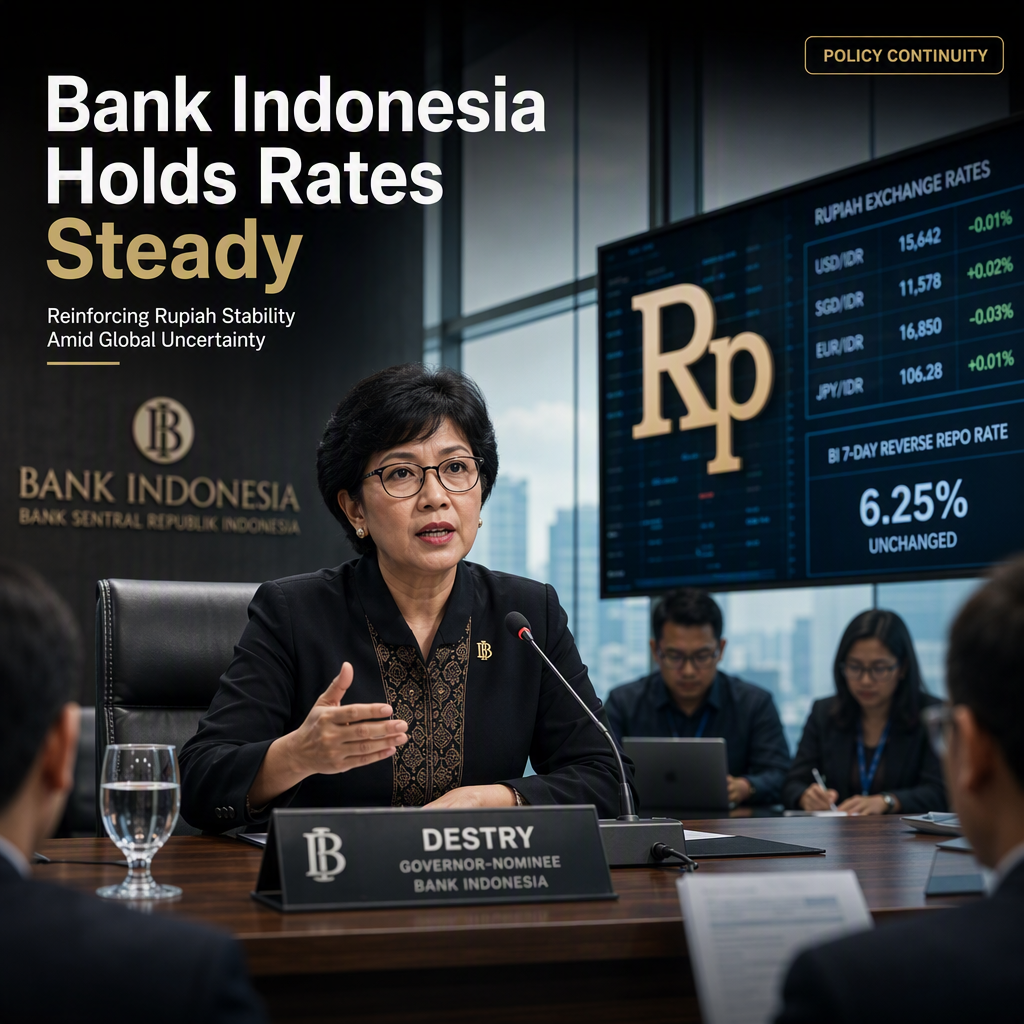
Bank Indonesia (BI) maintained its benchmark BI rate at 5.75%, with deposit and lending facility rates also left unchanged at 4.75% and 6.50% respectively, according to Societe Generale analysts Galvin Chia and Kunal Kundu [1]. This decision, which was in line with market expectations, was delivered by Governor-nominee Destry in her first policy meeting and signaled a strong commitment to policy continuity [1]. The analysts noted that the steady outcome, following a period marked by negative policy surprises, was viewed as an incremental positive by markets, especially after the recent Presidential budget speech [1].
Societe Generale described the policy hold as marginally positive for Indonesian rupiah (IDR) foreign exchange and yields, reinforcing BI’s commitment to rupiah stability and keeping inflation anchored within the 2.5% ±1% target range [1]. The central bank’s approach also allows for complementary liquidity and macroprudential measures to support credit and economic growth [1].
However, the analysts highlighted that BI’s decision underscores a policy bind, as the fragile rupiah and ongoing external uncertainty limit the central bank’s ability to provide further monetary support to the domestic economy [1]. They cautioned that if currency pressures persist or food inflation rises during the dry season, BI may be compelled to tighten policy further, even at the expense of economic growth [1].
Overall, the market reaction to the rate hold was positive, with the decision seen as consistent with BI’s ongoing strategy to protect the rupiah, maintain inflation within target, and balance external financial conditions against domestic growth priorities [1].
CONCLUSION
Bank Indonesia’s decision to hold rates steady was well received by markets, supporting the rupiah and reinforcing inflation control. However, the central bank remains constrained by external risks and a fragile currency, which could necessitate future tightening if pressures persist.