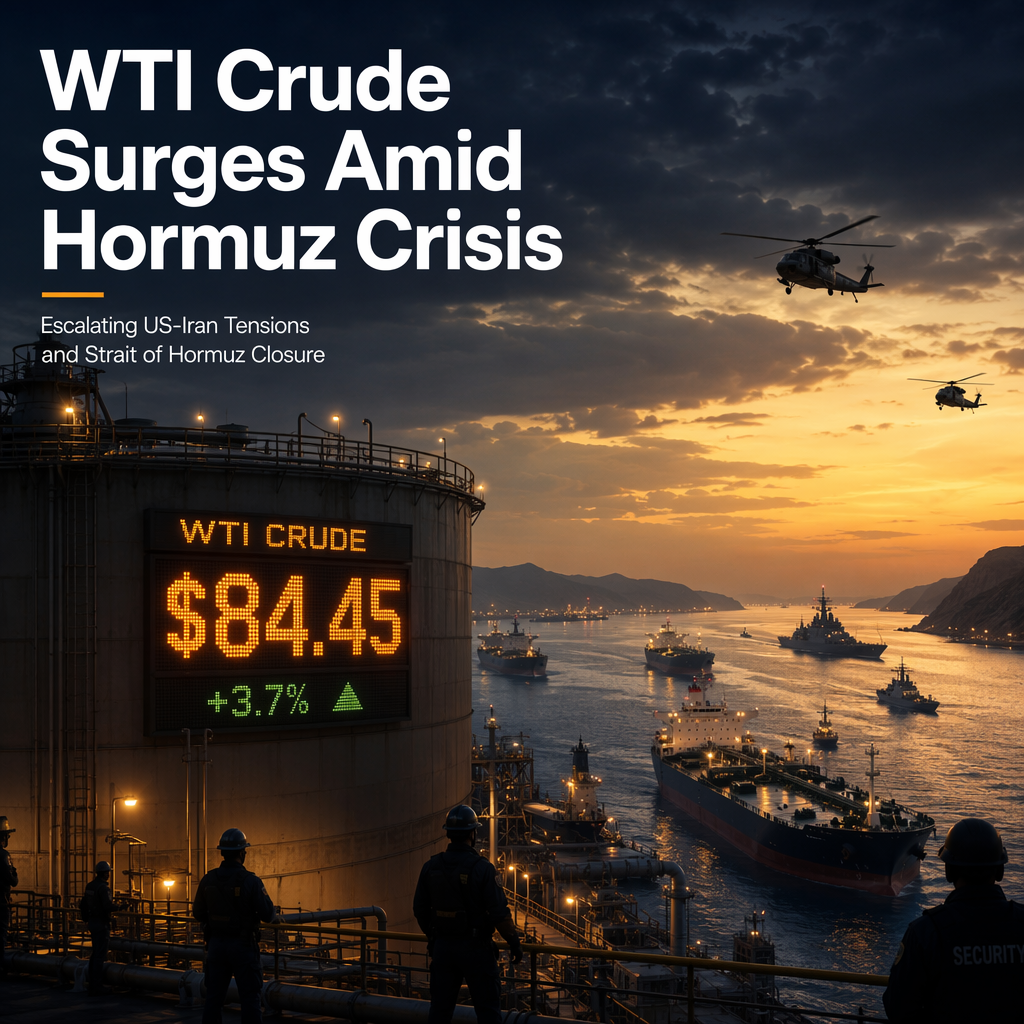
West Texas Intermediate (WTI), the benchmark US crude oil price, began the week on a strong note, reaching a fresh high since June 12 in the $84.40-$84.45 range during the Asian session. This upward momentum is attributed to escalating tensions between the US and Iran, as well as the closure of the Strait of Hormuz, which have supported the ongoing recovery from a multi-month low seen earlier in July [1].
From a technical standpoint, last week's breakout above the 200-period Simple Moving Average (SMA) on the 4-hour chart and a move past the 38.2% Fibonacci retracement level of the May-July decline have reinforced bullish sentiment. Momentum indicators such as the Relative Strength Index (RSI), which is currently in overbought territory near 76, and the Moving Average Convergence Divergence (MACD), which remains positive, suggest that upward pressure on WTI persists despite stretched conditions [1].
Looking ahead, further gains toward the 50.0% retracement level near $85.84 are considered possible, with a sustained break above this level potentially opening the way to the 61.8% Fibonacci retracement at $90.28, and higher targets at $96.59 and $104.64. On the downside, initial support is seen at the 38.2% retracement at $81.40, with deeper pullbacks targeting the 23.6% retracement at $75.91 and the 200-period SMA at $76.97. The cycle low near $67.04 is identified as a more distant structural floor [1].
No specific analyst opinions or forward-looking statements beyond technical projections are provided in the article. The market reaction is characterized by bullish control and constructive technical momentum, driven by geopolitical risks and supply concerns [1].
CONCLUSION
WTI crude oil prices have surged to a one-month high, fueled by geopolitical tensions and technical bullish signals. The market remains focused on potential further gains, with key resistance and support levels outlined. The current environment suggests heightened volatility and strong upward momentum for WTI in the near term.