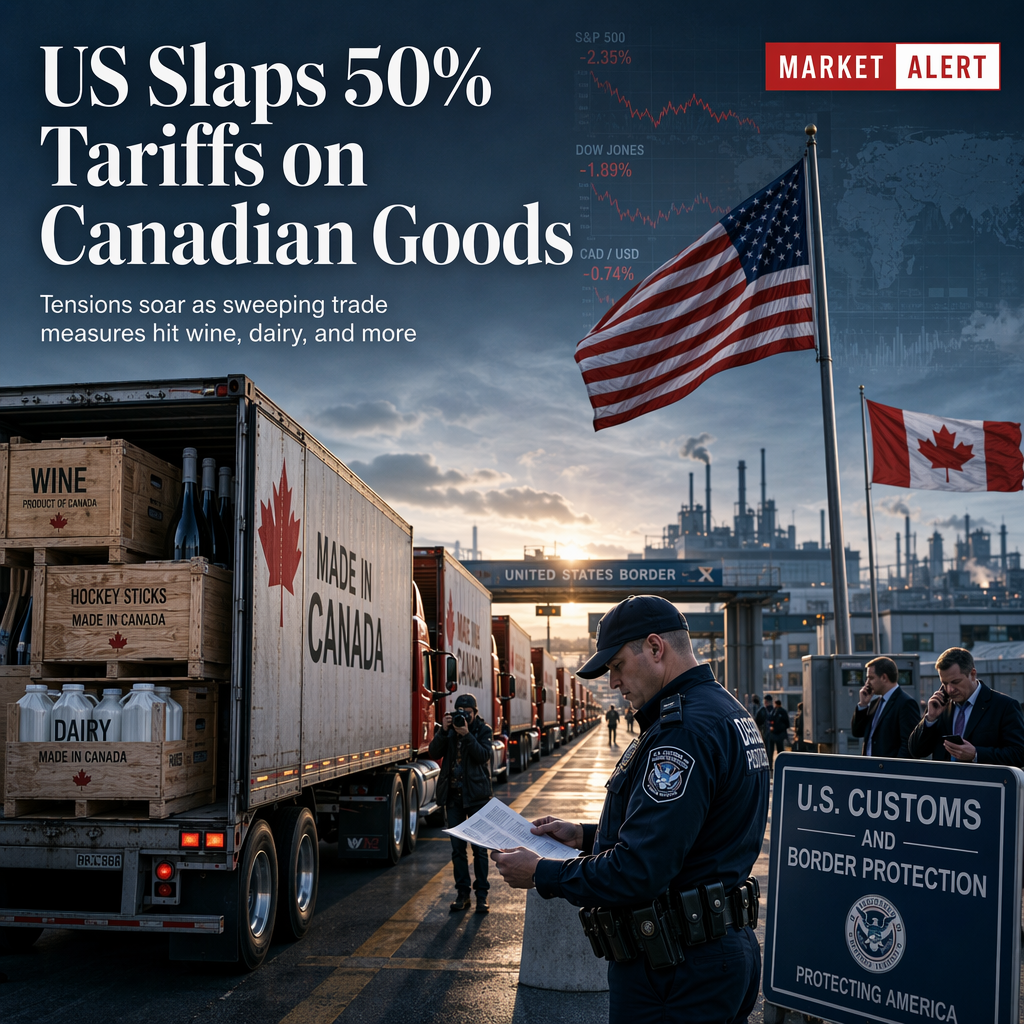
US President Donald Trump has announced the imposition of a 50% tariff on a wide range of Canadian products, citing what the White House describes as Canada's 'discriminatory treatment' of US cars, alcohol, and dairy products [1][2]. Trump signed three separate proclamations on Monday, each targeting different sets of Canadian imports, including items such as wine, hockey sticks, and cement [2]. The tariffs are being enacted under Section 338 of the Tariff Act of 1930, a rarely used provision that allows for tariffs of up to 50% on imports from countries deemed to be discriminating against the US [1][2].
The new tariffs will take effect on August 19, 2026, which is 30 days after the signing, and will apply regardless of whether the goods qualify under the US-Mexico-Canada Agreement (USMCA) [1][2]. However, certain categories such as energy, potash, fish, critical minerals, and products already covered by Section 232 tariffs are exempt from these new duties [1]. The Trump administration has stated that these measures are a direct response to perceived unfair treatment by Canada in the areas of motor vehicles, alcohol, and dairy [2].
Canadian Prime Minister Mark Carney responded by stating that Canada is prepared to intensify talks following the US announcement, which Ottawa claims breaches the existing trade agreement [1]. Ontario Premier Doug Ford called for Canada to respond 'tariff for tariff, dollar for dollar' if the US duties proceed [2]. The Canadian Embassy in Washington did not immediately comment on the new US trade actions [2].
The market reacted to the news, with the USD/CAD currency pair rising 0.38% on the day to 1.4075 at the time of reporting [1]. The Trump administration has also indicated a broader tariff-focused agenda, with recent statements about not renewing the USMCA and triggering annual reviews, further increasing uncertainty in US-Canada trade relations [2].
While President Trump recently linked Canadian wildfires to economic harm in the US, a senior official clarified that the newly announced 50% tariffs are not related to the wildfires, though Trump has requested options regarding that issue [2].
CONCLUSION
The Trump administration's decision to impose 50% tariffs on a broad range of Canadian goods marks a significant escalation in US-Canada trade tensions, with immediate market reaction seen in the strengthening USD/CAD pair. Both governments have signaled readiness for further negotiations or retaliatory measures, suggesting ongoing volatility and uncertainty in North American trade relations.