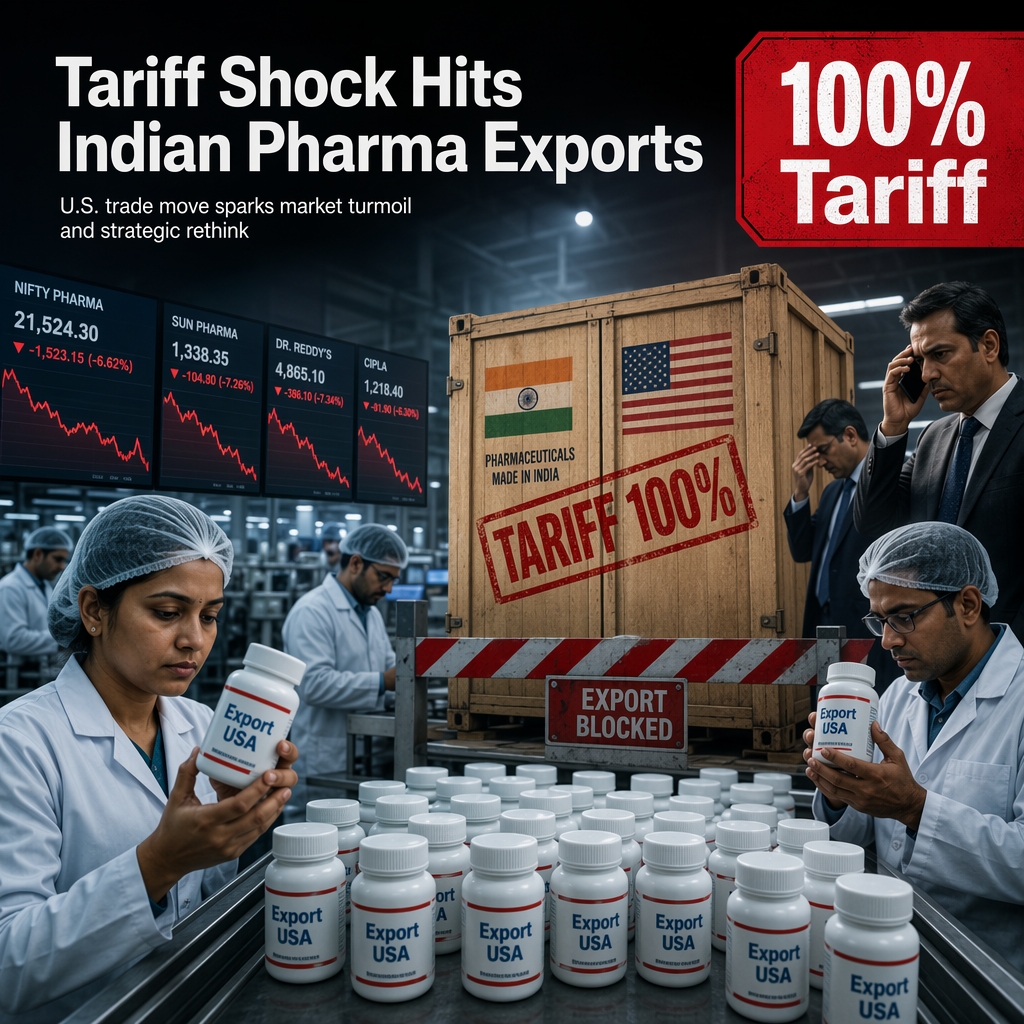
The U.S. government's decision to impose a 100% tariff on generic drug imports from 2028 poses a significant threat to India's pharmaceutical industry, which relies heavily on the American market for its exports [1]. In 2025, the U.S. accounted for approximately 37% of India's nearly $26 billion in pharmaceutical exports, according to estimates from the Global Trade Research Initiative [1].
The announcement of the proposed tariff has caused shares of several leading Indian drugmakers to decline, reflecting investor concerns about the immense investment and operational challenges required to shift production to the United States [1]. Market analysts have described the potential relocation of manufacturing as a 'gargantuan task,' citing regulatory, logistical, and cost hurdles [1].
Analysts warn that the tariff could force Indian pharmaceutical companies to pivot towards more complex and higher-value medicines or biosimilars, as the traditional generic drug export model becomes less viable due to the new trade barriers [1]. The development is expected to accelerate efforts among Indian firms to diversify both their product portfolios and geographic markets [1].
Despite these potential strategic shifts, immediate market sentiment remains cautious and negative, with analysts highlighting risks to revenue growth and profit margins if the tariff is implemented as proposed [1]. An analyst from a Mumbai-based brokerage stated, 'Indian pharmaceutical companies will need to rethink their U.S. strategies, either by investing in local production or by moving up the value chain. The days of easy gains from generic exports may be numbered if these tariffs come into force' [1]. No technical chart data or specific trading advice was provided in the article [1].
CONCLUSION
The proposed 100% U.S. tariff on generic drug imports has created significant uncertainty for India's pharmaceutical sector, leading to a negative market reaction and concerns over future revenue and profit margins. Indian drugmakers may need to adapt by investing in U.S. production or shifting towards higher-value products, but the immediate outlook remains cautious pending further details on tariff implementation.