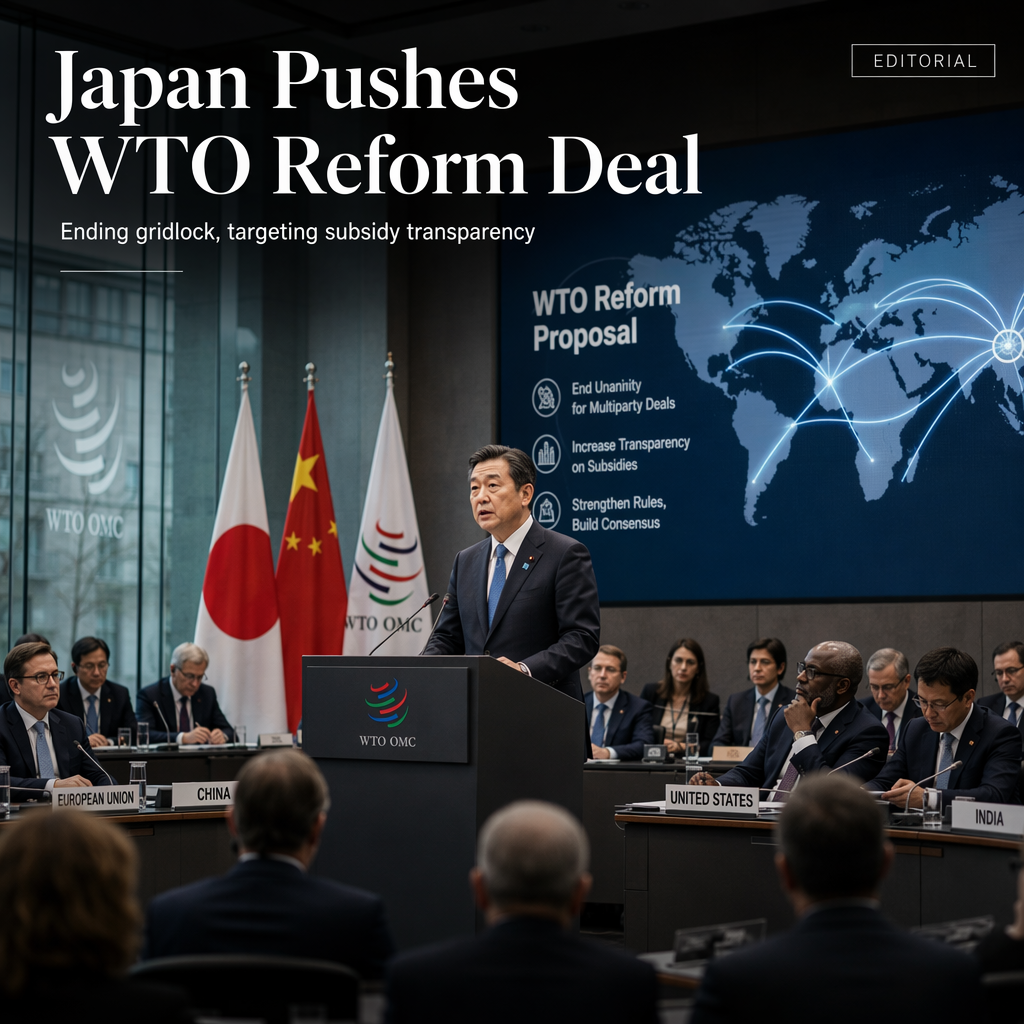
Japan has submitted a set of reform proposals to the World Trade Organization (WTO) aimed at changing the organization's unanimous decision-making process for certain multiparty agreements, in an effort to address the WTO's current dysfunction and longstanding negotiation gridlocks [1]. The proposals, which Japan hopes will be adopted by 2028, would allow groups of countries to reach agreements without requiring consensus from all WTO members [1].
Another key aspect of the reform package is the regulation of opaque government subsidies, with a particular focus on concerns related to China's trade practices [1]. By increasing transparency and regulating such subsidies, Japan seeks to promote fairer competition in global markets and reduce distortions caused by state intervention [1].
These reforms are being proposed as the WTO faces criticism for its inability to resolve major disputes and adapt to rapidly changing global trade dynamics [1]. The article does not provide any financial market analysis, price levels, or technical indicators, nor does it mention specific market reactions or analyst opinions [1].
CONCLUSION
Japan's proposed reforms to the WTO aim to address decision-making gridlocks and increase transparency around government subsidies, with a particular focus on China's practices. While the proposals could have significant implications for global trade governance, the article does not discuss immediate market reactions or analyst perspectives.