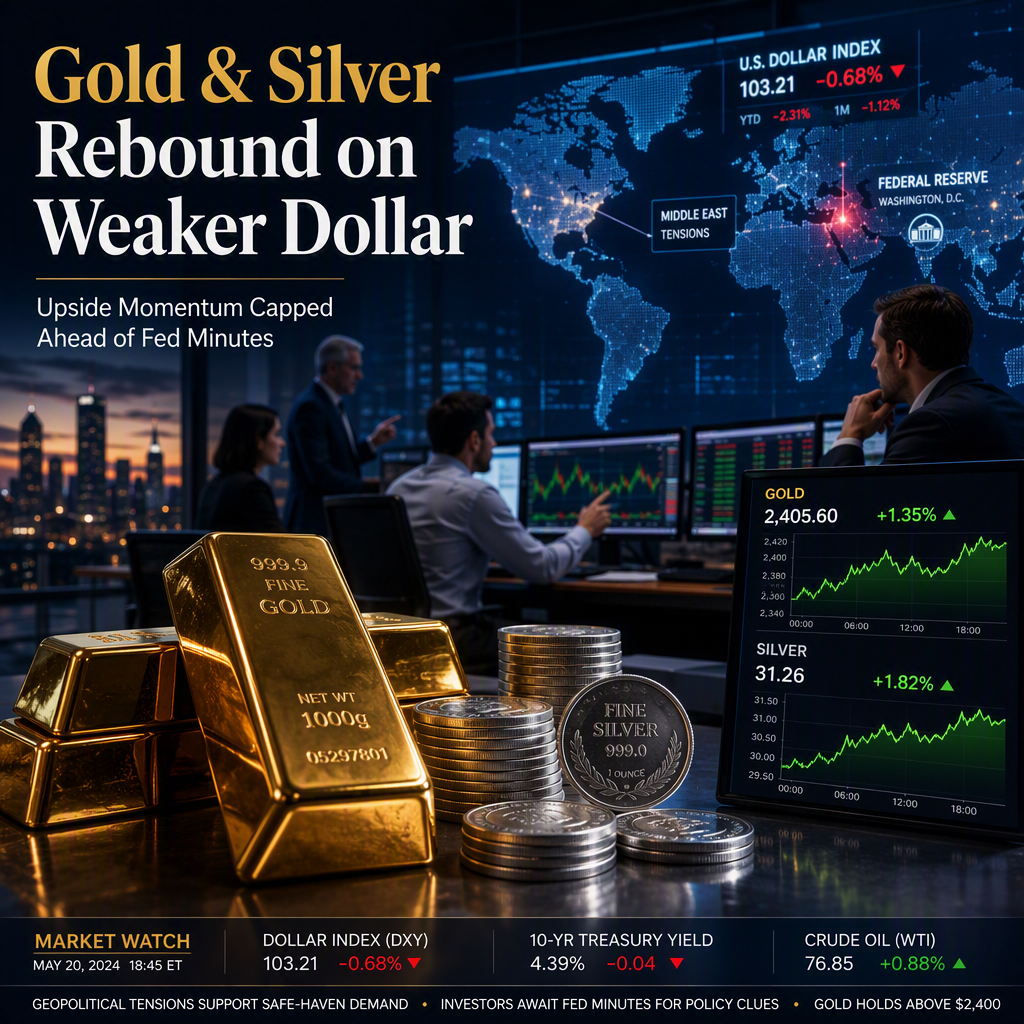
Gold (XAU/USD) rebounded to the $4,370 area on Wednesday, trading at $4,367 according to [1] and $4,371, up 0.90% on the day, according to [3]. This recovery follows a nearly 2% drop on Tuesday [3], with buyers stepping in near the $4,300 area [1]. The rebound was supported by broad-based US Dollar weakness and a modest pullback in long-term US Treasury yields ahead of the release of the Federal Reserve's July monetary policy meeting minutes [1][3]. The US Dollar Index (DXY) traded around 99.37, down 0.30% on the day [3].
Analysts at OCBC noted that gold's rebound has lost momentum due to renewed rises in oil prices and higher long-end US yields, which have curbed the metal's advance [1]. OCBC experts suggest that for gold's rally to regain traction, oil and yields need to stabilize or investment demand must pick up [1]. Antreas Themistokleous of Exness highlighted that softer US economic data has lowered the probability of additional Fed tightening, easing a major headwind for gold, while central-bank buying, particularly from China, and concerns over US government debt are also supportive factors [3]. However, the energy shock from the Middle East conflict keeps inflation risks elevated, supporting expectations that the Fed may eventually need to raise rates, which caps gold's upside [3].
Technical analysis from both sources points to fading bullish momentum. Tuesday's bearish engulfing candle is seen as a bearish sign, with momentum indicators such as RSI and MACD showing waning impetus [1]. Gold trades just below the 100-day SMA at $4,381, with resistance at $4,450 and $4,510, and support at $4,311 and $4,220 [1][3].
Silver (XAG/USD) also stabilized, trading at $63.45, up 0.16% on the day [2]. The metal attempted to recover after an intraday low of $62.19, but remains under pressure due to inflationary risks and elevated US Treasury yields [2]. Disruptions in the Middle East, particularly the expiration of the US-Iran Memorandum of Understanding and tensions in the Strait of Hormuz, have reinforced concerns about inflation and complicated the Fed's policy outlook [2]. The probability of a September Fed rate hike has dropped to 32%, according to the CME FedWatch tool, limiting downside for precious metals [2][3].
Technical analysis for silver shows resistance at $63.50, $64.65, and $64.74, with support at $62.60 and $61.00. The RSI at 44.51 suggests recovery attempts could remain limited [2]. Both gold and silver markets await the FOMC July meeting minutes for further direction, as analysts at ING see the release as a key catalyst for short-term moves [3].
CONCLUSION
Gold and silver prices have rebounded on US Dollar weakness and softer US economic data, but upside momentum is fading due to elevated yields and inflation risks from the Middle East. The probability of a September Fed rate hike has dropped, supporting precious metals, yet technical signals and analyst commentary suggest near-term gains may be capped. The release of the FOMC minutes is expected to provide the next major catalyst for market direction.