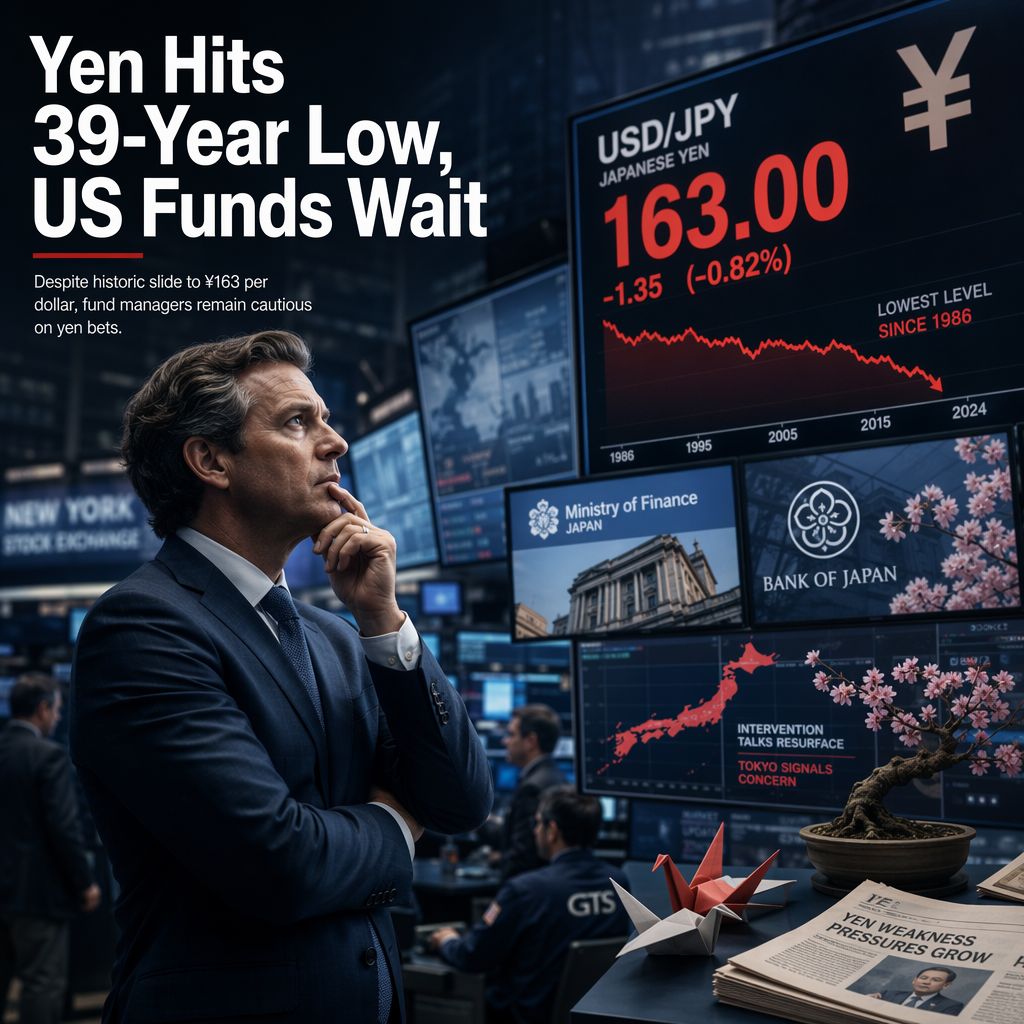
The Japanese yen reached a 39-year low against the U.S. dollar on July 22, falling to 163 per dollar, a level that many U.S. institutional investors and fund managers consider 'significantly undervalued' [1]. Despite this consensus on undervaluation, these investors remain hesitant to buy the yen, citing unclear signals and lack of concrete policy action from Japanese officials as the primary reasons for their reluctance [1]. The uncertainty surrounding potential intervention or support measures from Japan's policymakers, particularly the Ministry of Finance and the Bank of Japan, has kept major U.S. funds on the sidelines [1].
The yen's depreciation has been driven by a combination of domestic monetary policy choices and ongoing global geopolitical tensions [1]. The interest rate differential between Japan and the U.S. has further fueled the yen carry trade, exacerbating the currency's weakness [1]. Market analysis identifies technical support for the yen near the 165 per dollar level, with strategists warning that a break below this threshold could lead to further depreciation unless Japanese authorities intervene [1].
Traders and analysts are closely monitoring statements and actions from the Ministry of Finance and the Bank of Japan for any indications of direct market intervention [1]. Until such signals are provided, market sentiment remains cautious, and most U.S. institutional investors are refraining from taking large positions in the yen, despite its apparent undervaluation [1].
CONCLUSION
The yen's slide to a 39-year low has not yet prompted significant buying interest from U.S. fund managers, who are waiting for clearer policy signals from Japanese authorities. Market sentiment remains cautious, with the potential for further yen depreciation if intervention does not materialize.