
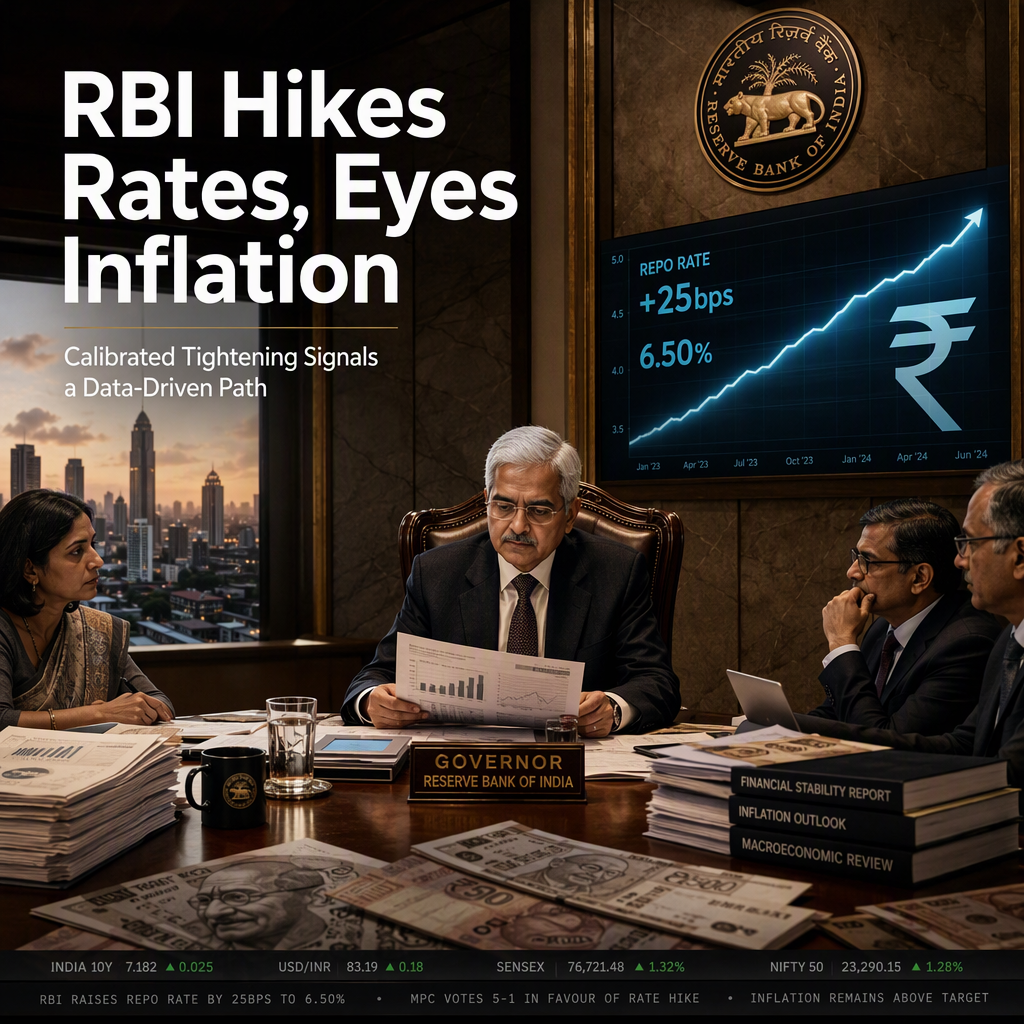
The Reserve Bank of India (RBI) has resumed its monetary tightening cycle, raising the repo rate by 25 basis points to 5.50%, marking its first rate hike in nearly four years [1]. The decision was made unanimously, with the central bank also shifting its policy stance from neutral to 'calibrated tightening' by a 4-2 vote [1]. According to Commerzbank’s Charlie Lay, the move is pre-emptive, aimed at containing rising inflation expectations amid resilient economic growth [1].
The RBI noted that while demand-side inflation pressures remain limited, there are signs of rising inflation expectations and broader price pressures, particularly due to higher food and energy costs [1]. The central bank emphasized that the new stance does not imply a predetermined sequence of hikes, but rather a data-dependent approach, with the next move potentially being either a hike or a pause [1]. Rate cuts have been ruled out in the near term [1].
In its updated outlook, the RBI raised its FY2026-27 Consumer Price Index (CPI) inflation forecast to 5.2% from 5.0%, projecting inflation to reach 6.0% in Q4 2026, which is at the upper end of the RBI’s 2-6% target range [1]. The policy shift is seen as marginally supportive for the Indian Rupee (INR), as higher rates and the prospect of further tightening enhance India's relative carry and demonstrate the RBI's commitment to containing inflation [1].
Despite the rate hike, the USD/INR exchange rate rose around 0.4% to 96.78 following the decision, as the 25bp increase was largely anticipated by the market and the policy guidance was not more aggressive than expected [1]. Lay notes that oil prices, US yields, the US Dollar, and portfolio flows will remain the key near-term drivers for the INR [1].
CONCLUSION
The RBI's pre-emptive 25bp rate hike and shift to a calibrated tightening stance signal a more hawkish approach to inflation, though future moves will be data-dependent. While the policy is marginally supportive for the INR, market reaction was muted as the hike was widely expected. Key external factors such as oil prices and US yields are likely to continue influencing the currency's direction.