
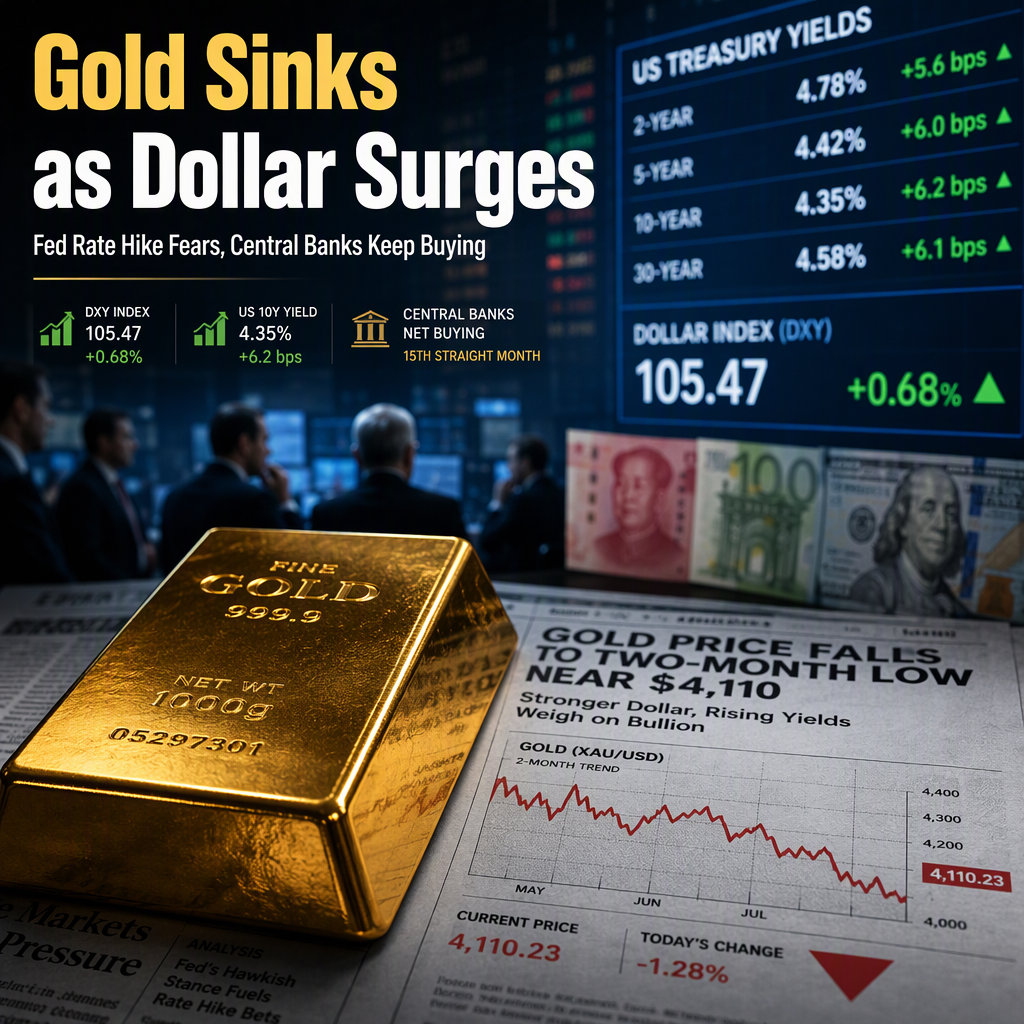
Gold prices (XAU/USD) fell to a near two-month low around $4,110 during the early Asian session on Thursday, pressured by a stronger US Dollar and elevated US Treasury bond yields, which reduced the appeal of the non-yielding metal [1]. The benchmark US Treasury yields are trading near their highest levels since 2002, and the greenback's strength has made USD-denominated gold more expensive for holders of other currencies [1]. Additionally, a spike in oil prices has reignited concerns over inflation and the prospect of higher interest rates [1].
According to the Minutes from the last Federal Reserve meeting, policymakers were united in supporting the September rate hike, and most officials assessed that another hike would be appropriate by year-end [1]. Markets are largely expecting the US central bank to keep interest rates on hold at its October policy meeting, but are still pricing in a 78.3% probability of a December increase, according to CME's FedWatch tool [1]. Peter Grant, vice president and senior metals strategist at Zaner Metals, stated, "I think the message is rates are going to continue to be higher for longer, and that's keeping yields and the dollar underpinned" [1].
Despite the heavy selling pressure from CTAs (Commodity Trading Advisors), with gold, silver, and platinum all under pressure, TD Securities notes that ETF accumulation continues and the People's Bank of China (PBoC) reported a 23rd consecutive month of central bank gold buying, with another 23 tonnes purchased in September [1]. TD Securities argues that discretionary traders, ETFs, and central banks are providing a strong floor for gold, driven by factors such as geopolitical risk, fiscal concern, Dollar debasement, de-dollarization, and stagflation concerns [1]. The bank expects the appetite for gold to be persistent and ultimately hold firm even in the face of surging real rates, and sees the stage being set for gold to disconnect from real rates and begin a new bull run into 2027 [1].
Federal Reserve's Schmid delivered a notably hawkish tone, emphasizing that inflation is "frustrating" and "must be fixed," and flagged AI as one of the largest drivers of inflation, signaling the possibility of more short-rate tightening [1].
CONCLUSION
Gold prices have come under significant pressure due to a stronger US Dollar, rising Treasury yields, and expectations of further Fed rate hikes. However, ongoing ETF inflows and sustained central bank buying, particularly by the PBoC, are providing support for gold. Market sentiment remains cautious, with the potential for a future gold rally if long-term supportive factors persist.