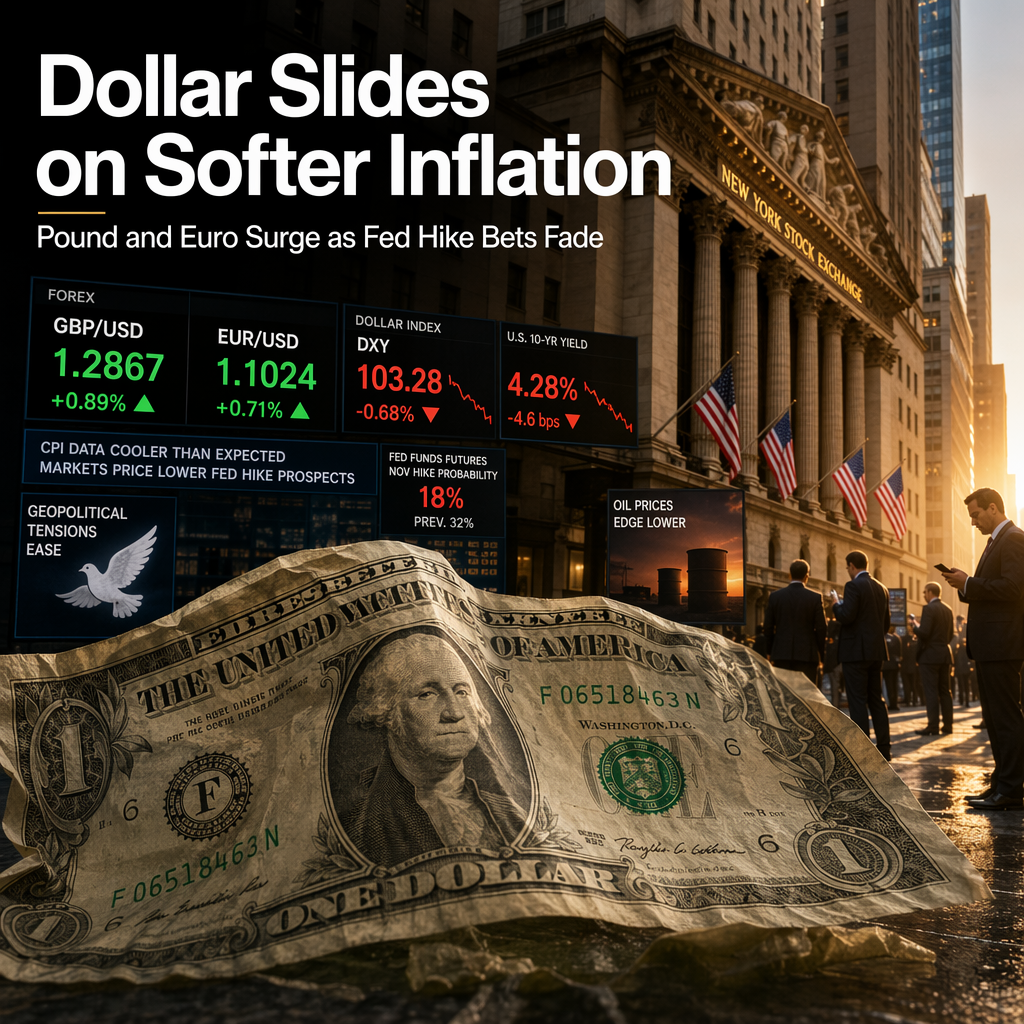
US inflation data for June surprised to the downside, leading to a sharp weakening of the US Dollar and a rally in major currencies such as the British Pound and the Euro [1][2]. The US Consumer Price Index (CPI) fell 0.4% month-over-month in June, following a 0.5% increase in May, and came in below the forecasted 0.1% decline [1][2]. Annual inflation dropped to 3.5% from 4.2%, also undercutting the 3.8% forecast [1][2]. Core CPI, which excludes food and energy, was flat on the month (versus expectations for a 0.2% rise), and the annual core rate slowed to 2.6% from 2.9%, below the 2.8% forecast [1][2].
In response, the British Pound (GBP/USD) rose to around 1.3415, up nearly 0.50% and near a one-month high [1], while the Euro (EUR/USD) climbed to approximately 1.1450, up nearly 0.60% and snapping a two-day losing streak [2]. The US Dollar Index (DXY) retreated to 100.70 from an intraday high of 101.32 [1][2].
Market participants quickly scaled back expectations for near-term Federal Reserve (Fed) rate hikes. According to the CME FedWatch Tool, the probability of a July rate hike dropped to 16% from 40% before the CPI release, and the odds of a September increase eased to 60% from 74% [1][2]. US Treasury yields also moved lower in reaction to the data [1].
Despite the softer inflation print, both sources note that the decline was largely driven by lower energy prices, which followed last month's interim peace deal between the US and Iran [1][2]. However, with renewed tensions and rising Oil prices—West Texas Intermediate (WTI) crude is trading around $80.00, up nearly 12% so far this week—inflation risks persist, and the possibility of a Fed rate hike later this year remains [2].
Looking ahead, traders are focused on upcoming remarks from Fed Chair Kevin Warsh and other Fed officials [1][2]. In prepared testimony, Warsh stated the Fed has 'no tolerance for persistently elevated inflation' and described the labor market as broadly stable, adding that if policy is set correctly, the inflation surge of the past five years will become 'a thing of the past' [2].
CONCLUSION
Softer-than-expected US inflation data has significantly reduced market expectations for imminent Fed rate hikes, resulting in a weaker US Dollar and gains for the British Pound and Euro. However, with energy prices rising again, inflation risks remain, and the Fed's future policy path is still uncertain. Market attention now turns to upcoming Fed communications for further guidance.