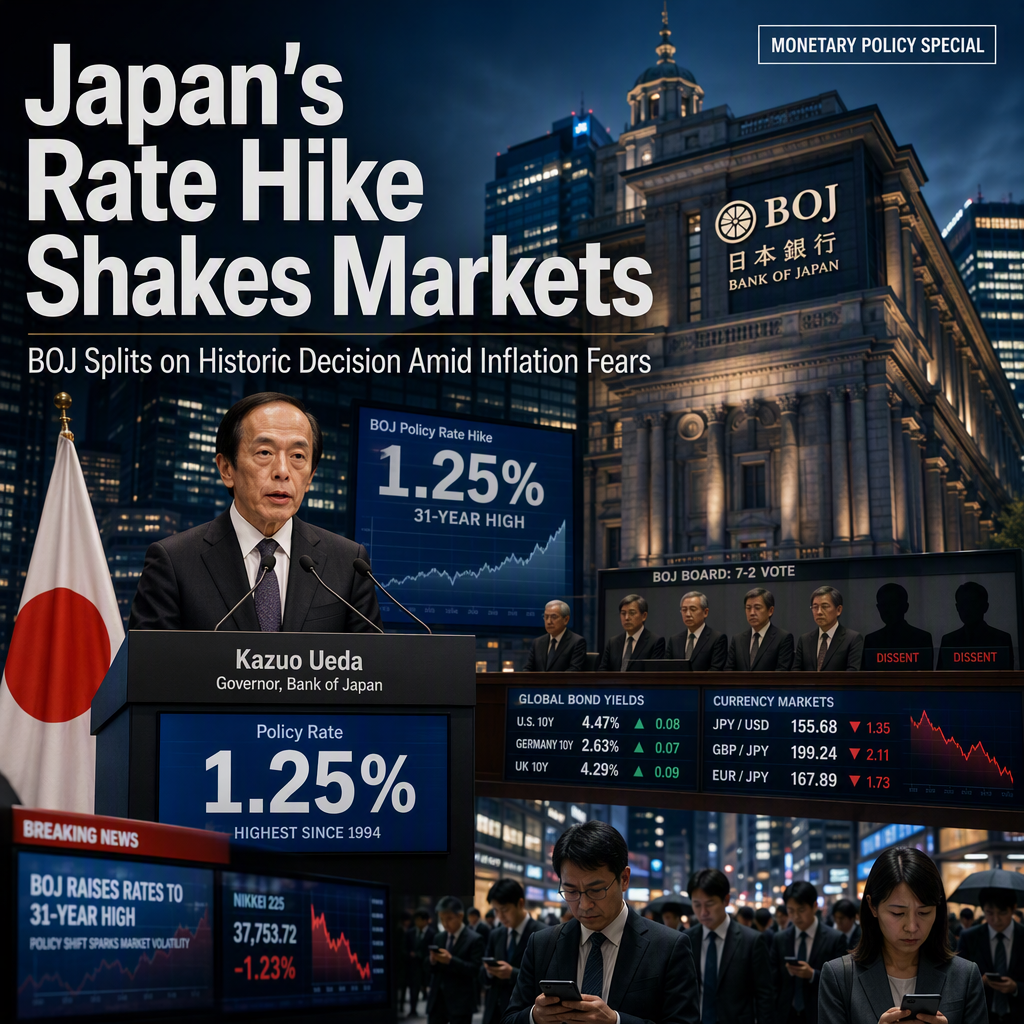
The Bank of Japan (BOJ) raised its benchmark interest rate by 25 basis points to 1.25%, marking the highest level since 1995 and a significant acceleration in its monetary tightening cycle. The decision, made after a two-day board meeting, was split 7-2, with board members Toichiro Asada and Ayano Sato dissenting, citing concerns that core inflation remains below the 2% target and that economic conditions may not warrant further tightening at this time [1][2][3][4][6]. The hike was widely anticipated, with nearly 90% of economists surveyed expecting the move and correctly predicting the dissenters [6].
The BOJ justified the rate increase by highlighting persistent inflationary pressures and the risk that underlying inflation could overshoot its 2% target, especially as recent yen depreciation feeds into higher prices [1][2][5][6]. Japan's headline Consumer Price Index (CPI) held steady at 1.9% year-on-year in August, while core inflation unexpectedly fell to 1.7%, remaining below the central bank's target [4][6]. The BOJ also flagged risks from global developments, including the Middle East situation, AI demand, and FX volatility, which could impact the economy and prices [2][3].
Financial markets reacted swiftly to the BOJ's decision. The Japanese yen weakened, trading at 156 per dollar and falling further to 156.95 against the US dollar, as the outcome was not deemed hawkish enough by investors [1][2][5][6]. The GBP/JPY and EUR/JPY crosses surged, with GBP/JPY jumping to a two-week high above 209.50 and EUR/JPY trading around 180.20 [3][4]. The benchmark 10-year Japanese government bond yield fell 4.9 basis points to 2.947% [6]. Technical analysis suggests the yen faces resistance at the 156-level, with support at previous lows, and volatility has increased in Asia-Pacific markets [1][5].
Analysts from Danske Bank and Deutsche Bank expect the BOJ to signal a more nimble approach to tightening, moving away from its previously cautious stance. Danske Bank warns that any indication of sticking to a gradual path could undermine the yen further [2][5]. The BOJ Governor Kazuo Ueda's post-meeting press conference is awaited for further cues on the timing and pace of future hikes, with the central bank reiterating that rate hikes are "on the table at every meeting" [1][2][4][5].
The BOJ's move aligns with global trends, as central banks like the U.S. Federal Reserve and the European Central Bank have also raised rates to combat inflation. The Fed recently hiked rates to the 3.75%-4.00% range, and the ECB raised its deposit rate to 2.50%, both citing persistent inflation risks [1][3][5].
CONCLUSION
The BOJ's 1.25% rate hike marks a historic shift in Japan's monetary policy, reflecting heightened inflation concerns and currency weakness. Despite the split vote and subdued inflation data, the central bank signaled ongoing vigilance and openness to further tightening. Market reactions were pronounced, with the yen weakening and global bond yields rising, underscoring the high impact of the decision on financial markets.