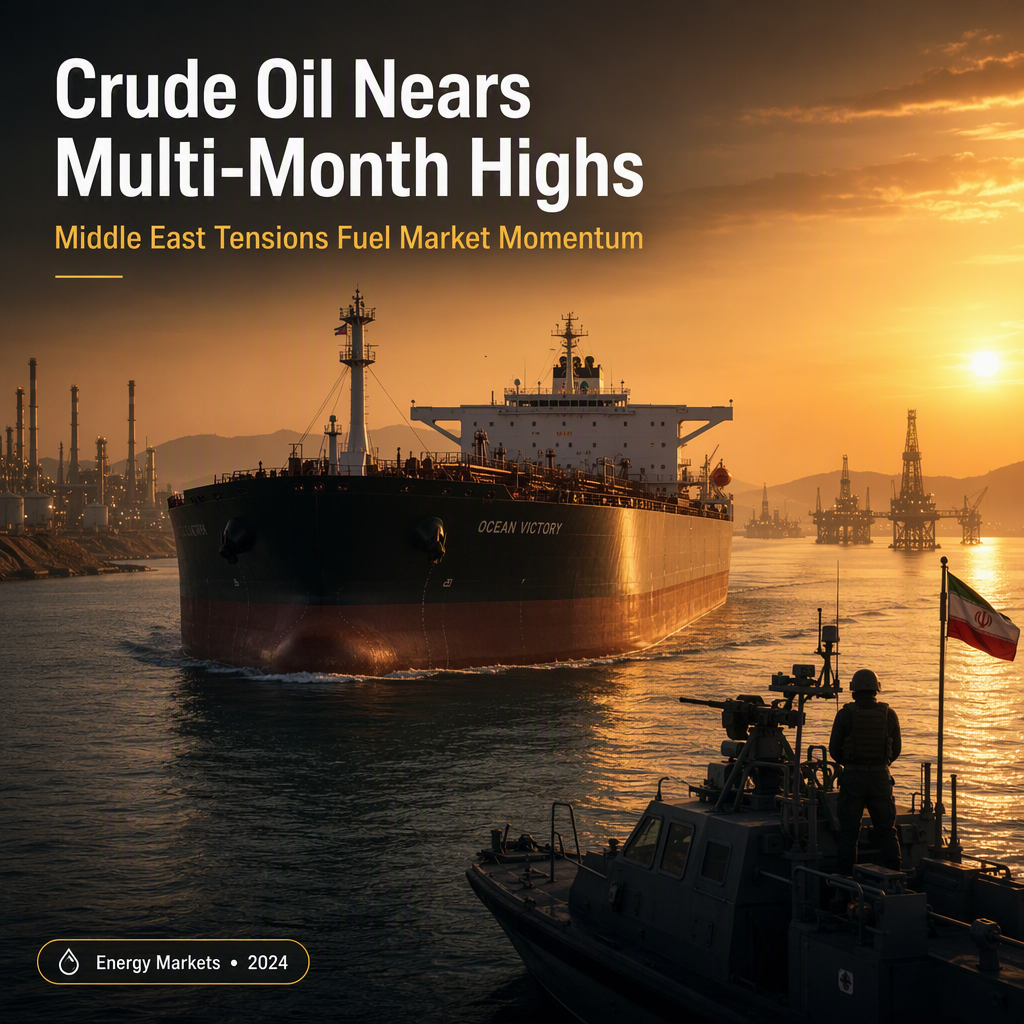
West Texas Intermediate (WTI), the benchmark US crude oil price, is consolidating below the mid-$96.00s after a modest overnight bounce from the weekly low of $94.65. As of the Asian session on Friday, WTI trades near $96.35, marking a 0.20% decline for the day, but remains close to its highest level since May 20, which was reached on Tuesday [1].
Geopolitical developments in the Middle East continue to influence market sentiment. Iran's Islamic Revolutionary Guard Corps (IRGC) reported striking a Togo-flagged tanker that allegedly attempted an illegal passage through the Strait of Hormuz. Additionally, US President Donald Trump stated he is nearing a major decision on whether to resume large-scale attacks on Iran. These events are maintaining a geopolitical risk premium in oil prices, providing ongoing support for crude [1].
Technical indicators suggest a bullish near-term outlook for WTI. The price remains above the 100-day Simple Moving Average (SMA) and the 61.8% Fibonacci retracement of the May-July corrective fall. The Moving Average Convergence Divergence (MACD) indicator is in positive territory, and the Relative Strength Index (RSI) is at 61, indicating constructive upward momentum. However, WTI has struggled to break above the 78.6% Fibonacci hurdle at $98.55, with the next resistance at the recent cycle high of $107.11. On the downside, immediate support is at $91.82, followed by $87.10 and the 100-day SMA near $85.24, with deeper pullbacks exposing $82.38 [1].
No specific analyst opinions or forward-looking statements beyond technical analysis are provided in the article [1].
CONCLUSION
WTI crude oil prices are consolidating near multi-month highs, supported by ongoing Middle East tensions and positive technical momentum. While the market remains bullish in the near term, resistance levels above $98.55 and potential geopolitical developments could influence future price action.