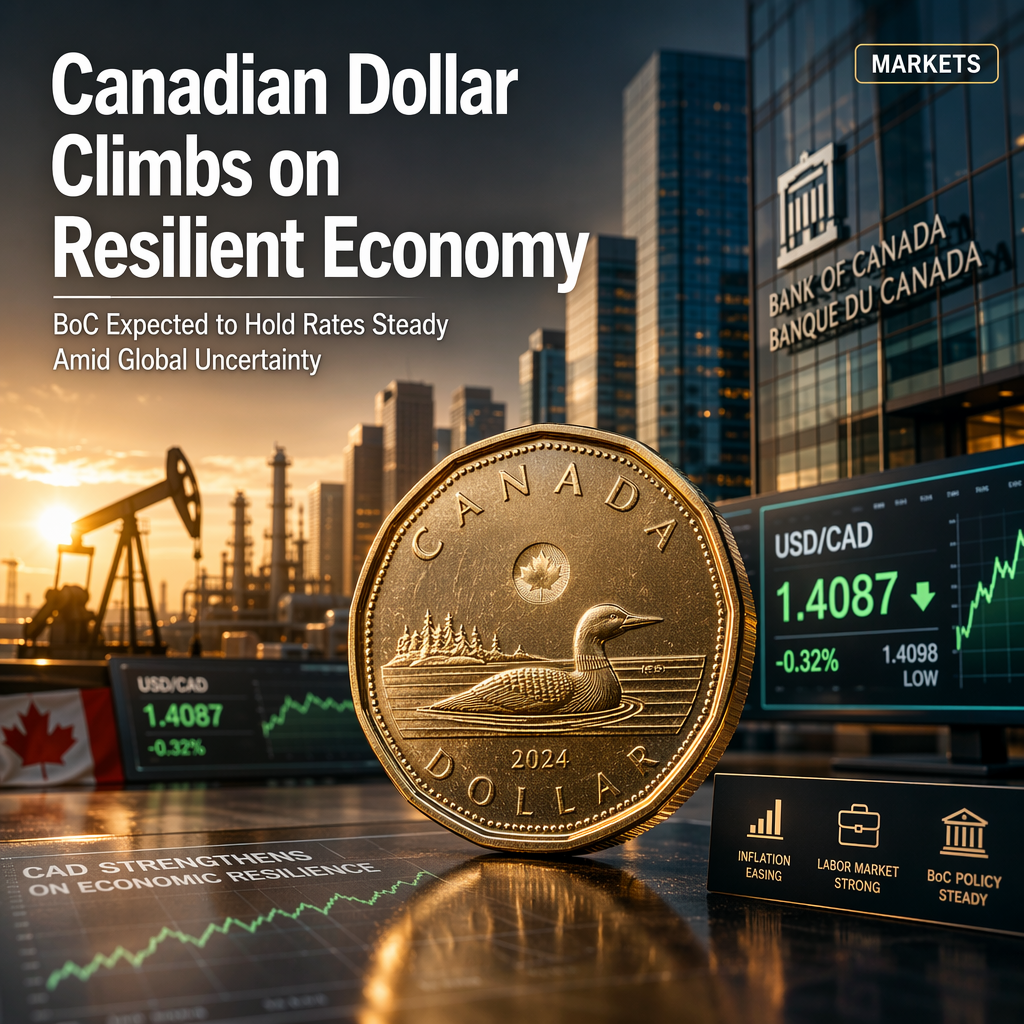
The Canadian Dollar (CAD) is trading close to a one-month high, with the USD/CAD currency pair dropping below the key 1.4100 level. This movement follows lower-than-expected US CPI data and comes ahead of the Bank of Canada (BoC) policy decision, where the central bank is widely anticipated to keep its policy rate unchanged at 2.25% for the sixth consecutive meeting [1].
Analysts from Societe Generale attribute the BoC's likely rate pause to a notably strengthened Canadian economic outlook, citing a rebound in economic activity in April and improved labor market conditions. Specifically, the unemployment rate has declined by 0.4 percentage points since April, reaching 6.5% in June, which is at the lower end of the BoC's forecast range [1]. While headline inflation may fall below 3.0% due to lower gasoline prices, core inflation measures remain close to the BoC's 2.0% target. This combination of economic growth and persistent core inflation keeps the possibility of a rate hike before year-end open, with market pricing suggesting a 25 basis point increase cannot be ruled out [1].
External factors are also influencing the CAD. ING notes that the BoC's Business Outlook Survey indicated elevated inflation expectations, though these surveys were conducted before the reopening of the Strait of Hormuz. Recent geopolitical tensions in the Middle East and higher oil prices have supported the oil-sensitive Canadian Dollar. However, ongoing trade concerns related to the United States-Mexico-Canada Agreement (USMCA) are limiting any significant upside for the currency [1].
From a technical standpoint, USD/CAD failed to consolidate above 1.4130, triggering a breakdown with gains capped near 1.4250. The immediate downside target is the 50-day moving average near 1.3970, with stronger support at 1.3850. ING suggests that a sustained move below the psychologically important 1.4000 level would require clear dovish signals from the US Federal Reserve [1].
Banks anticipate that the USD/CAD will trade in a tight range with a downward bias, especially if oil prices remain elevated and the BoC maintains its current policy stance without surprising the market with dovish commentary [1].
CONCLUSION
The Canadian Dollar's strength is underpinned by domestic economic resilience and external factors such as oil prices and geopolitical developments. While the BoC is expected to keep rates unchanged, the possibility of a rate hike later in the year remains. Market participants are watching for further signals from both the BoC and the US Federal Reserve to determine the next direction for USD/CAD.